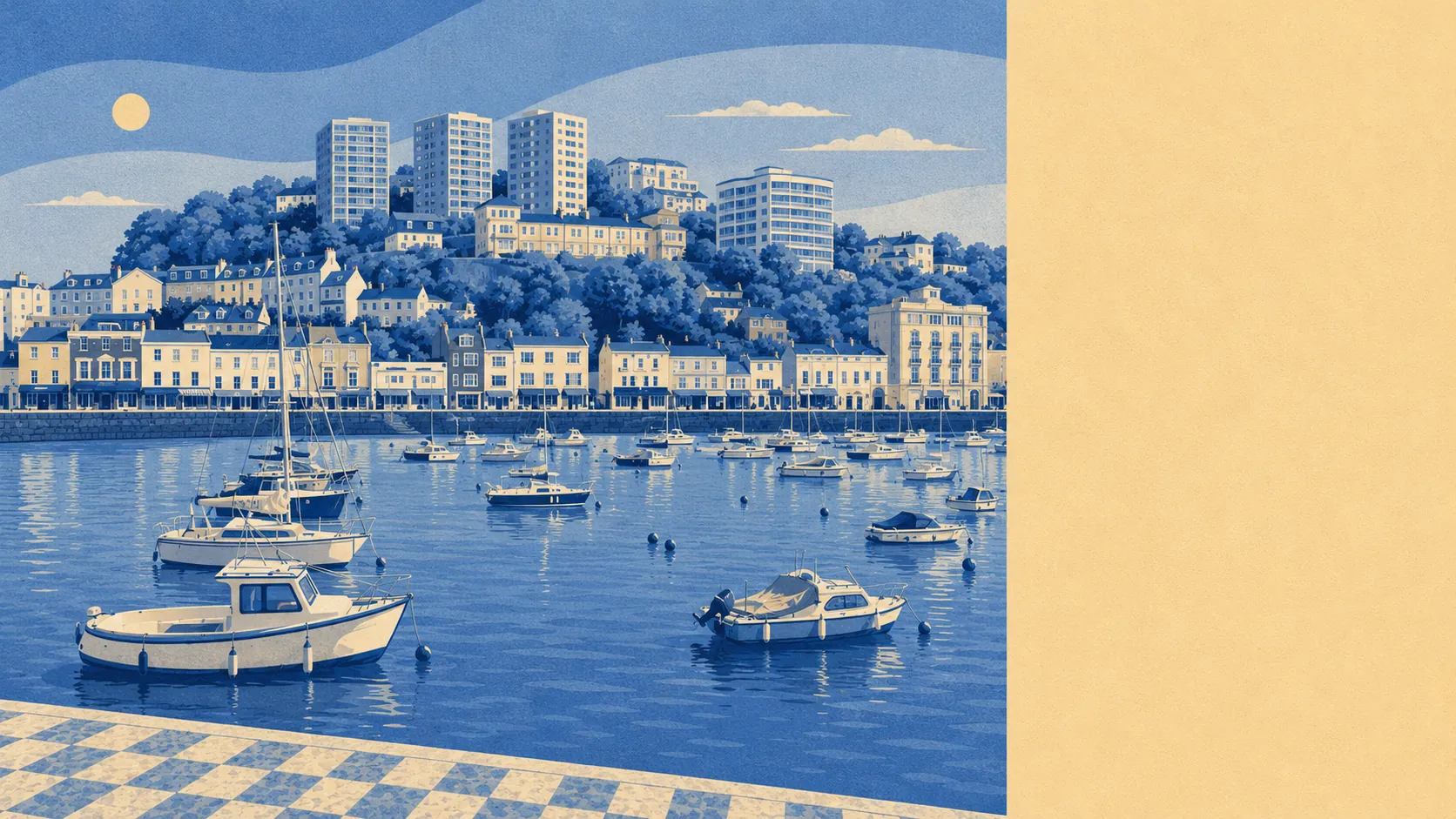
Torquay is a holiday brochure that somebody moved into. Nearly half the homes here are flats. Half the housing sits in the two cheapest council tax bands. The typical resident is closer to fifty than forty, and about four in ten rent. The bay is what sells the place. The town living underneath it is doing something more ordinary, and more honest about it.
Start with what you would actually be buying. The council tax valuation list, which covers every dwelling rather than just the ones sold recently, puts flats at 44% of the stock, terraces at 29%, semis at 12%, detached houses at 8% and bungalows at another 8%. Just under half of it went up before 1930, which in Torquay means the tall Victorian and Italianate villas of Wellswood, the Warberries and the Lincombes, most of them long since carved into apartments. Around 73% of homes run on mains gas and 15% are heated by electricity alone, and that second figure is the one worth chasing down before a viewing rather than after, because electric-only heating in a converted Victorian villa is a different monthly proposition to a gas boiler in a semi. Energy certificates issued across the town put 44% in bands A to C, 40% in band D and 16% in band E or worse. The sea view is free. The heat leaving through the bay window is not.
On price, the Land Registry recorded 588 sales in the twelve months to May 2026, at a median of £220,000. The split by type is wide enough to matter: flats came in at a median of £150,000 across 200 sales, terraces at £217,500 across 201, semis at £271,750 and detached houses at £390,000. Band B is the most common council tax band and 54% of dwellings sit in band A or B, which tells you more about the shape of the town than the median sale price does. Renting is the other half of the story. Typical private rent across the Torbay area was about £900 a month as of April 2026, up roughly 4% over the year, with one-bedroom places around £610, two-beds around £800 and three-beds around £980.
Safety is where the resort image and the recorded figures pull apart. Police records put Torquay at 142 crimes per 1,000 residents over the twelve months to May 2026, roughly 30% above the Torbay average of 109. Violence and sexual offences make up 42% of the recorded total against 35% across England and Wales, though that heading is a broad statutory grouping that sweeps in common assault without injury and tops the list almost everywhere. Devon and Cornwall Police charge 8% of recorded crimes, against about 12% nationally. A busy harbour town with a night economy produces this pattern reliably, and Torquay produces it too.
Schools do better than the town's reputation would have you assume. Ofsted has graded 22 settings in the authority, 20 of them good or better and two outstanding, with two at requires improvement. Primary maths scores across 17 schools average 104, and the main secondary measure across five schools averages 54. Two of the state secondaries are selective, Torquay Boys' Grammar School and Torquay Girls' Grammar School, both requiring the eleven plus and their own test, which means the local conversation about schools is really a conversation about an exam. The Spires College, St Cuthbert Mayne School and Torquay Academy take everyone else. A typical secondary is a seventeen minute walk, a primary under ten.
Getting out is a car job. Just over half of working residents drive, 20% work from home, 15% walk, 4% take the bus and well under 1% commute by train, despite Torquay Rail Station sitting near Torre Abbey Sands and Torre Rail Station a little inland. There are 398 bus stops, averaging 34 weekday departures each, and 78% of them see a weekend service. Broadband is the quiet strength: gigabit connections reach 82% of premises, superfast 96%, and nothing falls below the legal minimum. The hospital is 14 minutes by car and 30 by public transport on modelled 2019 journey times, which is the sort of gap that decides whether you keep a second car.
The surroundings are the best thing here and it is not close. Green space averages roughly 150 metres from the front door, with 28 separate spaces within a kilometre, and the water sits a median of 850 metres away. Kent's Cavern and Lummaton Quarry are both Sites of Special Scientific Interest. Flooding needs two separate readings, because the two measures on this site count different things: 8% of postcodes carry a high rating on at least one flood indicator including surface water, with 10% medium and 20% low, while 4% fall inside the Environment Agency's river-and-sea flood zone 3. Radon is the one to raise with a surveyor, with 91% of postcodes in band 3 or above and the highest local reading in the top band.
Heritage is where the freedom runs out. There are 454 listed buildings in and around the town, five of them Grade I and 14 Grade II star, plus 17 conservation areas including Belgravia, Chelston, Tormohun, Babbacombe Downs and St Marychurch, which this page also covers. Four listed buildings sit on the Heritage at Risk register. In practical terms, a large slice of the prettiest housing comes with a planning officer attached, and the windows you wanted are the windows you are getting.
The people are a settled crowd. About 56% own their homes, the median age is 47, and household income averaged around £43,750 in the financial year to March 2023. Roughly 39% of households are one person living alone, 17% of them a single pensioner. This is a town that produced Agatha Christie and Peter Cook, and one that sent Percy Fawcett and Richard Burton off elsewhere, which is a fair summary of the local temperament: politely working out what everyone else is hiding, or leaving to find out.
It suits people buying space and light near water on a budget that would get them a flat inland, retirees who want a seafront without a village, and anyone who works from home and wants the coast path at the end of the road.
It suits you less if you commute by train, need a period house you can reshape, or want the recorded crime figures to match the postcard.
Torquay is a genuinely good place to live for the right buyer and an expensive disappointment for the wrong one. Its real strength is the surroundings, the green space and the water, which no amount of town-centre grumbling takes away. The weak spot is the freedom to alter what you buy, hemmed in by listings and conservation boundaries across the streets people most want. Buy for the bay and the walking, and treat the Victorian villa as something you inherit rather than something you improve.