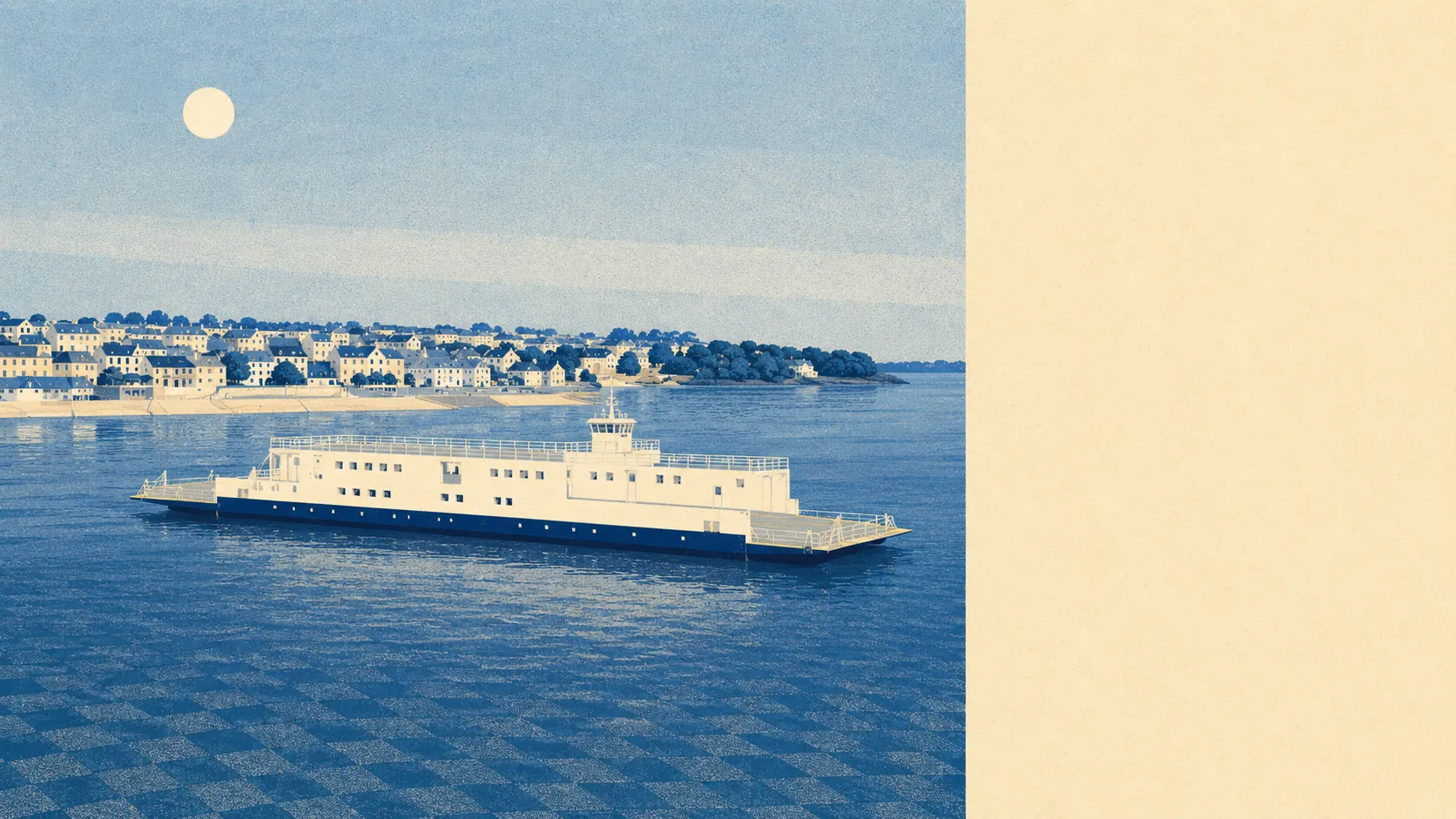
Yes, if you can live with the water being both the point and the problem. Two thirds of people own their homes. The median resident is 49. A ferry does the work a bridge would do anywhere else. This is a town that has organised its entire daily rhythm around a stretch of tidal water, and mostly enjoys it.
The housing is post-war and practical rather than picturesque. Council-tax records covering every dwelling in the area put terraces at about a third of the stock, semis at around a quarter, bungalows and flats at roughly a sixth each, and detached houses at about a tenth. Around a quarter of dwellings predate 1930, so the Georgian grid the town was planned on in 1774 survives in patches rather than in bulk. Energy certificates put nearly 40% of certificated homes in band D and about 48% in bands A to C, which is a stock that works and does not sparkle. Around 79% run on mains gas, and about 6% are on electric-only heating, which is the number worth checking before a viewing rather than after the first winter bill.
On price, the Land Registry's last twelve months to May 2026 gives a median of £210,000 across 77 sales. Terraces sat at about £190,000, semis around £222,500, detached houses at roughly £342,500, and flats at about £155,000. Council tax is where the affordability really shows: band B is the most common band, and about 58% of dwellings sit in bands A or B. That is a town where the annual bill is genuinely modest, which matters more to a monthly budget than most buyers admit while they are staring at the sale price.
For renters, the typical private rent across the Cornwall area runs to about £1,000 a month. That is a local-authority figure covering everywhere from fishing villages to the china clay country, so treat it as the regional weather rather than the forecast for one street.
Safety is the town's quietest strength. Police recorded crime works out at roughly 58 incidents per thousand people in the year to May 2026, which sits around 21% below the Cornwall average. That is a published rate, not something worked out on the back of an envelope, and it holds across a town that has a large naval training establishment on its doorstep and a ferry queue running through the middle of it.
Connectivity is where the honesty starts. Torpoint has no railway station of its own. The nearest are across the water at Devonport, Dockyard, Keyham and Plymouth, with Saltash and St Budeaux up the estuary, and half a percent of residents commute by train, which tells you how usable that actually is. Around 49% drive to work and about 17% walk. There are 36 bus stops in the area, averaging roughly 55 scheduled weekday departures each and about four or five in the peak hour, with weekend service at every one of them. Journey-time modelling puts the town centre at around ten minutes by car and about 16 by public transport, and the nearest hospital at roughly 51 minutes by car. Broadband is the compensation: gigabit service reaches about 81% of premises, superfast about 99%, and effectively nothing sits below the universal service obligation. You can work from here. Getting to a platform is the harder trick.
The Environment Agency's mapping puts about 2% of the area in the river-and-sea flood zone 3 and roughly 1% in zone 2, which is a small footprint for somewhere this close to a tidal estuary. On the broader postcode indicators, which include surface water, around 8% of postcodes carry a high rating on at least one measure and about 10% a medium one. Nothing here has a recorded historic flood. The greenery is the headline: green space averages about 150 metres away with roughly 17 sites within a kilometre, and water is closer still at around 240 metres. Radon reaches the Elevated band across roughly 10% of postcodes, which is a standard test-and-mitigate item rather than a reason to walk.
Heritage is light-touch by the standards of Cornwall. The area carries 31 listed buildings, two of them Grade I and four Grade II star, with one scheduled monument and no conservation area inside the town's own boundary. Unless you buy one of the listed properties, replacing windows or extending is a matter between you and the planning department rather than a negotiation with Historic England.
The character reads as settled rather than sleepy. About 66% own their homes, the median age is 49, and household income runs to roughly £49,700 a year before tax. It is a town of people who arrived for the dockyard or the navy, stayed, and now watch Plymouth's skyline from the kitchen window without any particular urge to live in it.
This page covers the wider Rame Peninsula with Torpoint: Antony, Cawsand, Crafthole, Cremyll, Freathy, Kingsand and Millbrook. They are a different proposition to the town itself, smaller and more coastal, and the ferry at Cremyll gives that end of the peninsula its own route into Plymouth.
Torpoint suits anyone who works in Plymouth and refuses to pay Plymouth prices for a sea view, anyone with naval or dockyard ties, and anyone whose idea of a good weekend involves being on the coast path within minutes of leaving the house. It suits families reasonably well: Cornwall's schools are graded good or better in around 95 of 120 settings with a published rating from Ofsted, and three are outstanding. A budget that buys a terrace here would buy considerably less across the water.
It does not suit anyone whose life depends on a train. If a commute requires a platform, the ferry and the road round through Saltash will grind you down inside a year, and no amount of estuary light fixes that. It also does not suit anyone wanting period drama in their housing stock, or the kind of buyer who needs a town to have arrived rather than simply to work.
Torpoint is a good place to live, and it earns that on the things people notice slowly rather than the things that photograph well. Its real strength is the surroundings: green space and water on the doorstep, a low crime rate, and a peninsula behind it that most of the country only sees on holiday. The weak spot is getting anywhere by public transport, which is the price of being on the wrong side of a river from a city. Buy here for the water and the quiet. Do not buy here expecting the water to get out of your way.