South Kensington has a royal park where most places would have a back garden and a museum quarter at the front. Green space is a short stroll from the typical door. Dozens of parks and gardens lie within a kilometre. Open water is a short walk away. Private gardens are scarce, and the parks make up for it.
The typical home is about 110 metres from the nearest public green space, with about 42 parks, gardens and squares within a kilometre. Hyde Park and Kensington Gardens are the big two, and The Boltons and the garden squares fill in between the terraces. Most people here can reach grass before they could find their keys.
Water is about 370 metres from the average home, with about 14 bodies of water within a kilometre. Most of that is park water, and the Serpentine in Hyde Park is the largest of it. A good many South Kensington residents live closer to a boating lake than to their own parking space.
The National Cycle Network is about 1,600 metres from the average home, and no part of the area is close to a route. Cycling here means the park paths and the ordinary roads. There is no ancient woodland, so a country walk means a trip out of town.
The rating list counts 233 shops, 68 restaurants and nine pubs, against 318 offices. Nine pubs for a district this size is a low count, and the evening revolves around restaurants. Old Brompton Road has some history with chains. Caffè Nero started there as one coffee shop in 1990. Christie's ran a second salesroom on the same road from 1975 until it closed in 2017. The area's only Royal Mail Post Office closed in 2019, so 233 shops still can't post your parcel.
Kensington and Chelsea as a whole recorded fine-particle pollution of about 9 micrograms per cubic metre in 2024, a borough-wide average that won't distinguish a mews from a main-road frontage.
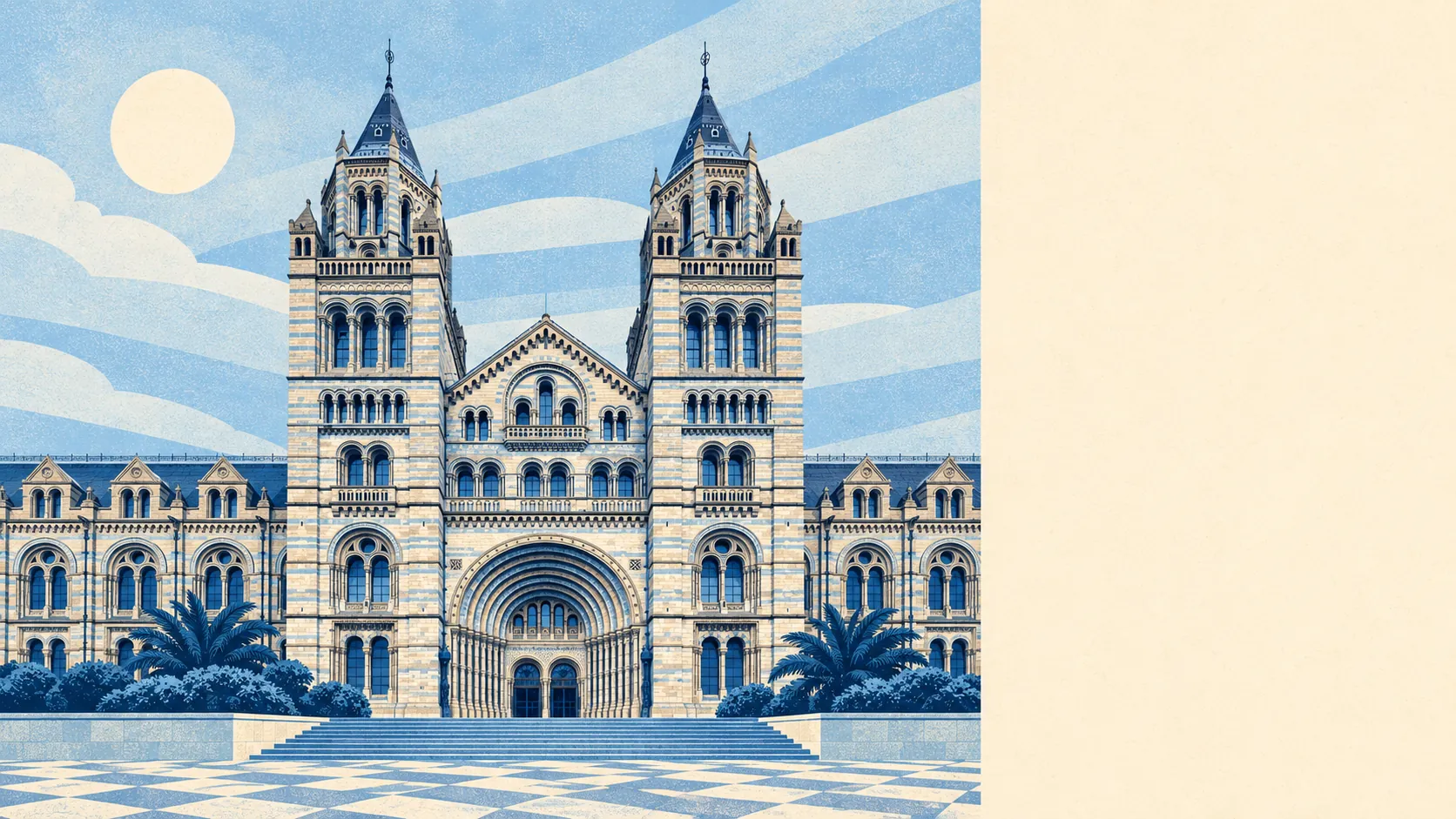
What sets the place apart is the institutions. The Natural History Museum, the Science Museum and the Victoria and Albert Museum share a street with Imperial College, the Royal Albert Hall, the Royal College of Music and the Royal Geographical Society. It all came out of the land the Great Exhibition commissioners bought after 1851 for the arts and sciences. Weekday crowds are there for the collections, and the residents live around them.
Private outdoor space is scarce. Gardens across the area come to about 12,400 square metres per 1,000 residents, and most homes here are flats in stucco terraces. A balcony, a lightwell or a share of a communal square is the usual arrangement. Hyde Park handles the rest.
The business rating list counts 937 rateable premises in the area, with offices and shops the two largest groups and restaurants after them. These are premises on the valuation list, and some will be empty or between tenants at any time.
Of the 249 food businesses rated for hygiene, about 88% hold the top score of five. Fewer than 1% sit at the bottom of the scale. Eating out in South Kensington is expensive, and the kitchens are mostly spotless.
No area of outstanding natural beauty, site of special scientific interest or ancient woodland overlaps South Kensington. This is a built district with landscaped parks, and the green space was laid out deliberately. Nothing wild has survived here.
The surroundings are one of South Kensington's real strengths. You get royal parks, open water and world-famous museums within a short walk, in exchange for living without much of a garden of your own.