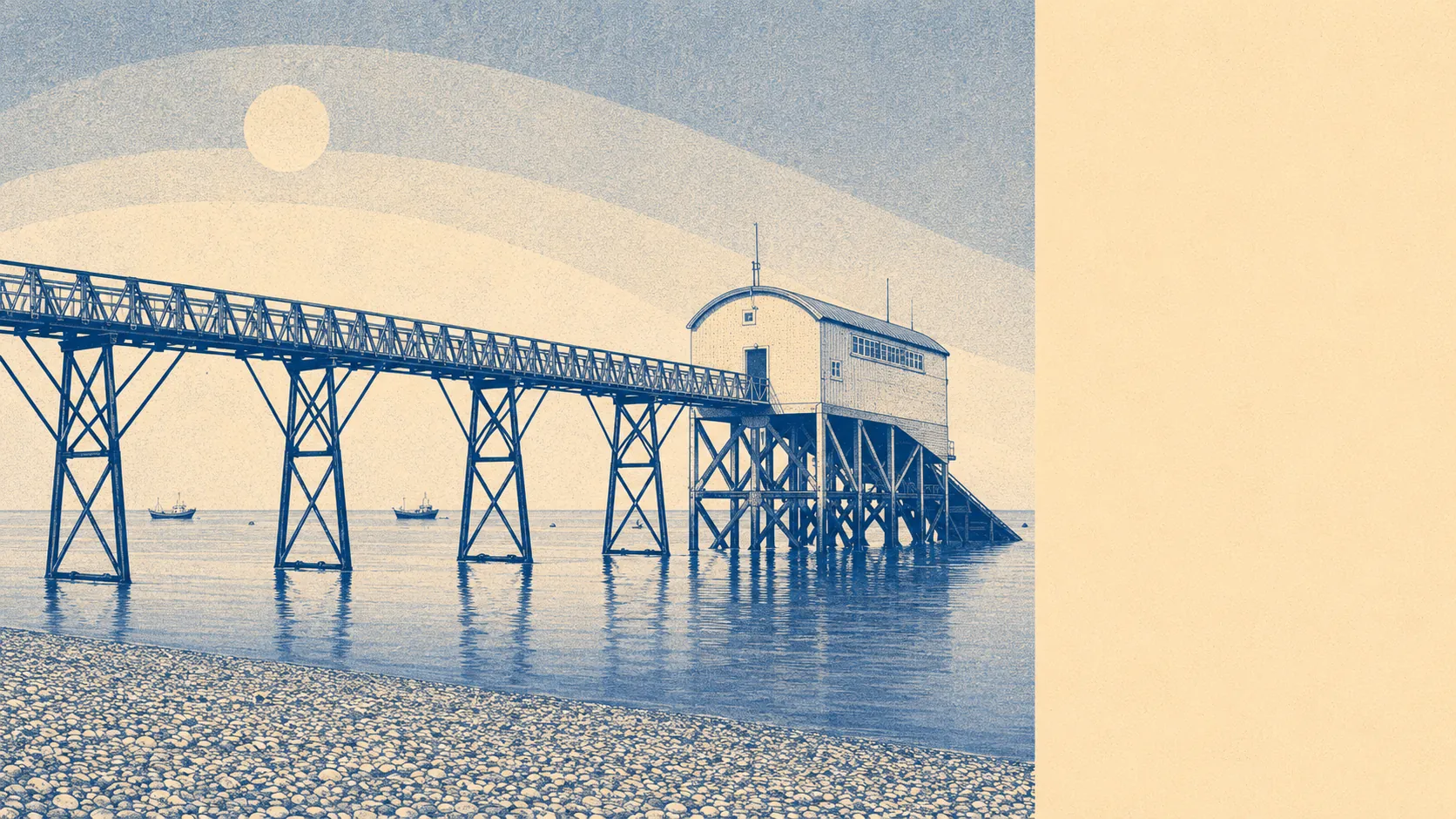
Selsey is what happens when a road runs out of land. One road in, one road out, median age fifty-seven. A third of the houses are bungalows. The trains stopped running in 1935 and nobody got around to bringing them back. The people who live here mostly chose it that way.
The stock is post-war, low, and spread out. Houses are just under half of it, bungalows make up a third, flats are about one in six. Built for retirement and built like it. Roughly four in ten properties land in the higher energy bands of A to C, which is fine for the era. Another four in ten are band D, which is the seaside-bungalow's natural altitude. The rest are E or worse, mostly where someone has bolted a conservatory onto a 1960s build and called it done.
The typical sale over the last year landed at around £359,000 across 172 transactions. Detached houses do the heavy lifting at roughly £420,000. Semis sit closer to £330,000, terraces around £295,000, and flats at about £157,000 if you can find one you want. Council tax sits squarely in band D for the modal household, with about a fifth of dwellings in bands A or B. Not Chichester money. Not Bognor money either.
Renting is harder to pin down because the published figure is the typical private rent across the Chichester area, which works out at about £1,320 a month rather than Selsey's own. The peninsula does not have its own rental market in any meaningful sense. It is mostly owners, and the renters who are here either work in care or hold a second home that pays for itself in the summer.
Crime sits at about 70 incidents per thousand residents over the last year, roughly 14% below the Chichester average. That is the published rate. The actual feel of the place is even quieter, because there is nowhere to go and most of the people are old enough to go to bed early. The crime that does happen tends to be the kind that happens everywhere. Opportunistic, occasional, not the headline kind.
Connectivity is where the peninsula extracts its tax. Fewer than one in two hundred residents commutes by train, which makes sense because there isn't one. The nearest stations are at Chichester and Bognor, both reached by the same road that everything else needs. Driving accounts for over half of all journeys to work, and a quarter of residents work from home, which is the only honest answer when your office is twenty-five minutes away in light traffic and an hour in summer. Buses run, mostly the Stagecoach 51 to Chichester, with around seventy-four stops across the wider area. Broadband is the one bit of infrastructure that arrived on time. Three-quarters of premises can get gigabit, and 98% have superfast.
The sea is the headline and the small print. Around a quarter of the post town's postcodes sit inside Environment Agency Flood Zone 3, and roughly a fifth show high risk from at least one flood source. Climate-adjusted maps put the entire area in some kind of future-risk band, which is what you would expect from a town sitting at the end of a sandspit. The compensation is green space. The average postcode is about 226m from a park or playing field and 276m from open water, with around fifteen green spaces inside a kilometre. The walk to the beach is shorter than the walk to most of the shops.
Heritage paperwork is light. There are sixty-one listed buildings, all Grade II, and one conservation area covering central Selsey. St Peter's Church and Medmerry Mill carry the named listings. The rest are smaller fish: cottages, churchyard fixtures, a few survivors from when the place was a fishing village rather than a retirement option. Changing windows or extending a property inside the conservation area means a permission round. Outside it, you are mostly free to do as you please as long as the planners are not feeling pedantic.
Three-quarters of households own their home. The median resident is fifty-seven. The typical household pulls in just under £41,000 a year, which is enough for a Selsey bungalow and not enough for a Chichester townhouse, which is exactly the calculation that gets done here every weekend in front of a property search tab.
Selsey suits someone in their late fifties or sixties who has worked out that a single-storey property near water is what the next twenty years need, has driven through it twice, and is not asking the village to do anything other than be the village. It suits someone who can put up with a twenty-five-minute drive being the only way to reach anything, and a flood map being honest about the next fifty years.
It does not suit anyone whose job requires a commute. It does not suit anyone who needs schools to be the sorting mechanism for the next decade. And it absolutely does not suit anyone who took the wrong train and thought they were getting Whitstable. This is Bognor Regis without the pier and Mablethorpe with a better postcode.
The history is consistent with the present. Selsey Abbey was the seat of the Sussex diocese until 1075, when a Council of London decided sees should be in cities and the bishop moved up to Chichester. The composer Eric Coates lived here in the early twentieth century and wrote 'By the Sleepy Lagoon' looking out toward Bognor Regis, which became the theme tune to Desert Island Discs and is probably the most-played piece of music ever composed within a hundred yards of a Selsey beach hut. Air Commodore Teddy Donaldson set the world air speed record at 616 mph in a Meteor IV in 1946, lived at Iron Latch Cottage, and is commemorated by a blue plaque on the beach at the bottom of Park Lane. Sir Patrick Moore lived here too. The pattern is consistent. People who wanted to be left alone to do their own thing chose Selsey, and the place repaid the favour by not being interesting enough to bother them.
Selsey lands at three out of five. The surrounding area and green space pull it up at four and a half. The flood map drags it down at two. Closer to Mablethorpe than Aldeburgh, and the people who live here know it. Bognor sold tickets. Selsey sold bungalows. Both ended up at the sea, and one of them is honest about what it is.