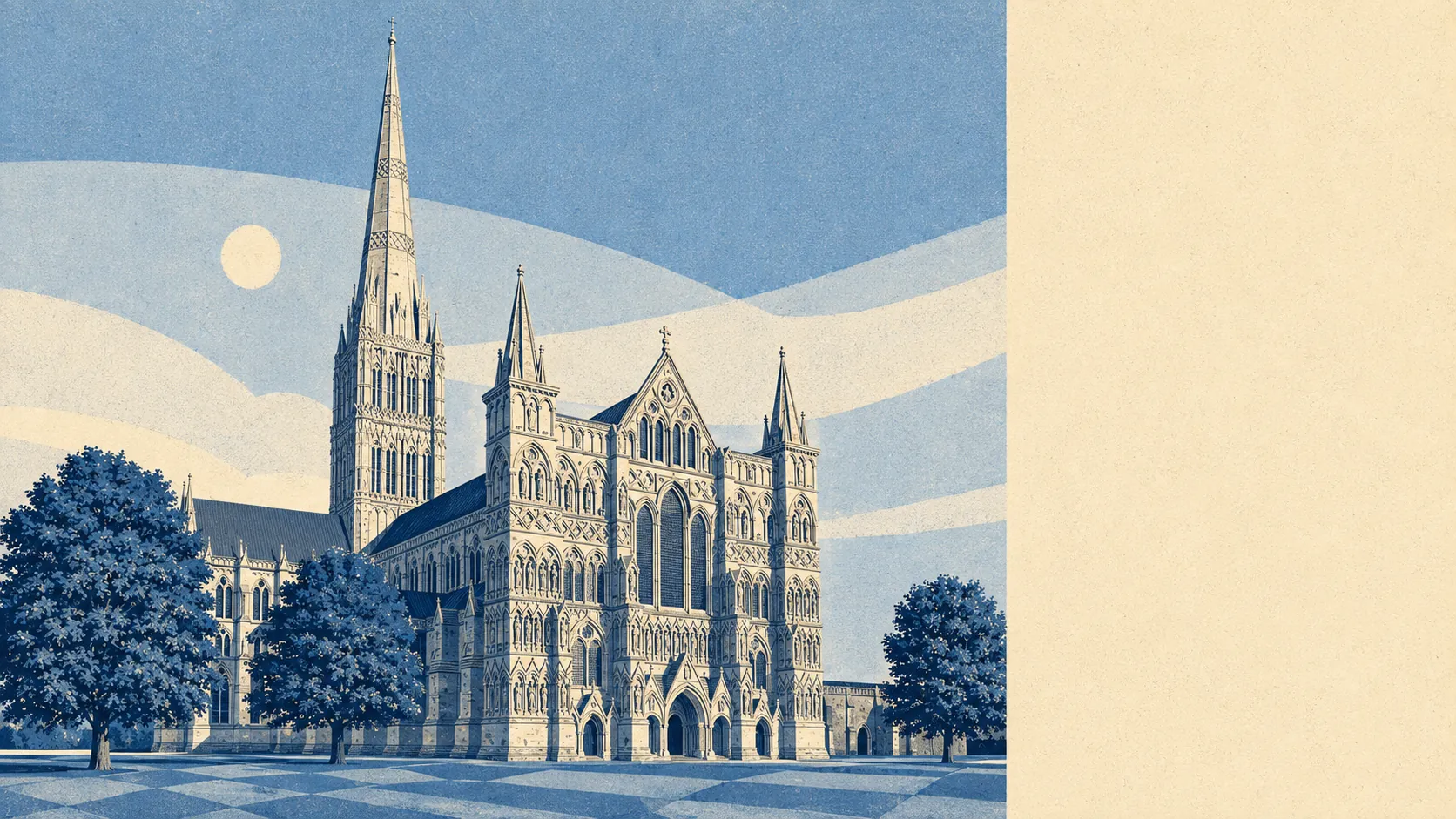
The area around Salisbury is the strongest argument for buying in it. Green space starts about a hundred and forty metres from the average doorstep. Water is barely further away than that. The villages have names like Bowerchalke, Winterbourne Gunner and Sixpenny Handley, and not one of them is being ironic. This is a small city sitting in a very large amount of countryside, and the countryside is winning.
Green space access here is close to as good as it gets. The typical postcode has 27 green spaces within a kilometre, with the nearest averaging around 140 metres away. That is not one flagship park doing the work for everybody. It is a city where the problem is choosing which patch of grass, which is a better problem than most places have.
Water is the other half of it. Blue space sits about 390 metres from the average postcode, with roughly 52 water features within a kilometre, which is what happens when a city is built at the meeting point of the Nadder and the Hampshire Avon. The rivers have been redirected and landscaped over the centuries to feed public gardens, and in Queen Elizabeth Gardens the water runs shallow and slow enough that people get into it in summer on purpose. The Town Path across the Harnham water meadows is the walk everybody eventually shows visitors.
For getting further out, the National Cycle Network averages about 540 metres from the typical postcode and 57% of postcodes sit close to it. There is no ancient woodland inside the boundary, which fits the geology: this is chalk downland and river valley, not oak forest.
The amenity mix is a market town's rather than a city's. The rating list carries 729 shops, 103 pubs and 52 restaurants across the area. More pubs than restaurants by a distance, which tells you what the evening economy here was built around, and which of the two the surrounding villages have been quietly keeping alive.
On air quality, the fine-particle level for the Wiltshire council area was 6 micrograms per cubic metre in 2024. That is a council-area figure covering a very large rural authority rather than a reading taken outside your house.
What gives the surroundings their character is that most of them are older than the city. Salisbury only exists because the church walked away from the hilltop at Old Sarum in 1220 and built a new town on a grid in the meadows below. Wilton, a few miles west, was the county town of Wiltshire until 1889 and has never entirely got over being demoted. Ringed around are Laverstock, Britford, Netherhampton, Quidhampton, Coombe Bissett, Odstock, Broad Chalke, Winterslow and a dozen more, most of them former villages that the city either absorbed or politely declined to. Figsbury Ring and Clarendon Palace sit in the fields nearby, doing what ruins do.
Private outdoor space is generous too, which is the bit public green space figures never tell you. The area carries roughly 122,000 square metres of private garden for every thousand residents. In practice that means most houses here have a real garden rather than a paved rectangle with a bin in it.
As for what is actually here to work in and buy from, the valuation list records 1,712 rateable premises across the area, including 704 offices alongside the shops and pubs, and 107 holiday lets. Those are premises on a list rather than businesses currently trading, so treat the count as the shape of the place rather than a directory.
Eating out is reliable. Of 300 food premises with a published hygiene rating, 79% hold the top score and 2% sit at the bottom of the scale. That is a comfortable ratio, and it applies to the village pubs as much as the city centre.
One honest absence worth knowing: no area of outstanding natural beauty, no site of special scientific interest and no ancient woodland overlaps this area. The countryside here is working chalk farmland and river valley rather than designated landscape, which means fewer protections on it and no queue of visitors following a signpost to it.
The setting is the best thing about Salisbury by some margin. Very few cities in England put this much green space, water and open country within walking distance of a medieval street grid, and none of it required the city to do anything clever.