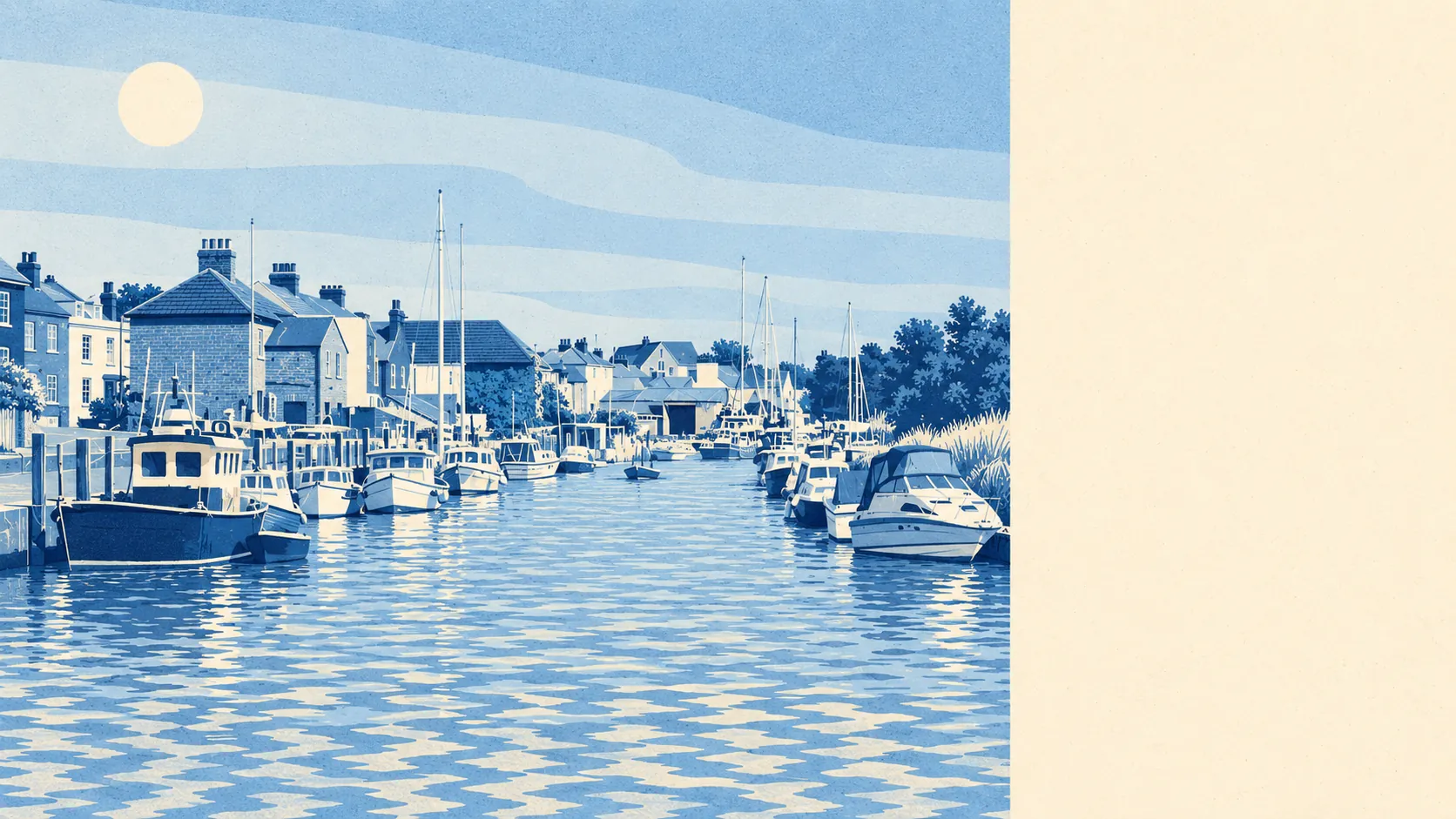
Mostly water, and a fair amount of grass. The average home has green space within a couple of minutes' walk and water a little further on. The high street is small and does the basics. There is no protected countryside to look at, just open estuary. The views are of working water rather than scenery, and there is a lot of it.
The average home is about 116 metres from public green space, with around 14 green spaces within a kilometre. That is the park at the end of the road rather than a trip in the car. For a dog owner, it means a short walk before breakfast, not a drive.
Water is closer still to most daily routines. The average home is about 166 metres from open water, and around 63 bodies of water sit within a kilometre, counting the estuary, creeks, drains and ponds of an island that is largely reclaimed marsh. Queenborough was built to face the Swale and the Medway, and the town still does.
The National Cycle Network is about 700 metres from the average home, and about 29% of postcodes count as close to a route. Longer rides are possible, though the network is not quite on the doorstep.
The high street is small. The rating list holds 17 shops, 6 pubs and 6 restaurants, with 15 offices alongside. That covers a pint, a meal and the everyday shopping. Anything bigger means a trip to Sheerness or further, and the car will be doing that trip.
For fine-particle air pollution, the Swale council area averaged about 7 micrograms per cubic metre in 2024. That is a borough-wide figure, not a reading for any one street.
The town sits on the west side of the Isle of Sheppey, with Sheerness to the north, Rushenden to the south and Halfway Houses and Minster further along the island. It has a large yachting harbour, where the pirate radio ship Radio Caroline once anchored for a while. Out on the salt marsh at the mouth of the Swale is Dead Man's Island, where the prison hulks buried their dead. It is still marked on local maps, and it rarely makes the sales particulars. Queenborough has had a copperas works, a glass works, a steel mill and a pharmaceutical plant over the centuries, and the character of the town comes from that industrial and maritime past rather than from any attempt at a postcard.
Homes here have gardens. Across the town, private gardens add up to about 80,000 square metres for every 1,000 residents, which fits a housing stock made up almost entirely of houses, not flats. Most buyers get their own grass as well as the park.
There are 205 rateable premises on the business valuation list, and industrial and storage premises top the list rather than shop units. These are premises, not a count of businesses open today, and some will be empty. The industry that built the town is still part of it, which is worth knowing before buying a house with a view of the harbour.
Of the 44 food businesses with a hygiene rating, about 82% hold the top score of five, and about 2% sit at the low end.
No protected landscape overlaps the town. There is no area of outstanding natural beauty, no site of special scientific interest and no ancient woodland. That tells a buyer the area is estuary, marsh and reclaimed land, and it means fewer landscape designations to deal with when anything needs building.
The surroundings are one of Queenborough's real strengths: parks within a short walk, the water close by, and a garden with most houses. It is working estuary rather than a beauty spot, and it is close to every door.