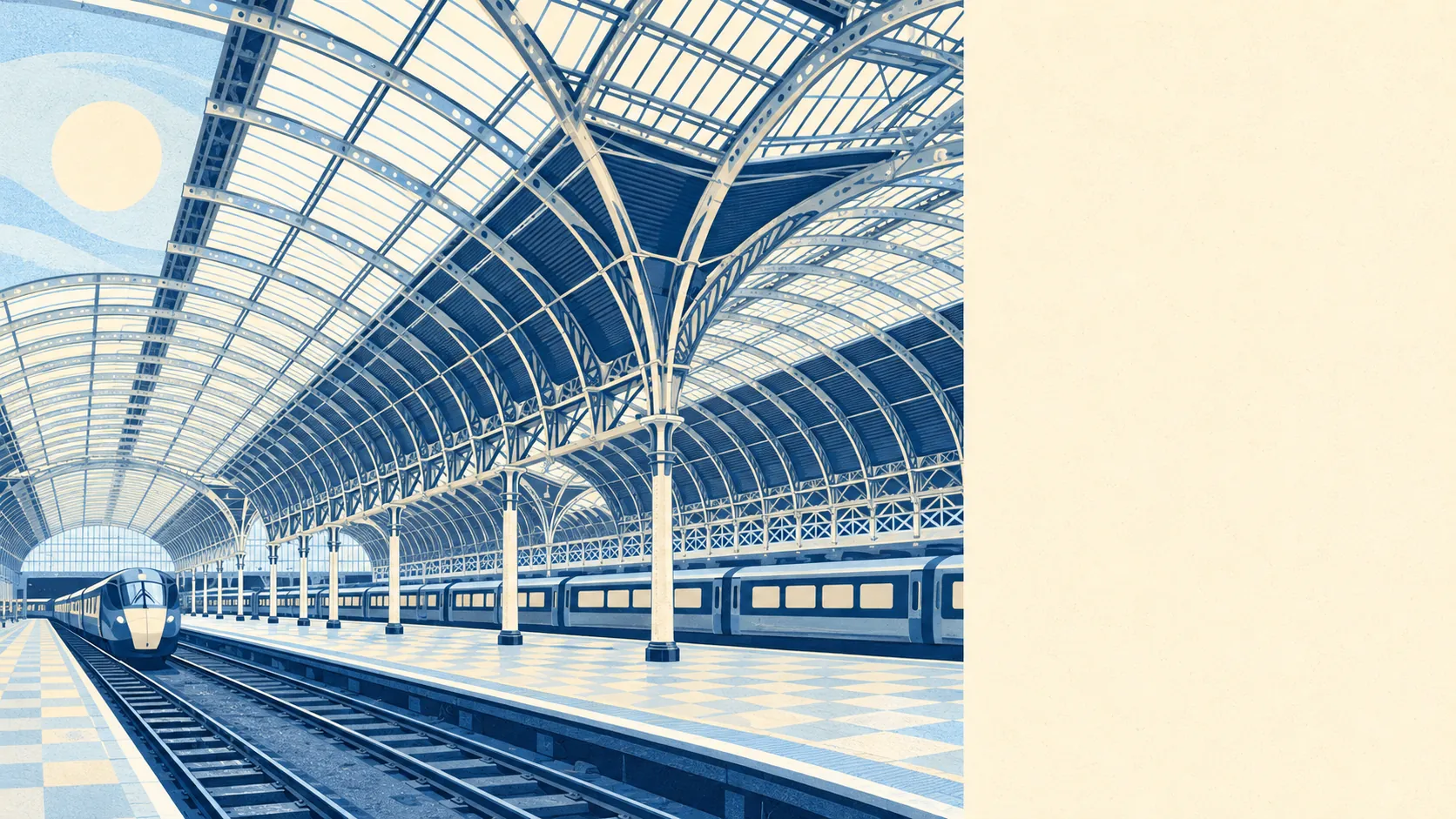
Paddington is very well connected, built around one of London's great railway terminals and so many buses that nobody bothers with a timetable. One station reaches Heathrow, the West Country, Wales and the far side of London. Most households own no car. Gigabit broadband reaches nearly every home. The only cost is the noise all that traffic makes.
London Paddington Rail Station has direct trains to Heathrow, to Reading and the west, and right across London, plus Underground platforms in the same complex. Hardly anyone who lives here commutes on them, though: the 2021 Census found only 2% of working residents travelling to work by train. The buses carried more, at about 7%, from 562 stops in and around the district. Brunel built the station to serve the whole western half of the country, and on the Census figures it does exactly that, while the people living next to it mostly stay put.
For most residents the commute is short or nonexistent. About 57% of working residents worked from home at the 2021 Census, a year still shaped by the pandemic, about 11% walked and about 4% cycled. Only about 6% drove. That fits the car figures: about 69% of households have no car and only about 5% have two or more. Parking the car is harder here than doing without one.
The Department for Transport's modelled journey-time statistics, which are averages for the area and date from 2019, put the nearest town centre about 11 minutes away by car, about 17 by public transport, about 12 by bike and about 24 on foot. The same statistics put a GP about 6 minutes' walk away, or about 7 by car, and a food shop about 5 minutes on foot. A hospital is about 10 minutes by car or 12 by public transport, with St Mary's on the doorstep, and the nearest employment centre is about 2 minutes by car or 8 by public transport. Distances to fixed places do not change, but the public transport times describe the 2019 timetable and are the least dependable of the set.
The buses are a full service. The national transport access data, which is current, gives the average stop about 478 scheduled weekday departures and about 25 an hour at peak, and 453 of the 454 stops with timetable data have weekend service. These are counts of departures, and at that frequency waiting at a stop takes about as long as reading the timetable would.
Gigabit broadband reaches about 89% of premises, ultrafast about 90% and superfast about 98%, and no premises fall below the legal minimum. Mobile coverage is complete, with 4G or 5G from every network everywhere in the area.
Road noise is the price. About 96% of Paddington's postcodes are near or above 65 decibels, the level at which official noise mapping treats road traffic as significant, and the loudest band present reaches 75 decibels. Rail noise is a separate source and puts about 14% of postcodes near the same 65-decibel threshold, with its own loudest band also at 75. The Westway flyover crosses the north of the district on stilts, carrying traffic over rooftops the way the railway carries it past them. For any flat here, find out which rooms face the flyover, the main roads or the tracks, and visit it at rush hour.
Charging an electric car is easy for the few households that have one. The area has 1,112 public charge points with 1,240 connectors between them, but only 15 are rapid units, so charging here is something you plan for, mostly overnight.
Paddington is very well connected by any standard in the country, and the main drawback is the noise from all that traffic.