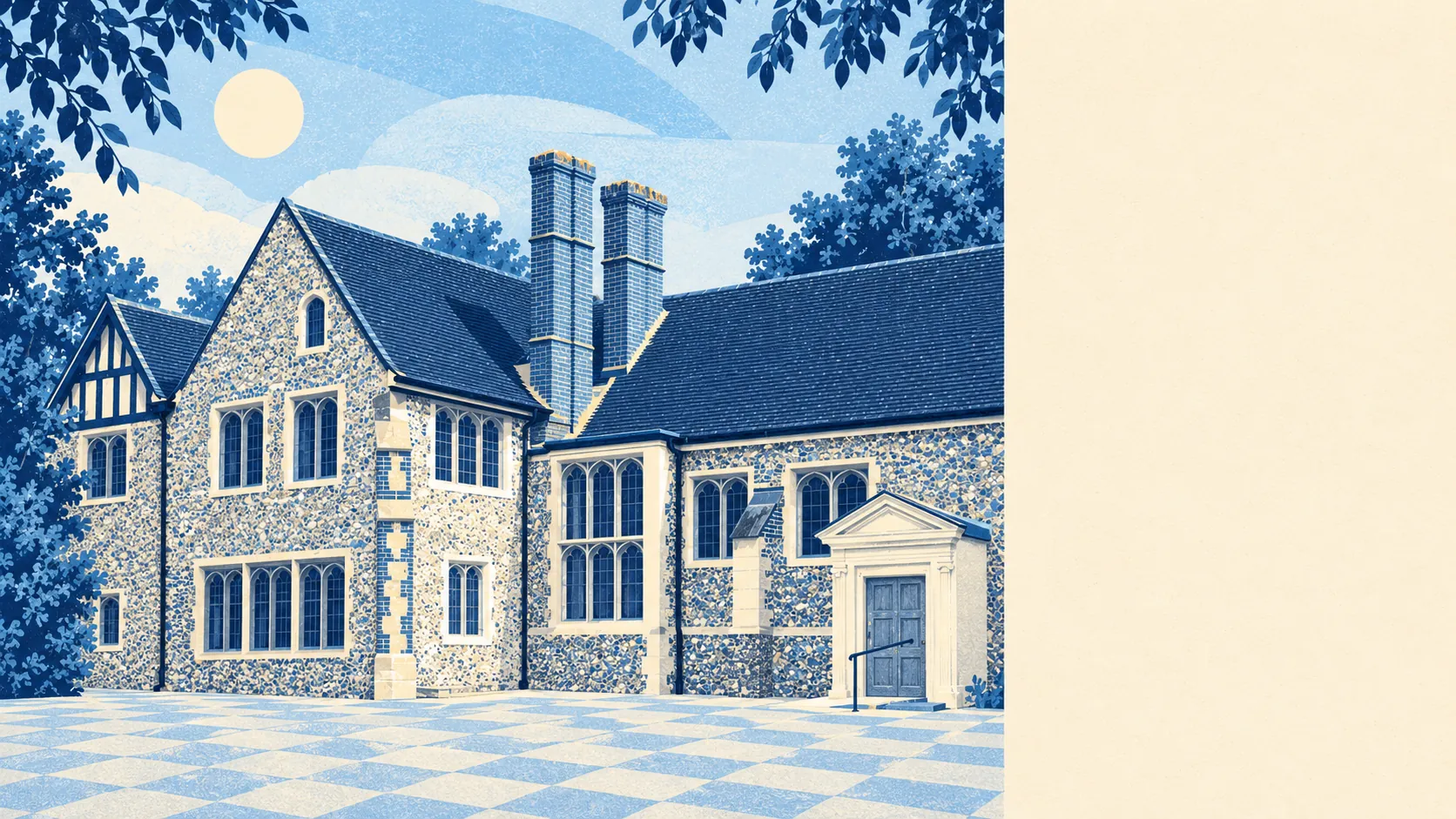
You can extend a house in Orpington, but the further you get from an ordinary post-war semi, the more people get a say. The wider area holds well over a hundred listed buildings. A dozen conservation areas ring the town. Roman and Saxon remains sit under parts of it. And most of the ground is clay that moves with the weather, so the foundations need some thought too.
Historic England lists 159 buildings across the wider Orpington area: two at Grade I, six at Grade II* and 151 at Grade II. Listing covers the inside as well as the outside, so changes to the structure, the windows or the layout of a listed building need listed building consent from Bromley Council on top of any planning permission, and doing the work first and asking later is a criminal offence. Most of the 159 are Grade II, the grade at which replacing a sash window turns into a written application.
There are 12 conservation areas in and around Orpington, including Chelsfield, Downe, Cudham Village, Farnborough Village, Farnborough Park, Keston Park, Broomhill and St Mary Cray. Inside them, the council controls demolition, works to trees and changes to how a house looks from the street more tightly, and some of the automatic rights to extend that apply elsewhere are cut back. Most of Orpington's conservation areas are its old villages, which predate the suburb by centuries and are run accordingly.
Five scheduled monuments sit in the same area, among them the Orpington Roman villa and the Romano-British building and Saxon cemetery at Fordcroft. Scheduling is the strictest protection there is, and it mainly matters to anyone planning to dig near one. A new foundation trench near Fordcroft gives the Saxons a say in the matter.
None of this stops people building. Bromley Council received 1,632 planning applications for the Orpington area between April 2024 and June 2026, 742 of them in the most recent twelve months. Orpington's houses are in a more or less permanent state of getting slightly bigger.
The ground is the part that catches people out. The British Geological Survey rates shrink-swell risk at class 3 across 74% of the area, meaning clay that swells when wet and shrinks in dry summers, and trees near a house make the effect stronger. That rarely stops an extension, but it usually means deeper foundations and a structural engineer's report before the design is finished, and those costs belong in the budget from the start. For any house that already has an extension, the building control completion certificate is the document that shows what foundations the last builder actually used, and it is worth asking the seller for it.
On an ordinary street outside a conservation area, a house usually keeps the permitted development rights that allow a modest rear extension or a loft conversion without a full planning application, though the council should still be asked for a lawful development certificate to confirm it. Inside a conservation area those rights shrink, on a listed building almost nothing can be done without consent, and flats never had them in the first place. Bromley Council's conservation area maps and Historic England's list will tell any buyer which of those three situations a particular house falls into.
Freedom to extend in Orpington is limited: the newer streets are straightforward, but the old villages, the listed buildings and the clay all add paperwork, time and cost to plans that would be simple elsewhere.