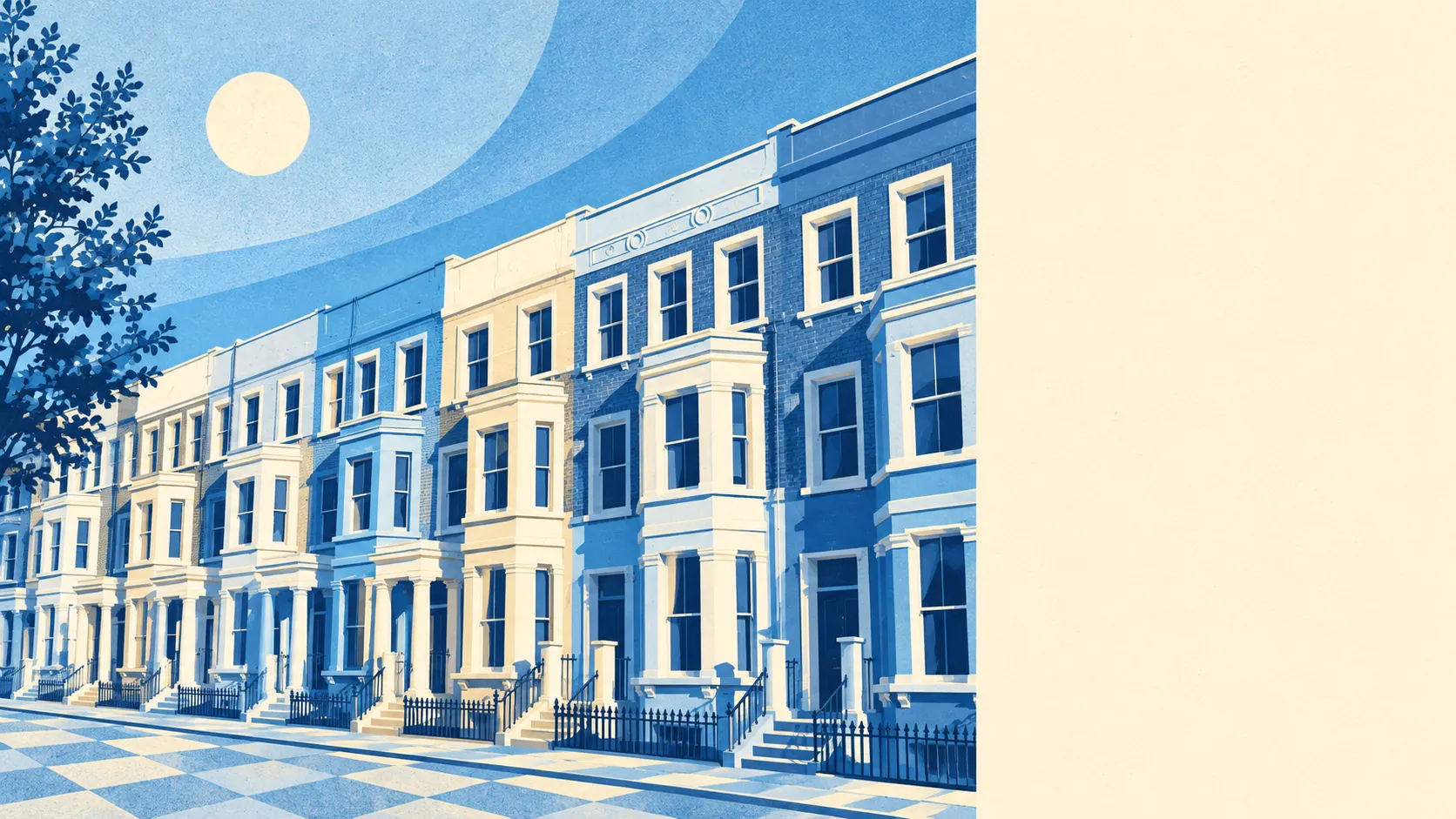
The area around Notting Hill is greener than its crowds would suggest. Most front doors are about a hundred metres from a park. Holland Park and Kensington Gardens are within reach. Several hundred shops line the streets in between. Most of the green is public parkland with railings round it, and there is a lot of it.
The average home is about 95 metres from the nearest green space, and there are about 59 green spaces within a kilometre. In a district this densely built, that is a lot of grass. The streets around Westbourne Green get the same short walk to a park as the stucco further south.
The nearest water is about 650 metres from the average home, with about 12 bodies of water within a kilometre. Most of it is ponds, lakes and canal, and the sea is nowhere near.
Getting out further on two wheels takes a little work. The nearest National Cycle Network route is about 4,200 metres away on average, and no postcode here counts as close to it. There is no ancient woodland in the area either.
The rated-premises list gives the district 711 shops, 82 restaurants and 17 pubs. That is a shopping district first and a drinking district a long way second. Portobello Road Market accounts for much of the shopping.
Kensington and Chelsea recorded fine-particle pollution of about 9 micrograms per cubic metre in 2024, a figure for the whole borough.
The character comes from the 19th-century Ladbroke Estate, laid out to turn farmland into a fashionable suburb, and from what moved in once it was built. The Electric Cinema is still showing films, and the market and the annual Carnival keep the streets busy. The district once had pig farmers working the clay around Pottery Lane, and the clay is still there under the stucco.
Private gardens come to about 17,500 square metres for every 1,000 residents. In a district made up mostly of flats, much of that outdoor space belongs to the houses and the communal gardens behind the terraces, and many flat owners have no garden at all. Ask whether a flat comes with access to a communal garden, because on these streets that is often the difference between having a lawn and walking to the park.
The district has 1,515 rateable premises on the valuation list. Shops are the biggest group, followed by 283 offices. These are premises on the council's valuation list, not a count of businesses open today. The offices are spread among the market stalls and boutiques.
Of the 317 food outlets with a hygiene rating, about 88% hold the top score of five, and about 1% are at the low end. For a district that eats out this much, the kitchens are well kept.
No area of outstanding natural beauty, site of special scientific interest or ancient woodland overlaps Notting Hill. For a district this close to central London that is only to be expected. Its green space is parks.
The surroundings are Notting Hill's best feature: parks a short walk from almost every door and a large shopping district on top. For a district this central, there is a lot of green space.