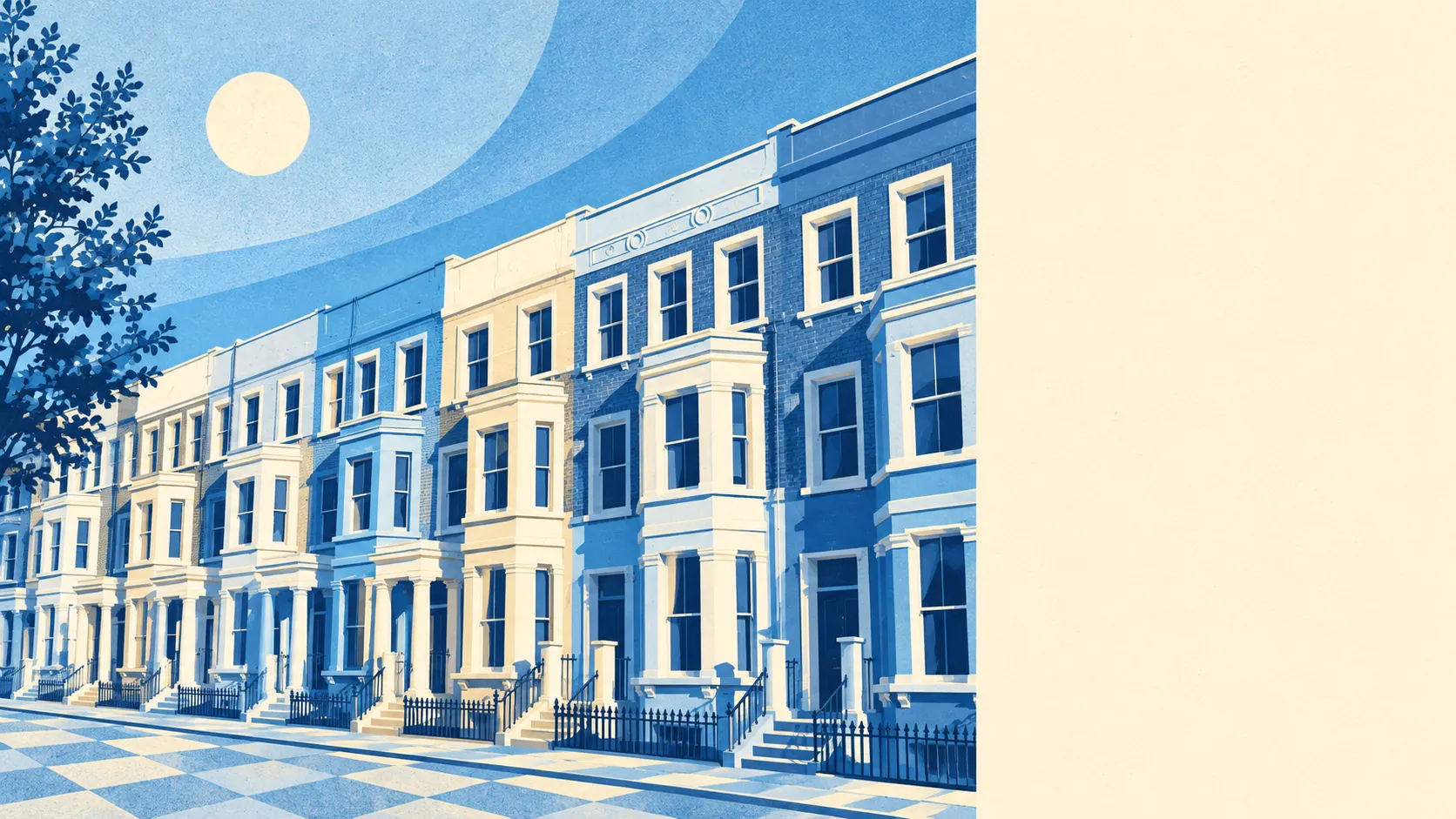
Notting Hill sells you a house on the condition that you leave it more or less as you found it. There are 527 listed buildings in one small patch of West London. The parks are on the doorstep, the schools are strong and the prices are brutal. Add it all up and it comes out middling, and middling here costs a fortune.
Of those listed buildings, 8 are grade I, 25 are grade II* and 494 are grade II, and Historic England has 4 of them on its Heritage at Risk register. Around them, 19 conservation areas fall inside the box drawn round the district. For an owner, that means replacement windows, a roof extension or a new rear elevation start with drawings and an application, not a call to a builder. The only surviving 19th-century tile kiln in London stands on Walmer Road, and it has a better chance of staying exactly as it is than your kitchen does.
The Land Registry recorded 184 sales in the year to May 2026, at a typical price of £1,107,500. That median is mostly a flat's number. Flats went for around £800,000 across 131 sales, the 48 terraced houses went for about £3,400,000, and the 3 semi-detached houses that sold went for a median of about £5,100,000. Three is a small sample. £5,100,000 is still a statement. Band D is the most common council-tax band, and only about 10% of homes fall in bands A or B.
Renting doesn't get you out of it. Across Kensington and Chelsea, the typical private rent was about £3,600 a month in April 2026, a borough-wide figure that stretches from Chelsea to the Westway and was down about 2% on the year.
The council-tax valuation list puts flats at about 78% of homes and terraced houses at 16%, with semis and detached houses at about 1% each. About 62% were built before 1930, so this is stucco and Victorian villas, mostly divided into flats. On the energy certificates, about 53% of rated homes reach bands A to C, 37% are band D and 11% are E or worse. About two-thirds of homes are on mains gas, and about 12% rely on electric-only heating. High ceilings look wonderful in photographs and are expensive to heat in January.
Only about 28% of households own their home. About 41% rent from a social landlord and about 30% from a private one, so the owner-occupied pastel terrace on the postcards is the minority here. The typical resident is 39. The Office for National Statistics models median gross household income at about £72,000 for the financial year to March 2023, averaged across neighbourhoods that are very different from each other. George Orwell and Rosalind Franklin both lived here, and so did Damon Albarn and Peter Gabriel. David Cameron was counted as part of the "Notting Hill Set" while insisting he lived in North Kensington, a rare case of a public figure trading down a postcode.
Recorded crime came to about 193 per 1,000 residents in the year to May 2026, roughly 6% above the Kensington and Chelsea average. Shoplifting is the largest single category at about 19% of recorded crime, against about 8% nationally, while violence and sexual offences make up 18%, about half the national share. The tills carry more of that figure than the front doors do.
Getting around is easy without a car, and about six in ten households don't have one. The district has 389 bus stops, each averaging about 482 weekday departures and around 25 buses an hour at peak, and every one has a weekend service. The Department for Transport's 2019 modelling puts the nearest town centre about 14 minutes away by public transport and 17 on foot, and those bus times will have aged faster than the walking ones. Paddington is the obvious main-line terminus. Gigabit broadband reaches about 87% of premises and superfast about 99%, which matters because about 53% of working residents were working from home at the 2021 Census.
The Environment Agency puts none of Notting Hill in its river-and-sea flood zones. The postcode measure tells a different story. About 22% of postcodes are rated high on at least one flood indicator, surface water included, and about 31% medium. With the river zones clear, that weight comes from rain the drains can't take quickly enough. The Thames is a long way off. The gutters are not.
Ofsted has graded 20 of the 22 graded settings in the Kensington and Chelsea count good or outstanding, 8 of them outstanding. The 5 primary schools with Key Stage 2 results in the district average about 109 in maths. The primaries on the map include Avondale Park, Colville, Thomas Jones and St Clement and St James Church of England Primary.
Green space is where Notting Hill earns its reputation. The nearest park is about 95 metres from the average front door, there are about 59 green spaces within a kilometre, and water is about 650 metres away. That holds from the streets around Westbourne Green down to Holland Park Avenue. Ladbroke Square is London's largest private garden square, so the biggest lawn around comes with a key, and you have to live on the right side of the railings to get one.
Notting Hill is right for people who want the finished article: a period flat, a park round the corner, a strong primary nearby and a bus stop at the end of the road. It is wrong for anyone whose plan starts with knocking through, going up or putting in bigger glass at the back. Whatever you buy here is very nearly the house you keep, because the council has a say in almost every change. Notting Hill is a middling place to live at a price that is anything but.