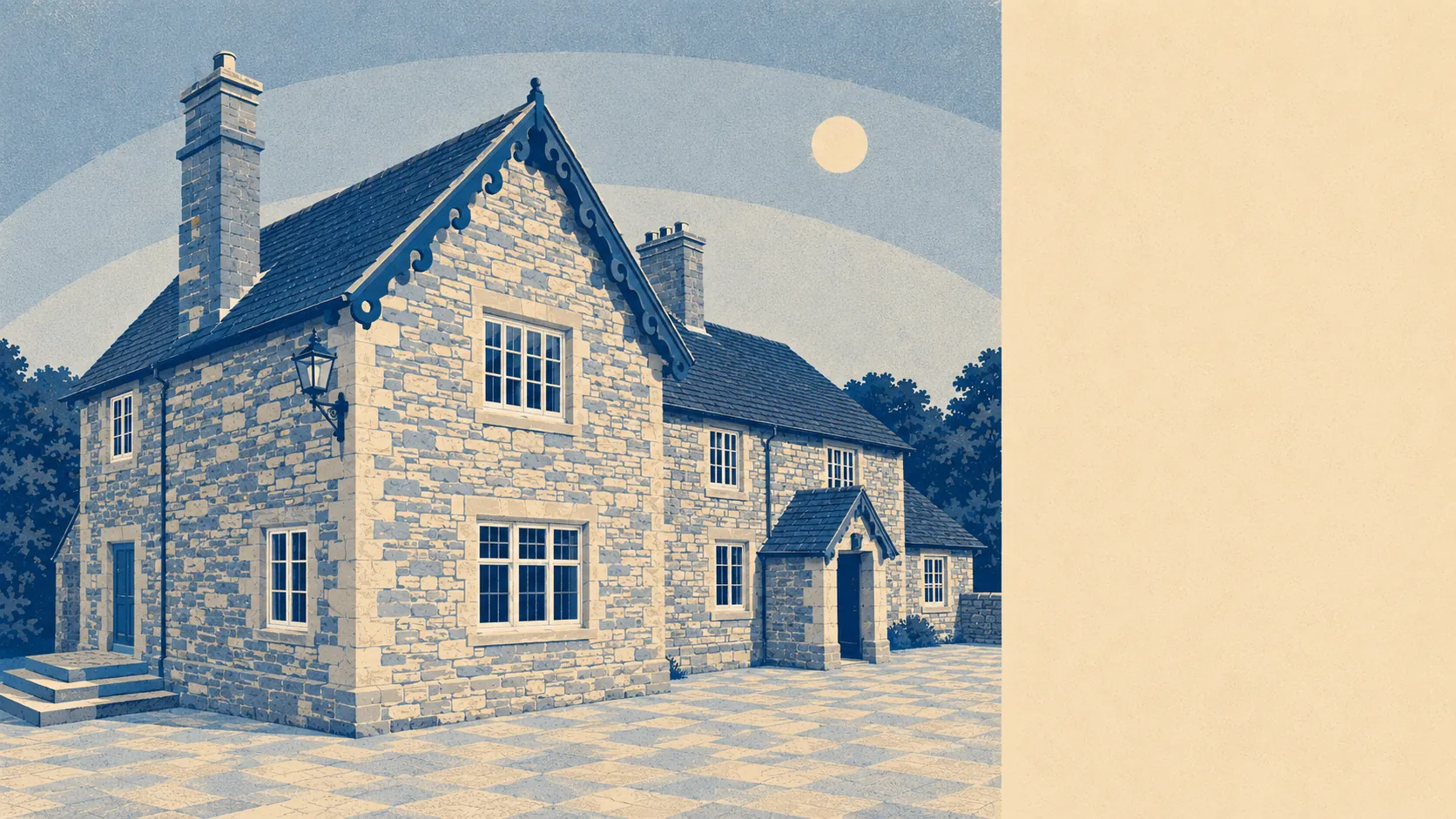
Yes, provided nobody needs it to be an old village. Almost none of the housing predates the 1930s. Seven in ten own their homes. Green space starts about a hundred metres from most front doors. Norton Fitzwarren is a modern village with a medieval parish attached, and the modern half is the reason it works.
The council tax valuation list, which covers every dwelling rather than only the ones with an energy certificate, splits the stock almost evenly: about 25% detached, 25% terraced, 23% semi-detached, 18% flats and 5% bungalows. Roughly 9% was built before 1930. That is what a village looks like when it gets built in instalments rather than over a century, and it means there is no single Norton Fitzwarren street type for a listing photo to sell you. The energy certificates agree: about 86% of certificated homes sit in bands A to C, 11% in band D, and 2% in band E or worse. Around 83% run on mains gas and only 4% are electric-only, which matters more than it sounds, because electric-only heating in a poorly insulated house is the bill nobody raises at the viewing.
The Land Registry recorded 76 sales in the year to May 2026, at a median of about £262,500. Flats came in around £155,000, terraces about £251,000, semis about £282,000, and detached houses about £340,000. The house price index has the average up about 3% over that year and about 15% across five. Council tax is undramatic: band B is the most common band, about 40% of dwellings sit in band A or B, and a band D bill runs to roughly £2,560 a year.
Renting is harder to pin down at village level. The typical private rent across the Somerset area is about £990 a month, up around 4% over the year, with two-bedroom homes near £890 and three-bedroom near £1,100. Those are area figures rather than the village's own. Treat them as the shape of the market, not a quote for the house you are looking at.
On the published police figures for the twelve months to May 2026, Norton Fitzwarren recorded about 67 crimes per thousand people, roughly 28% below the Somerset average. Avon and Somerset Constabulary covers the area. That is a genuinely strong number, and it is also the number residents quote over the fence when they want to feel clever about their own postcode.
Norton Fitzwarren Church School is the village primary, about eleven minutes' walk for a typical household. Across the three primaries in this postcode district, the average maths score in the national tests taken at the end of primary school is about 104. Secondary means Taunton, with Monkton Wood Academy and Pyrland School the nearest options, roughly eleven minutes by car and a walk long enough that nobody is doing it twice a day. Across Somerset, Ofsted has graded 140 settings: 101 good or better, 5 outstanding, 32 requiring improvement and 7 inadequate. The county contains all four outcomes, and the address decides which one arrives in the offer letter.
About 57% drive to work and about 26% work from home, which between them cover most of the working population. Buses take about 1% and trains about 0.2%, even with Taunton Rail Station being the nearest station on the network. Taunton town centre is about 13 minutes by car, 20 by bike, 23 by public transport and 46 on foot, on Department for Transport modelling from 2019, so treat the public transport figure with more suspicion than the driving one. There are 18 bus stops in the village area, 12 with published timetable data averaging about 51 weekday departures, and all 12 run at weekends. Broadband is the quiet triumph: gigabit-capable service reaches about 93% of premises, superfast about 99%, and nothing falls below the universal service minimum. At least one mobile operator covers effectively everywhere, with about 97% covered by all of them.
Flood risk is where the attention belongs. About 24% of postcodes carry a high rating on at least one flood indicator, surface water included, with a further 23% medium and 44% low. On the Environment Agency's river-and-sea mapping, about 14% of the area sits in flood zone 3 and 8% in zone 2, with about 32% falling inside the modelled climate-change extent. Six flood events are on record, the most recent in January 1999, when a main river exceeded its channel capacity. None of that makes the village a write-off. It makes the address-level check non-negotiable, because the gap between two streets here is wider than the gap between two towns.
Set against that, the surroundings are the best thing about the place. Green space averages about 113 metres from a home, with around 12 separate sites within a kilometre, and water about 179 metres away. There is no protected-countryside designation, no site of special scientific interest and no ancient woodland, so this is ordinary working countryside rather than the sort that arrives with a visitor centre and a car park charge.
Heritage constraint is light. Ten listed buildings in total, one of them the Grade two star Church of All Saints and the other nine Grade two, no conservation area at all, and one scheduled monument in Norton Camp, the hillfort on the slope above the village. For nearly every owner that means no heritage consent stacked on top of the normal planning system. Two miles away, in Staplegrove or Bishops Hull, the same window comes with a conservation officer attached.
About 68% of homes are owner-occupied, the median age is 37, and household income before tax sits around £51,750 for the financial year to March 2023, modelled at neighbourhood level by the Office for National Statistics. That combination describes a specific place: working households with mortgages and school runs, not retirees, not students. On the 2025 deprivation index the area sits in the seventh decile, toward the comfortable end without pretending to be anywhere near the top.
It suits a household buying a three-bedroom semi, running a car or two, working part of the week at the kitchen table and driving into Taunton for the rest. That buyer gets a low crime rate, a primary inside a ten-minute walk, broadband that never becomes a conversation, and countryside at the end of the road, for a price that is unremarkable rather than punishing.
It does not suit anyone who needs the train, anyone who wants a period house with original everything, or anyone buying without opening the flood mapping for the exact address. The first two are matters of taste. The third is the one that costs money.
So yes, above average and comfortably so. Its real strength is what surrounds it: green space at the end of almost every street, water minutes away, and a crime rate well under the county's. The weak spot is water in the other sense, and flood exposure here varies street by street rather than village-wide. Norton Fitzwarren is a good place to live with one condition attached, and the condition has a postcode.