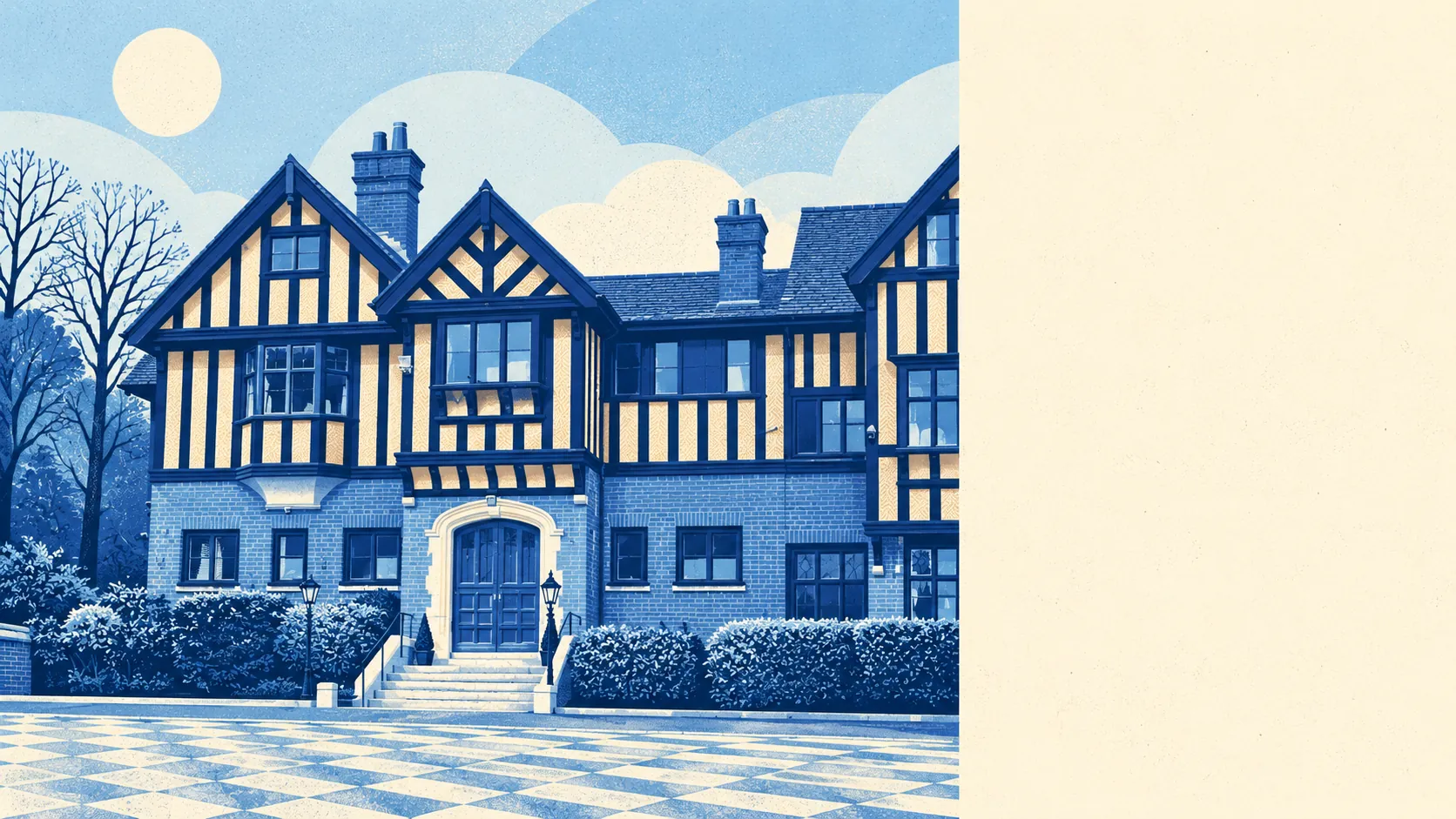
Possibly, with a lot of people watching. There are more than a hundred and sixty listed buildings in and around Norbiton. There are twenty conservation areas in the surrounding area. The neighbours file planning applications constantly. Every postcode sits on clay that shrinks and swells. The planning office is one obstacle to an extension here, and the ground underneath is another.
There are 161 listed buildings in and around Norbiton: 3 at Grade I, 17 at Grade II* and 141 at Grade II. Listing covers the inside of a building as well as the outside, so changing a listed home, even an internal wall or a window, needs listed building consent from the council on top of any planning permission. Most of these are Grade II, the most common grade, but Grade II still covers the back of the house, which is usually where the extension was going to go.
The wider surrounding area has 20 conservation areas, among them Coombe Hill, Coombe Wood, Coombe House, and Fairfield and Knights Park. Inside one, the council has a say over demolition, front elevations and how big an extension can be. Some building work that would go ahead without an application elsewhere needs consent there. Names like Coombe Hill and Coombe Wood sound like countryside walks, and planning-wise they behave like rulebooks. The useful check is the council's conservation-area map for the exact house. A buyer who finds out the property is inside a boundary only when an application comes back has found out too late.
There are also 5 scheduled monuments in the wider area. That is the strictest level of heritage protection, and it matters mainly for anyone whose land is next to one.
Between April 2024 and June 2026, 1,274 planning applications were made in the area, 500 of them in the last twelve months. That is 500 households in a year deciding the house they bought was not quite the house they wanted, and doing something about it. The council records don't show reliably how those applications were decided, so the volume shows that people here do try to alter their homes, not how often they succeed.
The ground is harder to argue with than the council. Every postcode in Norbiton reaches class 3 on the national geological survey's shrink-swell scale, its published rating for clay that expands when wet and shrinks when dry. That does not stop an extension. It does mean the foundations may need to go deeper than a builder's standard quote assumes, especially near trees, and a structural engineer should see the plans before the price is agreed.
Three listed buildings in the wider area are on Historic England's Heritage at Risk register. That means they are in poor condition, and any repair may attract grant money along with close attention from the authorities. For someone extending an ordinary house a few streets away, they make no difference.
Away from listed buildings and conservation areas, an ordinary house keeps its permitted development rights, so many modest rear extensions and loft conversions can go ahead without a full application, within national limits. Flats have far fewer of those rights, and most homes here are flats. Inside a conservation area or in a listed building, assume most changes need consent until the council confirms otherwise in writing.
Freedom to extend is one of Norbiton's weaker points. Heritage rules apply across much of the area, the clay applies to all of it, and an extension that would be routine on paper elsewhere tends to come with conditions here.