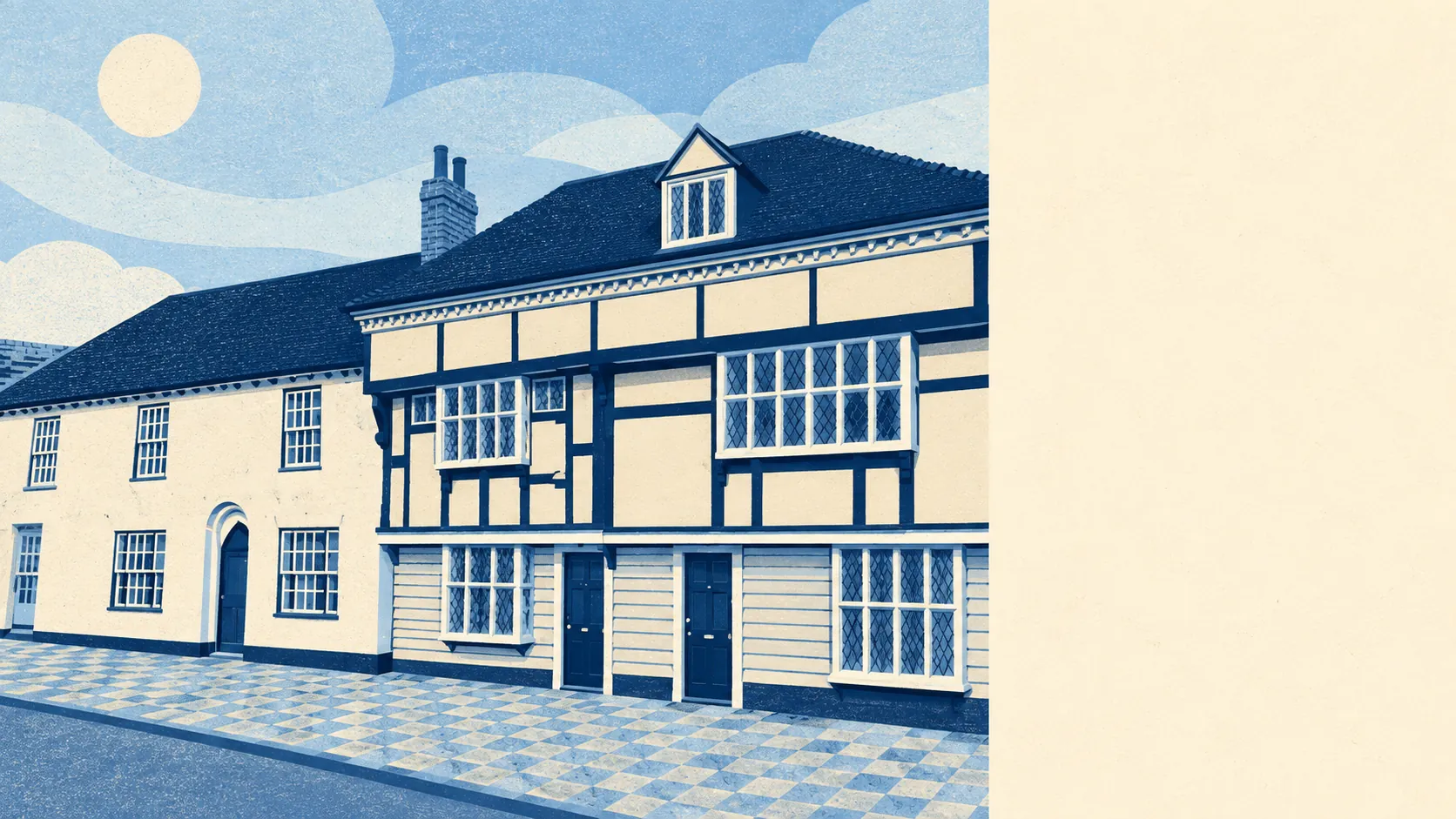
Yes, Newington is a good place to live, provided you check the drains before the kitchen. Crime runs well under the Swale average. Nearly eight in ten households own their home. About a fifth of postcodes carry some kind of flood flag. The burglar is less of a worry here than the gully at the end of the road.
The Newington area is a house-and-bungalow place, and it doesn't pretend otherwise. The council-tax valuation list puts detached homes at 26%, semis at 27% and terraces at 23%, with bungalows at 12% and flats at 4%. Anyone who wants a loft conversion with a view of a bar has come to the wrong village. Most of the stock is post-war, but about 21% of homes were built before 1930, which is enough to make "character property" an honest description rather than an estate-agent euphemism for draughts. Energy certificates show 46% rated A to C, 37% on band D and 16% on E or worse. About 74% of homes are on mains gas and 5% rely on electric-only heating. If the house you're viewing is old and in that 5%, ask for the bills before you ask about the garden.
The Land Registry's last twelve months, to early May 2026, show a typical sale price of about £365,000 across 66 sales. By type, detached houses went for around £505,000, semis for about £353,000 and terraces for about £287,000. Being a village doesn't get you a village discount. The most common council-tax band is D, and only 27% of homes sit in bands A or B, so the cheap-band starter terrace is harder to find than the listings make it look.
For renters, the only figure available is the typical private rent across the Swale area, about £1,090 a month as of April 2026. That is a borough-wide average, not a Newington figure, and a three-bed semi in a Kent village won't be the typical Swale rental. Private renting is a sideline here anyway. Most people bought and stayed.
Safety is where Newington earns its keep. Police figures for the year from June 2025 to May 2026 put crime at about 62 incidents per 1,000 residents, well below the Swale average of about 105. Violence and sexual offences make up the largest share, as they do almost everywhere, but the totals are small enough that a handful of incidents moves the mix by several points, so read the category split as noise rather than character. The bigger point stands. Anyone who moved here "for the peace and quiet" and then complains about crime on the village Facebook group is complaining about a fraction of what Sittingbourne deals with.
On schools, the eleven primaries in the surrounding districts average about 104 on the end-of-primary maths score, where 100 is the expected standard. The one secondary counted in those districts posts an Attainment 8 score of about 63. Ofsted has graded 221 of 245 inspected settings across Kent good or better, 38 of them outstanding. Close to home, Newington Church of England Primary School sits in the village, with Lower Halstow Primary School, Hartlip Endowed Church of England Primary School and Bobbing Village School nearby. For secondary, the options people usually look at are Rainham Mark Grammar School, Rainham School for Girls, Leigh Academy Rainham and The Howard School. Kent's selective system means the choice gets made in Year 6, and most of the parental anxiety arrives with it.
Newington Rail Station is in the village, which is more than a lot of places this size can say, and yet only 4% of working residents take the train. About 54% drive and 33% work from home. The station is there for the few; the A2 is there for everyone else. Department for Transport modelling from 2019 puts the nearest town centre about 14 minutes away by car and 24 by public transport, and a food shop about 11 minutes on foot. The 68 bus stops in the area average about 11 weekday departures each, so the bus is a plan B you check the timetable for. Broadband is decent: 75% of postcodes can get gigabit and 90% superfast, and every postcode has 4G or 5G from at least one operator. Working from home is a realistic option here.
The outdoors is the best thing about the place. The average home is about 300 metres from green space, with around seven spaces within a kilometre, and water is typically under 500 metres away. The northern edge runs down towards the Medway at Lower Halstow, and a sliver of the Kent Downs Area of Outstanding Natural Beauty clips the area. Flood risk is the catch, and the two measures need keeping apart. About 21% of postcodes carry a high rating on at least one flood indicator, surface water included. On the Environment Agency's river-and-sea zones the exposure is much smaller, with about 3% of postcodes in zone 3 and 1% in zone 2. Around 3% of postcodes fall within the Lower Medway Internal Drainage Board's patch. The surface water is the risk the listings leave out and the insurers price in.
Heritage is dense for a village. There are 80 listed buildings, three of them Grade I, five Grade II* and 72 Grade II, plus ten conservation areas including Newington High Street, Newington Church, Newington Manor, Hartlip Village and Lower Halstow. The Romano-British villa and the Romano-Celtic temple at Boxted are scheduled monuments. If your plans involve uPVC windows on a listed cottage, the council will have an opinion, and it will be longer than yours.
The residents are settled rather than passing through. About 78% own their home, the median age is 44, and gross household income averaged roughly £62,000 in the financial year to March 2023. That is a middle-aged, mortgage-paid-down, two-cars-on-the-drive profile. It suits the housing, and the housing suits it. Upchurch and Lower Halstow sit inside the same patch and follow the same pattern: quiet, owner-occupied, closer to the estuary than to anything lively.
It suits families who want a village primary, a garden and a low crime rate, and who are happy to drive to most things. It suits people working from home who want fields out the back and gigabit broadband. It suits anyone who likes a church, a manor house and a Roman temple more than a high street.
It doesn't suit anyone who needs a bus every ten minutes, a flat or a nightlife that runs past the pub's last orders. Anyone who wants that trade will find it in Rainham or Sittingbourne, with shorter commutes and more to do but less countryside. And it doesn't suit a buyer who skips the flood search because the house "looks high up".
Newington is a good place to live, and its real strength is the surrounding countryside: green space on the doorstep, water nearby and fields that haven't yet been turned into a car park. The weak spot is flood risk, which is patchy and street-specific and is the one thing a quiet village can't talk its way out of. Buy the right road and it's one of the calmer corners of Swale. Buy the wrong one and it'll be the surface water that keeps you up at night, not the neighbours.