New Romney is a good place to live, provided you read the clause about water. Three in four households own their home. The typical resident is in their mid-fifties. A third of the homes are bungalows. Crime runs well below the rest of the district. It is a settled, owner-occupied town whose only serious argument is with the sea.
The bungalow is the house of record here. The council-tax valuation list, which covers every dwelling in the New Romney area, puts bungalows at 33%, ahead of detached houses at 28%, semis at 15%, terraces at 13% and flats at 11%. Only 15% of homes were built before 1930, and about 3% went up between 2000 and 2008. The period cottage in the listing photos is the exception, which is why it got photographed first. Energy certificates split down the middle: 49% rate A to C, 36% sit at D and 15% are E or worse. Mains gas heats 80% of homes and about 5% rely on electric-only heating, so ask which kind you are viewing before the first winter bill tells you. The single-storey layout suits a buyer already thinking about stairs they won't want to climb later. It also makes the loft-conversion conversation a short one.
The Land Registry recorded 97 sales in the year to mid-May 2026, at a median of £368,000. That headline blends very different homes. Detached houses made up 48 of those sales at a median of £425,000. Semis went for about £322,000, the seven terraces for £275,000 and the 16 flats for £153,000. Flats are the entry ticket, and a rare one. On council tax, band C is the most common, and bands A and B together cover 23% of homes. A band D bill runs to about £2,540 a year.
For renting, the only figure available covers the whole district: the typical private rent across the Folkestone and Hythe area is about £1,140 a month as of April 2026, up about 9% on a year earlier. Treat that as the district's number, not New Romney's own. Across the same area a one-bed averages about £780, a two-bed about £1,000 and a three-bed about £1,250. With only 13% of households renting privately, landlords here are a minority hobby rather than the local economy.
The New Romney area's published crime rate for the twelve months from June 2025 to May 2026 is about 61 per 1,000 residents, comfortably below the Folkestone and Hythe average of about 85. Kent Police, the force covering the area, charged in about 16% of cases over the same year against 12% nationally, which puts it sixth of 42 forces. The marsh is flat enough that anyone making off with your wheelie bin stays in view for a long time.
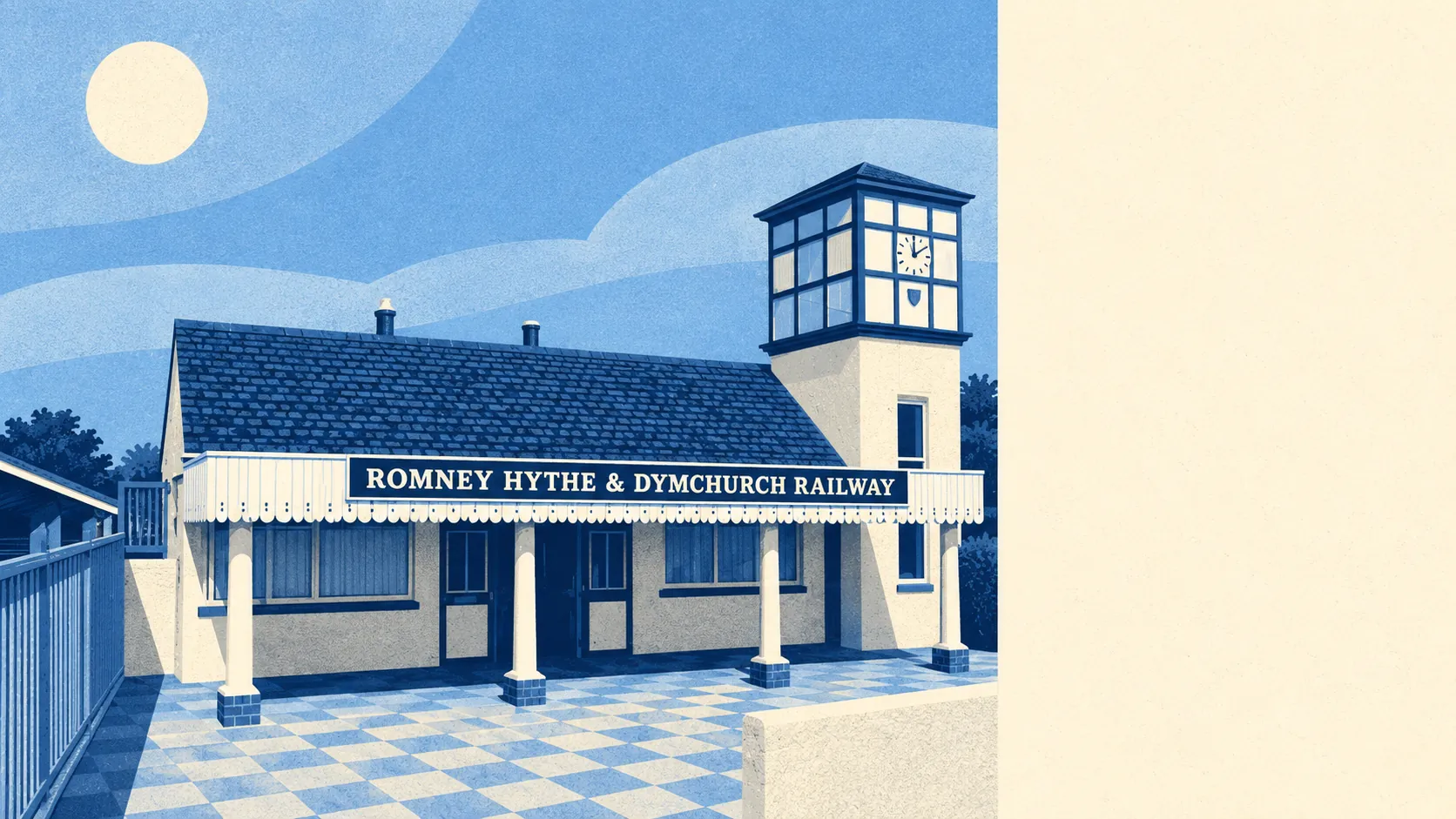
This is car country, and the commuting figures say so plainly. About 60% of workers drive, 24% work from home and 1% take the train, which is what happens when the town's railway station closes and gets replaced by a bus. The area's 59 bus stops average 44 scheduled departures each on a weekday, and 96% get a weekend service. The Department for Transport's 2019 modelling puts the nearest town centre 28 minutes away by car and 47 by public transport. The hospital is 43 minutes by car and 95 by public transport. Anyone buying here to retire should time that hospital trip before timing the walk to the beach. Broadband is better than the bus map: gigabit connections reach 76% of premises and superfast 90%, and every postcode gets 4G or 5G from at least one operator.
Flood risk is where the brochure goes quiet. In the Environment Agency's river-and-sea flood zones, 22% of the area sits in zone 3, the highest-risk band, and 7% in zone 2. On this site's postcode indicators, which include surface water, 8% of postcodes are high risk on at least one indicator and another 8% medium. Every postcode falls within the Romney Marshes Area Internal Drainage Board's patch, and the shoreline management plan's policy is to hold the line at the 20, 50 and 100-year horizons. Hold the line is a policy, not a promise, and buyers should read it that way. The British Geological Survey flags compressible ground and running sand at a moderate class across 98% of postcodes, while radon sits in the lowest band. The trade for all that water is space: the nearest green space is about 190 metres away on average, with about 10 within a kilometre, and open water about 200 metres.
The area holds 64 listed buildings: one at Grade I, two at Grade II* and 61 at Grade II. There are three conservation areas, New Romney High Street, New Romney Cannon Street and Littlestone-on-Sea, plus scheduled monuments including the remains of Romney Priory and the Phoenix Caisson off Littlestone, a wartime Mulberry harbour section still sitting in the sand. Inside those boundaries, windows, doors and extensions need permission and patience. Outside them, the post-war stock leaves you mostly free, and nobody will stop you fitting double glazing.
About 77% of households own their home and the median age is 55. Median gross household income was about £46,000 in the financial year to March 2023. Single pensioners head 17% of households; couples with children, 13%. The school run is not what sets the tempo of the week.
The page also covers Greatstone-on-Sea, Littlestone-on-Sea and Dungeness. Littlestone was laid out in the 1880s by Sir Robert Perks as a resort for the gentry, and the ambition still shows in its conservation area. Dungeness is a shingle headland with a nuclear power station on it, the one neighbour on this coast unlikely to object to your extension.
New Romney suits buyers who want a detached house or a bungalow at a price the rest of the south-east stopped offering years ago, who drive, and who value a quiet street and open space over a train timetable. It suits people who work from home or have stopped working, and who will check a flood map before falling for a sea view.
It does not suit a London commuter, anyone who needs a hospital close by, or a young family hoping for a lively high street. It also does not suit anyone who treats flood searches as paperwork for the solicitor to deal with.
New Romney is a good place to live for the right buyer, and better than average overall. Its real strength is the surrounding area and green space: open marsh, water close by, and a coastline you can reach without a car park fee. The weak spot is flood risk, which is structural on land like this. Buy the house above the waterline and the town gives you exactly the quiet it promises.