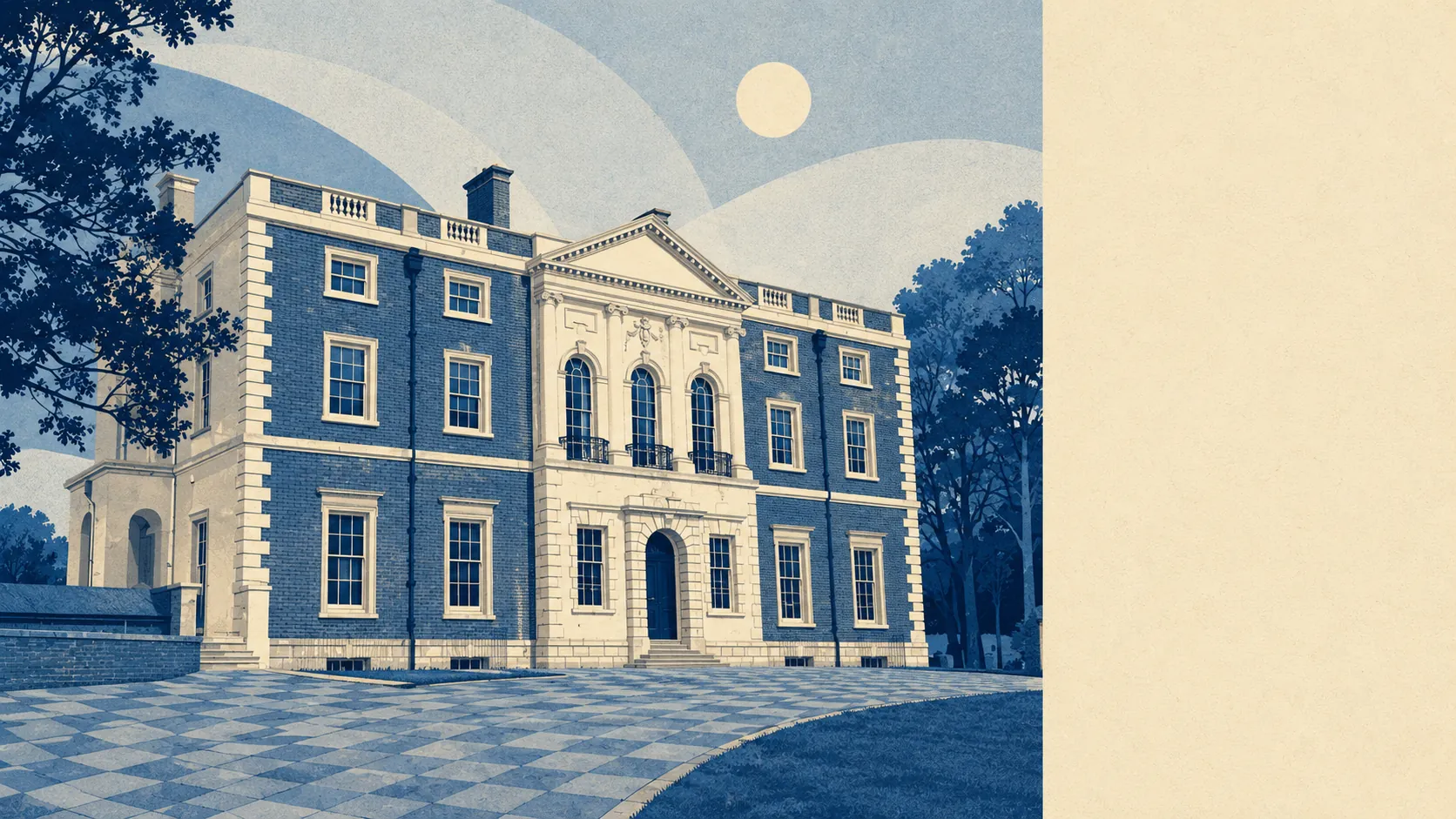
Merley is a good place to live, as long as your definition of an event is flexible. Eight in ten households own the roof over their heads. Half of them keep two cars or more on the drive. The typical resident is in their late forties and has no appetite for surprises. This is not a village that grew into itself. It is farmland that was drawn up on paper and then got comfortable.
The bungalow runs the place. On the council-tax valuation list, which covers every dwelling rather than just the ones recently sold, bungalows take 31% of the stock, with detached houses just behind on 28%. Terraces sit at 16%, semis at 15%, flats at 10%. Only 3% of homes predate 1930, and the bulk went up between the 1950s and the early 1980s on plots wide enough that extensions go sideways instead of upwards. Mains gas heats 85% of it. On the energy certificates, 50% of certificated homes reach band C or better, 40% land on band D and 10% sit at band E or worse. A band D rating on a single-storey home with a wide ground-floor footprint is a heating bill rather than a talking point, and it is the most common outcome here.
The Land Registry recorded 162 sales across the wider Merley area in the twelve months to May 2026, at a median of about £372,500. What you buy decides most of what you pay. Detached houses, 90 of those sales, ran to a median of roughly £447,500. Semis came in near £332,500, terraces near £274,000, and the 15 flats that changed hands sat at about £192,000. Council tax lands mostly in band C, with 20% of dwellings in bands A or B, so there is no bargain tier here, only a slightly less expensive one.
Renting is the minority position: 11% of households rent privately. Typical private rent across the whole Bournemouth, Christchurch and Poole area was about £1,400 a month as of April 2026, up around 4% over the year, with a three-bedroom home across that same area at roughly £1,460. Those are area-wide averages rather than Merley's own, and Merley is not where the area keeps its cheap stock, so treat them as the floor of the expectation rather than the ceiling.
Recorded crime ran at about 63 offences per 1,000 people in the year to May 2026, against roughly 88 per 1,000 across Bournemouth, Christchurch and Poole. That is around 28% below the local-authority average, and it is a published rate rather than a sum worked out from the resident headcount. The mix is telling: shoplifting accounts for about 14% of recorded offences against 8% nationally, anti-social behaviour about 21% against 16%, while violence and sexual offences take a smaller share than the national figure. The trouble here is made of nuisance rather than menace.
Gigabit broadband reaches 83% of premises and superfast reaches 94%, with nothing falling below the minimum service standard, so working from home is a genuine option and 29% of working residents take it. Another 58% drive. There are 242 bus stops in the area, 89% of them with a weekend service and an average of 30 scheduled weekday departures each. On the Department for Transport's 2019 modelling, the nearest town centre is about 13 minutes away by car and about 25 by public transport. The closest railway stations are at Poole and Branksome, which makes the train a decision rather than a habit.
Flood risk here splits across two measures that say different things. On the postcode indicators, which include surface water, about 8% of postcodes carry a high rating on at least one measure, 9% a medium and 25% a low. On the Environment Agency's river-and-sea flood zones, about 1% of the area falls inside them. Three flood events are on record, the most recent in January 2014, when a main river exceeded its channel capacity, the Stour running along the northern side of Oakley being the obvious candidate for a buyer's attention. Against that, green space is closer than the front gate suggests: about 210 metres to the nearest patch, roughly 12 separate green spaces within a kilometre of the average postcode, water about 440 metres away, and gardens taking up 28% of the total area.
Heritage is where the freedom to do what you like with your own house runs out. There are 48 listed buildings in and around the area, 5 of them grade one, and 6 conservation areas including Canford Magna, Oakley Lane and Ridgeway and Broadstone Park. Thirteen scheduled monuments sit in the wider bounds, mostly bowl barrows, because the first people here also picked the high ground and the good drainage. For most Merley homes none of this bites, since a post-war estate house sits outside those boundaries. Buy inside one, though, and replacing a window becomes a conversation with the council, and that conversation moves at the speed of the council.
Around 80% of households own their home, the median age is 47, and household income across the area ran at about £50,400 gross in the financial year to March 2023. A quarter of households are one person living alone, 15% of them a pensioner on their own, and 19% are couples with children. The place is not old so much as settled, which is a different and more permanent condition. Oakley, covered by this page alongside Merley, runs into it with no seam a stranger could find, and the shops signposted at Oakley serve both. Head out in any direction and the map turns comic: Happy Bottom, Lambs' Green, Naked Cross, Sleight.
It suits downsizers who want a drive and a single storey, and families who want space and quiet within a short drive of everything, with Ofsted having graded 38 of 41 settings good or better across the Bournemouth, Christchurch and Poole authority, 6 of them outstanding.
It does not suit anyone who wants a station within walking distance, a Friday night that starts after nine, a period house, or a cheap way in. Those things exist. They are somewhere else.
Merley is a good place to live and an easy one to underrate from a listing photo. Its real strength is how little goes wrong, with recorded crime well below the wider area and the offences that do happen weighted towards nuisance. The weak spot is the freedom to alter your own home, where conservation boundaries and listed stock mean the answer depends entirely on which side of a line your deeds fall. Buy the bungalow, keep the drive, and make peace with the fact that the most dramatic thing happening this year is the bin calendar.