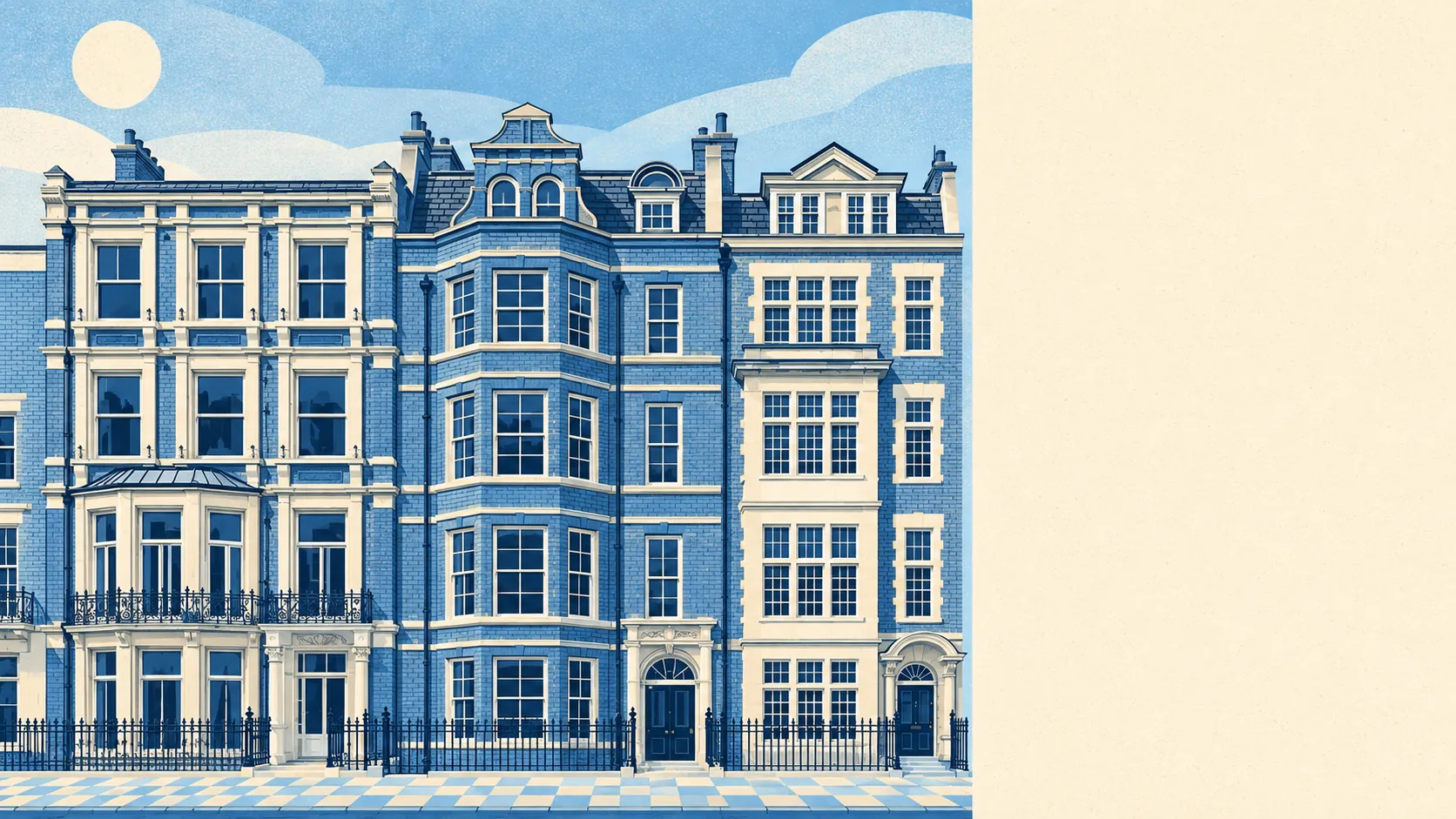
Marylebone's surroundings are some of the best in central London. Two royal parks are within reach. A green space is a couple of minutes from most front doors. The streets in between are crammed with shops, restaurants and offices. Private gardens barely exist, so the parks do the work that back gardens do elsewhere.
The average home here is about 140 metres from the nearest public green space, with 31 green spaces within a kilometre. Those range from the garden squares to Regent's Park to the north and Hyde Park off the south-west corner. A garden square at the end of the road is the default here, not the exception.
Water is a little further. The nearest blue space averages about 690 metres from home, with 15 within a kilometre, including the ornamental lake in Regent's Park and the Regent's Canal along its northern side. For a neighbourhood with no river of its own, that is plenty to walk to.
The National Cycle Network is about 3,000 metres away on average, and 0% of homes are close to it. Anyone cycling here is on the city's roads and lanes.
On the valuation list the area has 749 shops, 42 pubs and 142 restaurants, set among 2,728 offices. A Marylebone high street is a café, a boutique, a consulting room and then four floors of somebody's office.
Westminster's fine-particle pollution came to 9.7 micrograms per cubic metre in 2024, a borough-wide reading that covers Marylebone along with everywhere else in the City of Westminster.
The texture comes from the history. The Marylebone Cricket Club began at Dorset Square before moving to Lord's, and the square is still there and still green. Portman Square and Manchester Square are registered historic gardens, Marylebone Village keeps a small-street feel behind Oxford Street, and London Zoo lies inside Regent's Park on the northern edge. Hanover Square, Piccadilly and Hyde Park fall within this page's wider reach too. Plenty of cricket clubs have moved grounds, but few kept the original square as a garden on the doorstep.
Private outdoor space is the scarce thing. There are about 5,989 square metres of private garden for every 1,000 residents, which in a neighbourhood of flats means most households have none of their own. Some flats come with a key or a right of access to a communal garden square. The lease will say whether yours does, and that clause can matter as much as the floor plan.
Westminster's rating list carries 4,448 business premises in the area. Offices are the largest group at 2,390, followed by 688 shops. Those are premises on the valuation list, which is a different count from businesses open and trading, and they show how much of the neighbourhood is working space with homes fitted above and between.
Of the 493 food premises given a hygiene rating, about 74% hold the top score and about 6% sit at the low end. For a neighbourhood that eats out this much, the inspectors are mostly happy with the kitchens.
No protected landscape designation covers the area: no area of outstanding natural beauty, no site of special scientific interest and no ancient woodland. Marylebone's green spaces are designed and planted, all squares and parks, with no wild countryside among them.
What surrounds a Marylebone home is one of its real strengths. Two royal parks and a run of garden squares make up for the back garden almost nobody here has.