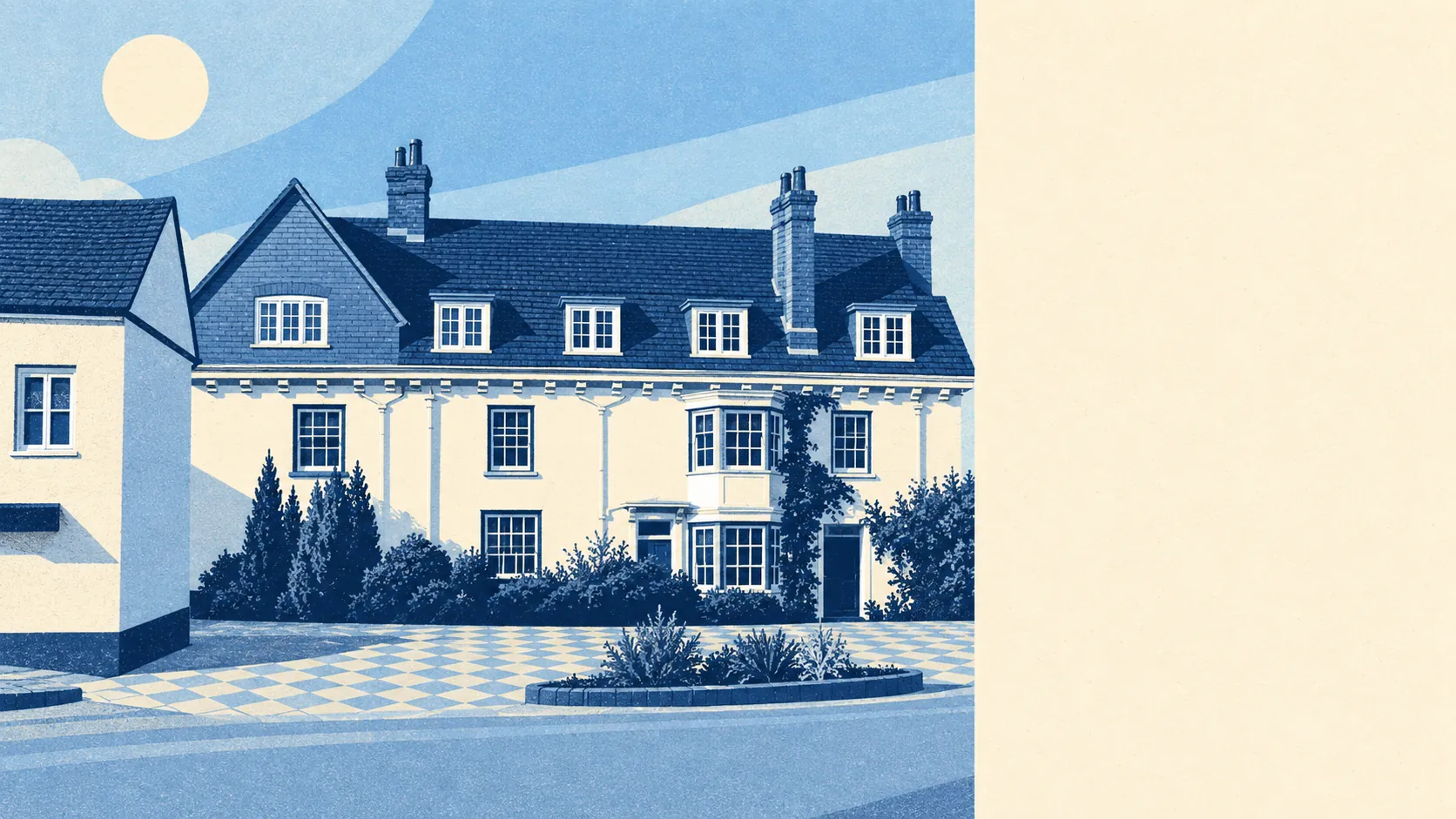
The countryside around Liphook is the best thing about living there, and it starts close to the front door. There's green space within a few minutes of almost every house. Water is close by too. The high street runs to shops and offices, with only a few restaurants. People choose Liphook for the commons and the woods, and the village comes with them.
On average, the nearest public green space is about 190 metres from a Liphook postcode, with about 14 green spaces within a kilometre. That's close enough to walk a dog before breakfast without planning a route. Few villages this size have that much open ground so close to the houses.
Water is nearly as close. The nearest pond, stream or lake averages about 280 metres away, and there are about 17 within a kilometre. Liphook grew up above the marshes of the River Wey, and the river still runs through the parish, so some of that water is part of the village's history as well as its scenery.
Cycling is harder. The nearest stretch of the National Cycle Network averages about 720 metres away, and only about 32% of postcodes are close to it. The countryside is easier to reach on foot than on a bike.
The businesses in the village cover the everyday. Liphook has 61 shops, five pubs and three restaurants among its rated premises, so eating out mostly means a pub.
Air quality is decent. Fine-particle pollution across the East Hampshire council area averaged about 6 micrograms per cubic metre in 2024. That's a figure for the whole district, not for Liphook's own streets.
The civil parish includes Bramshott, Griggs Green, Conford, Passfield, Hammer Bottom and Waggoners Wells. Liphook itself grew on the edge of an old royal hunting forest. Weavers Down lies nearby, and its Bronze Age barrows are protected as scheduled monuments. The village has its own conservation area, and the Wey Valley and River Wey conservation areas lie close by. Hollycombe House is on the national register of historic parks and gardens. Liphook's historic setting is mostly heathland, burial mounds and old estates.
Private gardens are generous too. The area has about 290,000 square metres of private garden for every 1,000 residents, so most homes have outdoor space of their own as well as the commons nearby. For many buyers, the back garden will matter as much as the common.
The valuation list gives a clearer idea of what the village is made of. It records 184 rateable premises in Liphook. The largest group is 59 shops, followed by 47 offices. These are premises on the rating list, not a count of businesses trading today, but they show a working village rather than a village of retirement flats.
Food hygiene is mostly good. Of the 34 rated food premises, about 68% hold the top hygiene score, and about 3% sit at the bottom end. Most places you'll eat in are fine, and the one or two that aren't don't change the overall picture.
None of the area falls within an Area of Outstanding Natural Beauty or a Site of Special Scientific Interest, and none is classed as ancient woodland. The green space here is ordinary countryside, used every day by the people who live next to it rather than protected by a designation.
The area around Liphook is one of the village's real strengths. It has open ground, water and heathland within easy reach of almost every house.