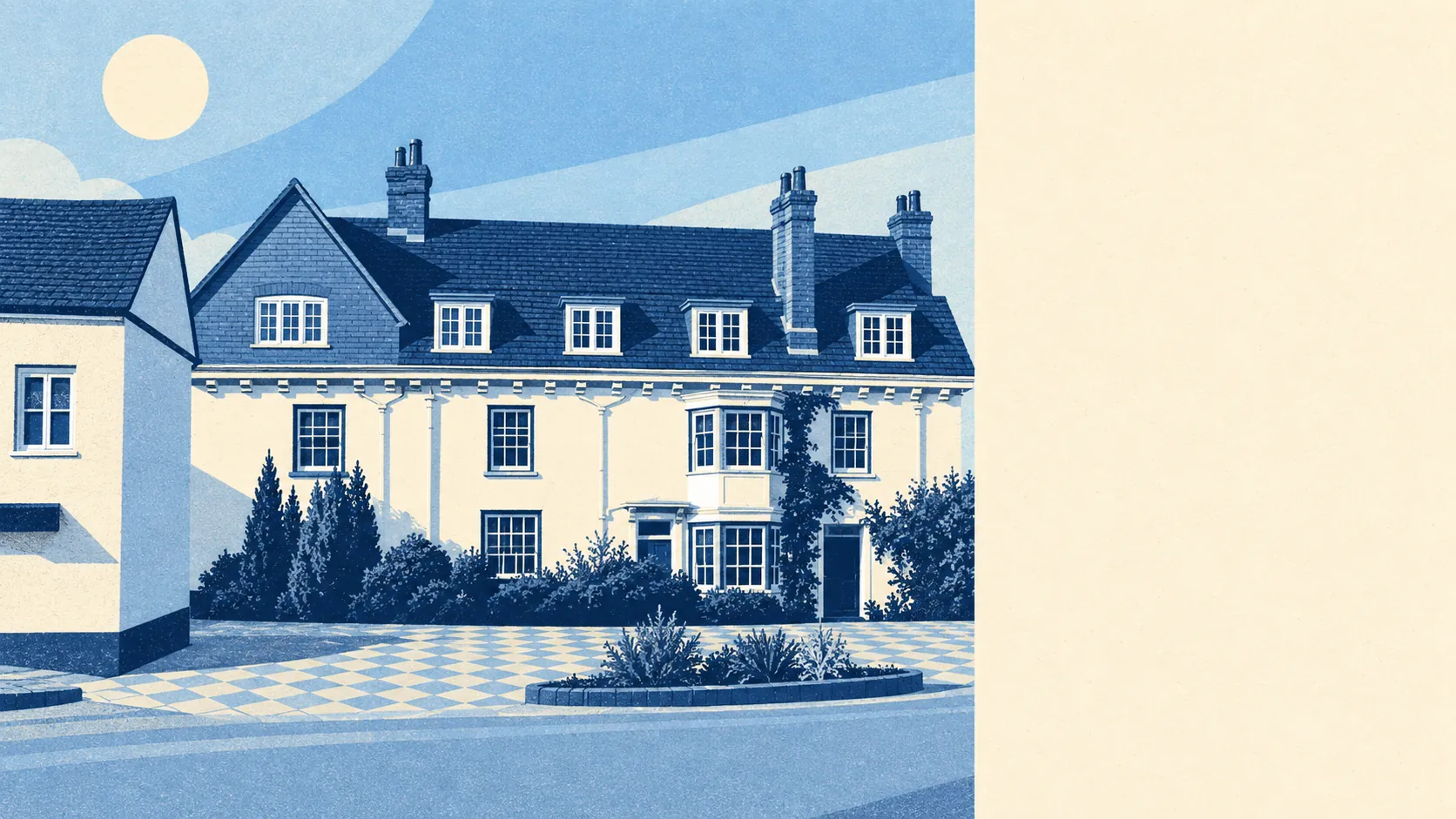
Yes, and it's a commuter village that has mostly stopped commuting. About seven in ten own their home. Four in ten work from home. Hardly anyone takes the train, despite the station in the middle of the village. Liphook sells itself as a railway village and lives like a village of home offices with a very good rail link for emergencies.
The housing is mostly houses, and it has been built for the car. Every dwelling on the council-tax list gives the split: about 33% detached, 21% semi-detached, 17% terraced, 17% flats and 12% bungalows. Only about 19% of homes were built before 1930, so the half-timbered buildings around The Square are the postcard, not the stock. Most of what you'll view is post-war. Energy ratings are respectable: about 64% of certificated homes sit in bands A to C, 29% in D, and 7% in E or worse. About 75% of homes heat with mains gas and about 6% rely on electric heating alone. If the house you like is one of the electric ones, check the heating before the survey does.
The cost of getting in is the weak part of the case. The Land Registry's figures for the year to mid-May 2026 put the typical sale price at about £450,000, from 79 sales. That number hides a wide spread. Detached houses went for a typical £737,500, semis for £450,000, terraces for £365,000, and the nine flats that sold came in around £190,000. Council tax follows the housing. The most common band is D, and only about 14% of homes are in bands A or B. Nothing about Liphook's pricing says bargain. It says Hampshire's border with Surrey and West Sussex, and it charges accordingly.
Renting has no neighbourhood figure. The typical private rent across the whole East Hampshire area was about £1,260 a month in April 2026. That's a district average, so a family house near The Square could come in well above it and a small flat below it. Only about 12% of Liphook's households rent privately, so the choice is thin. Agents may pitch this as exclusivity, but it means there aren't many flats to choose from.
Crime is unremarkable, which is what most buyers want to hear. Police figures for the year to May 2026 put Liphook's rate at about 46 crimes per 1,000 residents, roughly 4% below the East Hampshire average. That's close enough to the district norm that neither an estate agent nor a worried relative can make much of it. A village with a supermarket and a few pubs at its centre gets the ordinary crime of a small town centre. If someone calls Liphook "very safe" or "going downhill", neither claim is in the numbers.
Getting around depends on where you're going. Liphook Rail Station is in the village and Haslemere Rail Station is nearby. Yet only about 2% of working residents commuted by train at the 2021 Census, against about 47% who drove and about 41% who worked from home. The 33 bus stops average about seven weekday departures each, and only about a third of them see any weekend service, so the bus is a backup plan, not a timetable. Broadband is better. Superfast is available to about 99% of premises and gigabit to about 60%. Mobile coverage from at least one operator reaches every postcode. For a village this dependent on home offices, the fibre matters more than the trains.
Flooding is limited and very local. In the Environment Agency's river-and-sea flood zones, under 1% of postcodes fall in Zone 2 and none in Zone 3. Surface water is where the risk sits. Counting any flood indicator including surface water, about 8% of postcodes carry a high-risk flag and about 14% a medium one. The village average doesn't tell you much here, so check the individual street. The green space is the part that needs no caveat. On average the nearest green space is about 190 metres away, with about 14 within a kilometre, and water is roughly 280 metres away. Few places this size give you that much open ground on the doorstep.
Heritage rules are real without being oppressive. There are 17 listed buildings, one at Grade II* and 16 at Grade II, one conservation area covering the centre of Liphook, and one scheduled monument. If you buy in or beside the old centre, extensions and replacement windows go through the planning office first. If you buy on the post-war estates that make up most of the village, the historic constraints are mostly somebody else's problem.
The people fit the housing. About 74% own their home and the typical resident is about 45. Modelled gross household income for the financial year to March 2023 averaged about £72,000. So Liphook is settled, mid-career and comfortably off, and mostly already owns the house it will stay in. That's also why so little comes up for sale.
This page also covers Bramshott, the medieval village just to the north that shares Liphook's civil parish, along with Passfield and Milland on the Hampshire and West Sussex edges. They're quieter, more scattered versions of the same trade: more countryside, fewer shops, longer drives to everything.
Liphook suits a buyer who works from home most of the week, wants open ground within a short walk, and would rather drive than depend on a bus. It also suits the hybrid commuter who goes into London twice a week and wants a station in the village for those two days. Families will find Bohunt School, Liphook Infant School and Liphook Church of England Controlled Junior School in the village.
It's a poorer fit for anyone who needs to rent cheaply, anyone without a car, and first-time buyers hoping for a bargain. With so few flats and bands A and B, there isn't much at the bottom of the ladder. If your plan relies on buses at weekends, the timetable will change it for you.
Flora Thompson lived here from 1916 to 1928, while her husband was the village postmaster, and published her first book, Bog-Myrtle and Peat, here in 1921. Liphook later named two roads, Lark Rise and Candleford Gate, after her books. The civil engineer John Clarke Hawkshaw also lived here, and the Paralympian Olivia Breen went to Bohunt School. The village's history is mostly about wars. Canadian troops trained at Bramshott Camp in both World Wars, and newer roads carry Canadian place names in their memory. The army's old stores depot later became the site of the Sainsbury's. In the summer of 1983, Liphook was briefly the hottest place in the country. It hasn't been in the national news much since, and residents seem happy with that.
Liphook is a good place to live, and above average once everything is weighed. Its real strength is its surroundings: there's green space at the end of almost every road and open country all round the parish. The weak spot is value. Around £450,000 buys you a settled village, not a bargain, and the cheaper end of the market has very little stock. Pay for the fields and the fibre and you'll probably be happy. If you're paying for the station, check how often you'll actually use it.