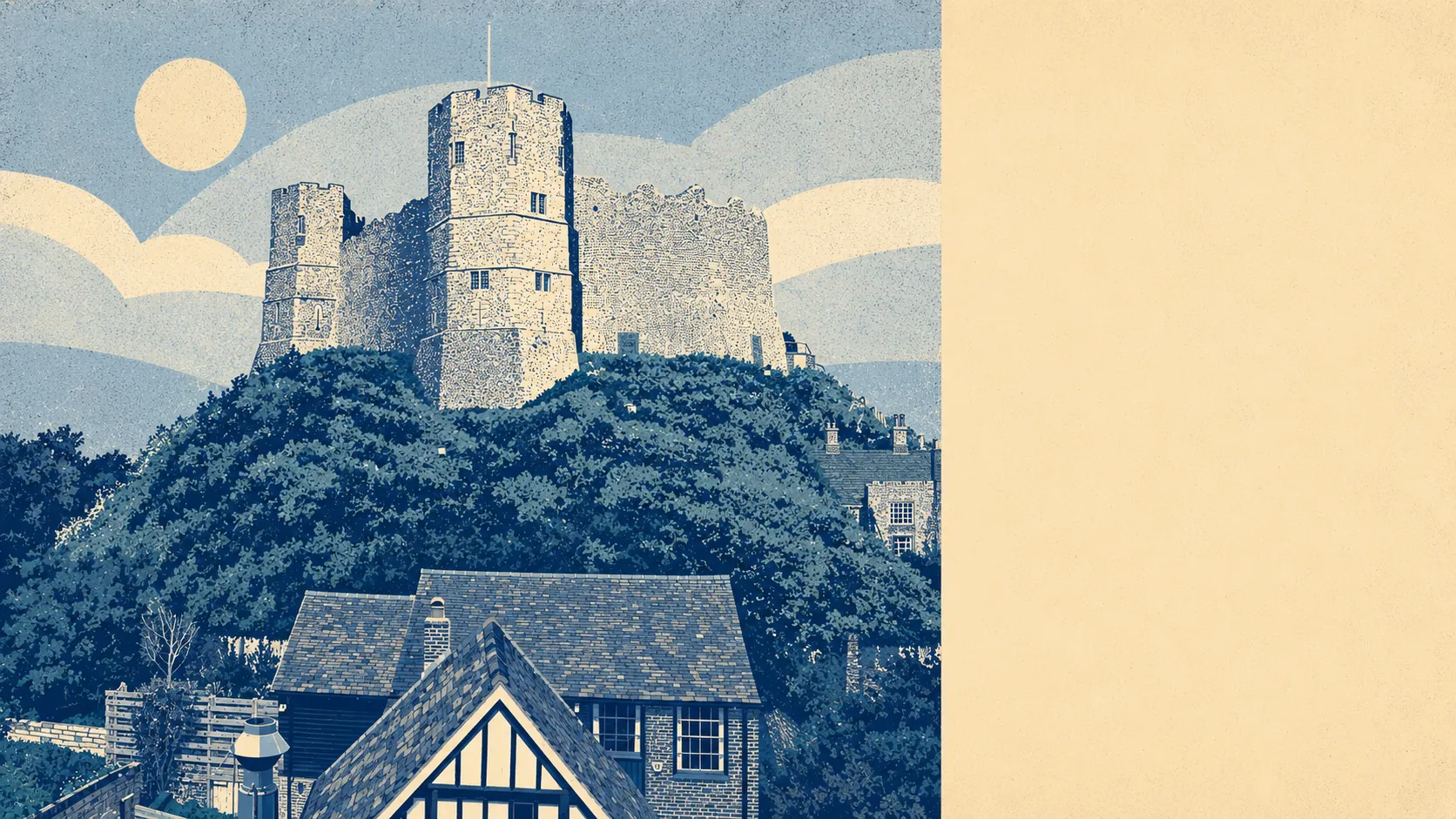
Lewes is Brighton for people who decided Brighton was beneath them. The median sale price runs to just under half a million. The average resident is forty-nine. Every November the town lights bonfires for seventeen Protestants burned at the stake here in the 1550s, because Lewes holds a grudge. The version of East Sussex that the rest of East Sussex secretly thinks it ought to be.
The housing stock is mostly houses. About seven in ten of everything, with fewer than one in five flats and a respectable bungalow showing for the retirement-curious. Around four in ten of those homes carry a decent energy efficiency rating. The other six in ten sit at band D or worse, with a quarter at band E or below, which on a January morning means the heating bill outpaces the council tax. The dominant era is post-war, which sounds dull until you remember the rest of Lewes was built between Domesday and the Industrial Revolution, and the post-war estates are the only flat ground anyone could find.
Buying here costs about £468,500 at the median. A terrace runs to about £430,000, a semi to £477,500, and a detached to about £730,000. Flats start at £240,000, which sounds reasonable until you see what £240,000 of flat looks like in Lewes. Most homes sit in council tax band C, with under one in five in bands A or B. The annual council tax bill runs from about £1,837 at band A to £2,756 at band D and £5,512 at band H, which is one of the larger arguments for putting your money into a smaller house.
The typical private rent across the Lewes area is about £1,320 a month, up roughly six percent in the last year. A one-bed averages around £920, a two-bed around £1,200, and a three-bed close to £1,500. By the standards of southern England this is not punishing. By the standards of someone who rented a two-bed here for £700 a decade ago, it is the kind of figure that earns a quiet snort.
The published crime rate sits at about sixty-seven incidents per thousand residents, roughly six percent below the local authority average. The kind of percentage that justifies neither smugness nor anxiety. Lewes is a market town where the cobbled streets and the South Downs both work as deterrents. Nothing happens on Keere Street that doesn't end up in someone's WhatsApp group.
Key Stage 2 maths attainment sits at 104.4, slightly above the expected standard, across about fifteen primary schools in the post-towns. Secondary attainment sits at 47.6 across three schools. Established primaries in the area include Wallands, Western Road, Southover, South Malling, and Iford and Kingston, with church schools at Firle, Hamsey, Plumpton and Ringmer. Priory School anchors the secondary picture in town, with Chailey School and King's Academy Ringmer in the surrounding parishes. Lewes Old Grammar School handles the private end. Four primary schools in the area have closed in recent years, which makes the surviving schools' admission criteria do more of the work. If catchment matters to you, the houses where it matters are priced accordingly.
Lewes Rail Station gets you to London in about an hour, which the town considers an acceptable price for not being in London. About forty-five percent of working residents work from home, three percent take the train daily, and just under forty percent drive. Cooksbridge, Glynde, Plumpton and Southease railway stations cover the surrounding parishes, so you can be carless in Rodmell or Hamsey if you commit to the schedule. Broadband is mostly fine. About nine in ten postcodes can get superfast connections, though only about four in ten can get gigabit. Fewer than one in a hundred falls below the universal service obligation.
The South Downs are right there. Greenspaces sit on average within about 340 metres of your front door, with around fifteen of them inside a kilometre. Blue space is closer still, around 275 metres on average, because the River Ouse runs through the middle of the place. The Ouse is the reason for the second thing you need to know. About one postcode in eight here carries some level of high flood risk, with around seven percent of the area sitting in the Environment Agency's highest flood zone. About a tenth of the area has historic flooding on record. In October 2000 Lewes was the most severely affected location in England. If you buy a riverside cottage and tell your insurer you didn't know, you are going to have a conversation.
This is where the romance gets expensive. There are 1,603 listed buildings across the area, including 38 at the most-protected Grade I and 76 at Grade II-starred. There are 39 conservation areas and 129 scheduled monuments. If you want to put a glass extension on the back of your Georgian townhouse, the planning officer will explain why the answer is no using sentences that start with the year 1538. Even the twittens, the medieval alleyways that thread through the centre, are protected. Lewes records the lowest score on this report for the freedom to extend or alter your home. If you bought it to renovate it, buy a different one.
About seven in ten households own their homes. The median household income is around £64,000, meaningfully above the regional average and a strong signal that whatever else Lewes is, it is not struggling. Around three in ten households are single people. Single pensioners make up about one in six. Couples with kids account for about one in five. Roughly 45 percent of working-age residents hold a degree and 12 percent hold no qualifications. The deprivation index sits in decile seven out of ten, which is the comfortable end. The trend, though, is a touch worse than it was in 2019, which is the polite way of saying even Lewes is not insulated from the country it sits inside.
This answer also covers the surrounding parishes that Lewes commuters and weekend ramblers know by name. Beddingham, Chailey, East Chiltington, East Hoathly with Halland, Firle, Glynde, Hamsey, Iford, Kingston near Lewes, Laughton, Plumpton, Rodmell and Southease. The parish villages have stronger green credentials, fewer choices for evening drinks, and significantly more sheep. The town has the festival, the brewery and the cinema. Most residents settle into a pattern of choosing one or the other depending on the weather.
Lewes suits people who want a market town with opinions, somewhere within striking distance of London but committed enough to the South Downs that commuting is an event rather than a daily defeat. It suits households with one travelling income and two working-from-home incomes. It suits anyone who reads. It suits a buyer who can absorb a £468,500 sale price, a house that costs more to heat than they expected, and a council that will object to their conservatory in writing.
It is a poor fit for someone who needs cheap. It is a poor fit for the daily London commuter who wants forty minutes door to door. It is a poor fit for the buyer who wants to gut the place and start fresh, because the planning regime will explain the limits of that fantasy at length. It is a poor fit for the household that thinks bonfire night should involve sparklers. And it is a poor fit for anyone who has decided Brighton or Tunbridge Wells is the version of South-East England they want, because Lewes is not pretending to be either.
The list of historic residents is short and unusually loud. Thomas Paine spent six years here from 1768, working as an excise officer and lodging at Bull House on the High Street before emigrating to America. The Rolling Stones drummer Charlie Watts lived nearby. The geologist Gideon Mantell practised in Lewes. Daisy Ashford, who wrote The Young Visiters at the age of nine, was raised here. The radical tradition that Paine joined runs straight through to the present, which is what the bonfire is really about. Lewes attracts people who think they have something to say.
Overall, Lewes scores three out of five on this report, which is the average grade. Its strongest dimension is the surrounding area and green space, where it lands four and a half out of five. Its weakest is the freedom to alter your own home, where it lands one out of five. The verdict is the gap between those two scores. You are buying a setting, a heritage, a brewery, a station and a town with views. You are not buying flexibility. If those terms read as a worthwhile trade, Lewes will agree with you for years. If they read as someone else's idea of a good time, there are other towns. Don't move to one and tell yourself it's Lewes.