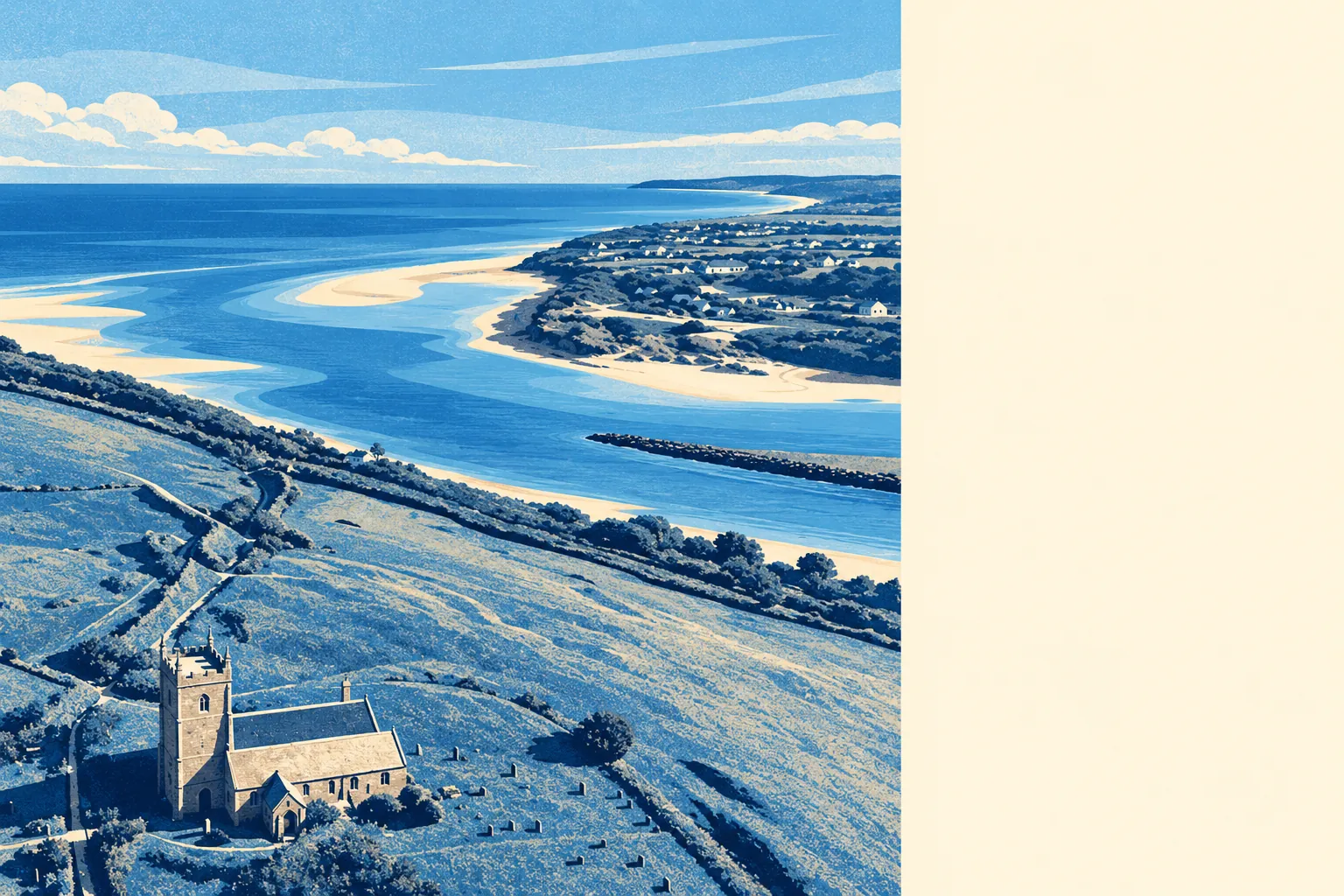
Open, tidal and outnumbered by visitors. Water sits closer to most front doors than the nearest shop does. Green space starts where the lanes run out. The surrounding district carries more holiday lets than it does shops. This is a place where the countryside is the amenity, and the towns next door are expected to supply everything else.
Green space is genuinely close rather than technically close. The typical address has about four separate green spaces within a kilometre, with the nearest averaging around 250 metres away. That is a two-minute proposition rather than a weekend expedition, and it is the single most reliable thing about living here.
Water is closer still. Blue space averages roughly 175 metres from the typical postcode, with something in the order of 93 separate points of water access within a kilometre. A figure like that only appears where a settlement is wrapped around a tidal shoreline, and it explains most of why people put up with everything else on the list.
Cycling is less generous. The National Cycle Network runs about 830 metres from the average postcode, and no part of the area falls inside the close-access threshold, so getting onto it involves a stretch of ordinary road first. There is no ancient woodland recorded here at all, which in a county of scoured coastline and open downland is unsurprising rather than damning.
On amenities, the wider district's rating list holds 371 shops, 38 restaurants and 32 pubs, alongside 139 offices. It also holds 1,946 holiday lets. Those are rateable premises rather than a guarantee that each is currently trading, but the shape of the list tells you who the local economy is built around, and it is not the people paying council tax. Lelant's own immediate area accounts for 45 rateable premises in total, which is the correct size for a village that has never wanted to be a high street.
Air quality is clean by the measures available. Fine-particle pollution across the Cornwall council area averaged about 5 micrograms per cubic metre in 2024, a council-wide figure rather than a reading taken at the end of your road.
The character comes from what sits around the edges. Lelant Downs rises behind the village, The Towans stretch away along the coast, and Trencrom Castle, a hilltop enclosure with Iron Age defences, occupies the high ground inland. Knill's Monument stands on Worvas above St Ives, which is the direction most people drift for an evening out, with Carbis Bay in between and the Barbara Hepworth Sculpture Garden among the reasons to bother. Hayle and St Erth handle the practical end of life. It is a village that outsources its entertainment and keeps the view.
Private outdoor space is the part nobody quantifies and everyone wants. Gardens here run to roughly 278,000 square metres per 1,000 residents, which is a genuinely large amount of private ground, and it reflects a stock built at bungalow-and-detached density rather than terraced density.
Eating out is a small sample with a perfect record: all four rated food premises in the area hold the top hygiene score, and none sit at the bottom of the scale. Four is not a restaurant scene, but the ones here are doing their paperwork properly.
Worth saying plainly: there is no national landscape designation over this area, no site of special scientific interest and no ancient woodland. The setting is not protected by a designation, it is protected by being mostly water, sand and farmland that nobody can build on easily.
The surroundings are the strongest part of the case for Lelant: water within a few hundred metres, green space at the end of the lane, gardens of a size most buyers have stopped expecting, and open country in three directions. The trade is that you will drive to almost everything else.