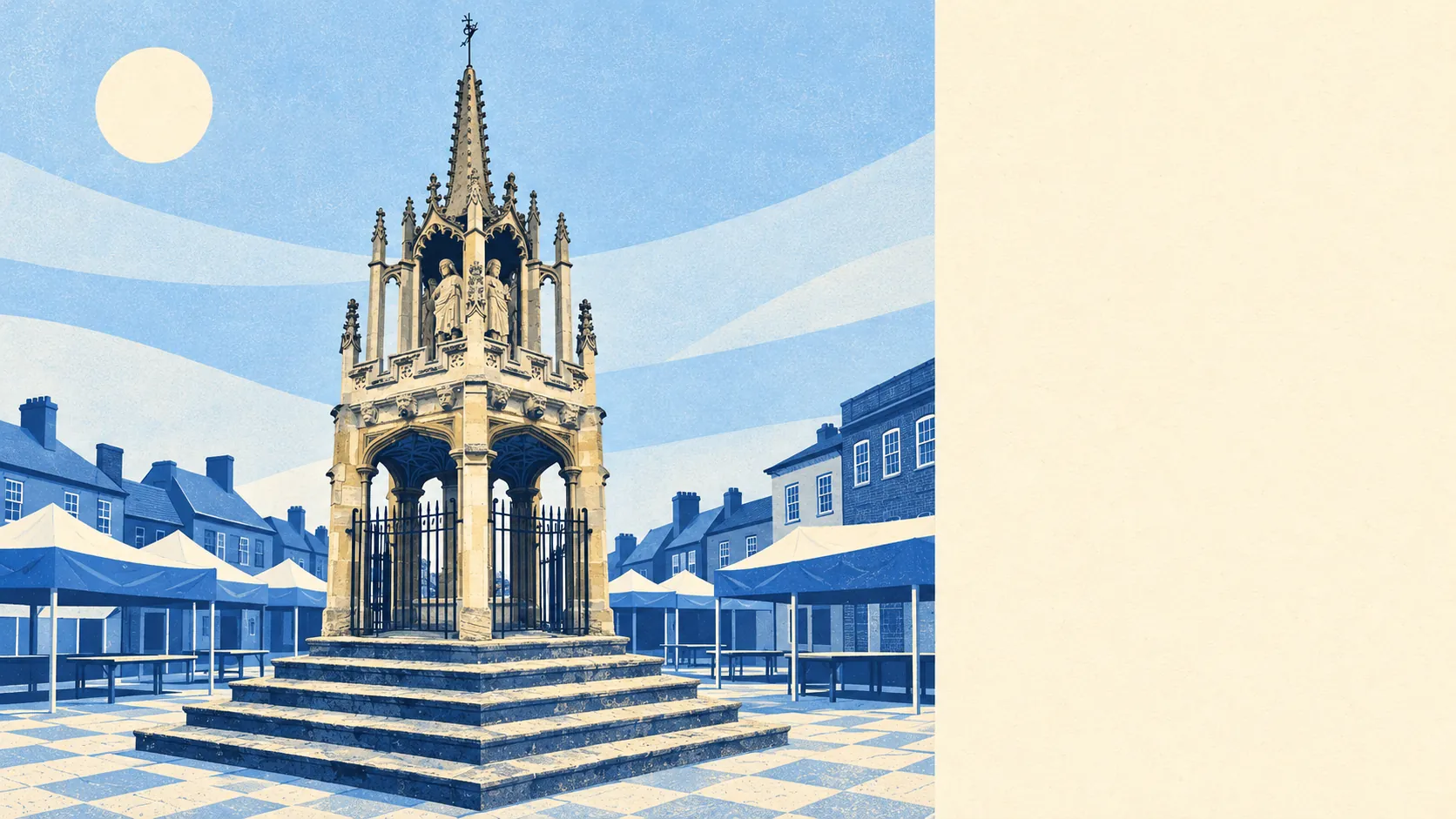
Leighton Buzzard gets most of the big things right and very little badly wrong. It is a working market town with a fast line to London, a ring of villages around it and a park or a towpath at the end of most roads. Seven in ten own their home. Plenty of residents see the station only a couple of times a week. Water is the weak spot, and it reaches some streets far more than others.
It is right for a family that needs three bedrooms, a garden and a short walk to grass, and can live with the drive or the train. The Land Registry's last twelve months, to May 2026, put the typical sale at about £336,000. Property type moves that a long way. Flats went for about £190,000, terraces for £311,000, semis for £365,500 and detached houses for £498,000. On Central Bedfordshire's valuation list Band C is the most common council tax band, with 28% of homes in Bands A or B. Most buyers here are climbing a ladder, and the rungs are wide apart.
Renting runs at about £1,240 a month in April 2026 across Central Bedfordshire, a council-wide mean from the Office for National Statistics index that covers Dunstable and a long list of villages as well as this town.
The council tax list splits the stock almost evenly. Terraces make up about 28%, semis 25%, detached houses 23%, flats 17% and bungalows 7%. Only 12% was built before 1930, so the period streets run out quickly once you leave the High Street, the Market Cross and the Alfred Waterhouse bank on Market Square. The biggest single slice of the certificated stock went up between the 1950s and the early 1980s, and 61% of homes with an energy certificate are rated C or better. Mains gas heats 81% of homes. Buyers who come for the Waterhouse frontage and expect the whole town to match will find a lot of honest post-war brick behind it.
Bedfordshire Police recorded crime at a published rate of about 68 per 1,000 residents in the year to May 2026, roughly 4% above the Central Bedfordshire average. The mix leans slightly towards what a market town with a busy centre attracts. Shoplifting is 10% of recorded crime against 8% across England and Wales, and vehicle crime 7% against 5%. Violence and sexual offences, the broad category that tops almost every list, comes in a little below the national share.
The town is middle-aged and comfortable. About 71% of households own their home, the median age is 40, and modelled gross household income came to about £67,500 a year in the financial year to March 2023, according to Office for National Statistics estimates averaged across the area. The Rothschilds bought the farmland west of town in 1873, built up Ascott House and still keep Southcourt Stud at Southcote. Everyone else makes do with a mortgage.
Leighton Buzzard station, over the Ouzel in Linslade, runs non-stop trains to Euston, and Cheddington is the fallback down the line. At the 2021 Census, though, only 3% of working residents went to work by train, 47% drove and 37% worked from home. Arriva's X2 and X3 use the Luton to Dunstable Busway towards Luton and Milton Keynes, and the town has 235 bus stops. Gigabit broadband reaches 76% of premises and superfast 98%. The Euston line is a big draw for a town where most people commute from the kitchen table.
Flooding is the topic that deserves the most attention. On the site's postcode indicators, which include surface water, 26% of postcodes carry high risk on at least one measure and about half carry some risk. The Environment Agency's river-and-sea flood zones look far smaller, with 1% in Flood Zone 3 and 3% in Zone 2. The gap is rainwater with nowhere to go, and 16% of postcodes fall under the Buckingham and River Ouzel Internal Drainage Board. The river map is the reassuring one, and the rain does not read it.
Heritage rules bite less than the old centre suggests. The town has 135 listed buildings, two of them Grade I and three Grade II*, and no conservation areas within its boundary, although Soulbury has one. If your house is not on the list, an extension is an ordinary planning application. The market charter dates from 1086 and the market still runs, so the town has had plenty of practice at changing without asking anyone.
Schools here follow the three-tier model, with lower schools such as Linslade Lower School and Leedon Lower School feeding upper schools such as Cedars Upper School and Vandyke Upper School. Ofsted has graded 52 of the 59 rated settings in the wider area good or better. The eight primary-phase schools counted in the town's postcodes average about 103 in Key Stage 2 maths, and the three secondaries average an Attainment 8 score of about 48. Since 2019 the council has given lower-school priority by distance to the nearest school, worked out by computer, and catchment zones were dropped by 2024. The computer measures from the front door, and charm does not shorten the distance.
The surroundings are where Leighton Buzzard pulls clear. The nearest green space is on average about 170 metres from home, with around 22 within a kilometre, and water, usually the Grand Union Canal or the Ouzel, is about 310 metres away. North of town, Heath and Reach puts countryside a short drive off. Villages such as Eggington, Stanbridge, Slapton, Stewkley and Mentmore sit within the same postcode for anyone who wants the fields closer still.
The town's best-known names tended to make their mark elsewhere. Edward Backwell became a goldsmith-banker and politician, Harry Brown ended up mayor of Perth in Western Australia, and Samuel Claridge settled the Muddy River Valley in Nevada.
The verdict is above average, earned by a lot of solid middles and one real strength. The green space and water within a few minutes' walk will shape daily life more than anything on this page. The flood picture is the cost, and it shows up on some streets and not others. Leighton Buzzard is right for families who want space, grass and a train they rarely catch. Buyers who want a period cottage, a lively evening or a home safely above the wet ground should look somewhere else.