Kentish Town is well connected, and at the last census most of its working residents weren't commuting anywhere at all. It has its own mainline station and an interchange with the Underground. Buses come about twenty an hour at peak. Gigabit broadband reaches almost every home. About six in ten households have no car, and most of them don't need one.
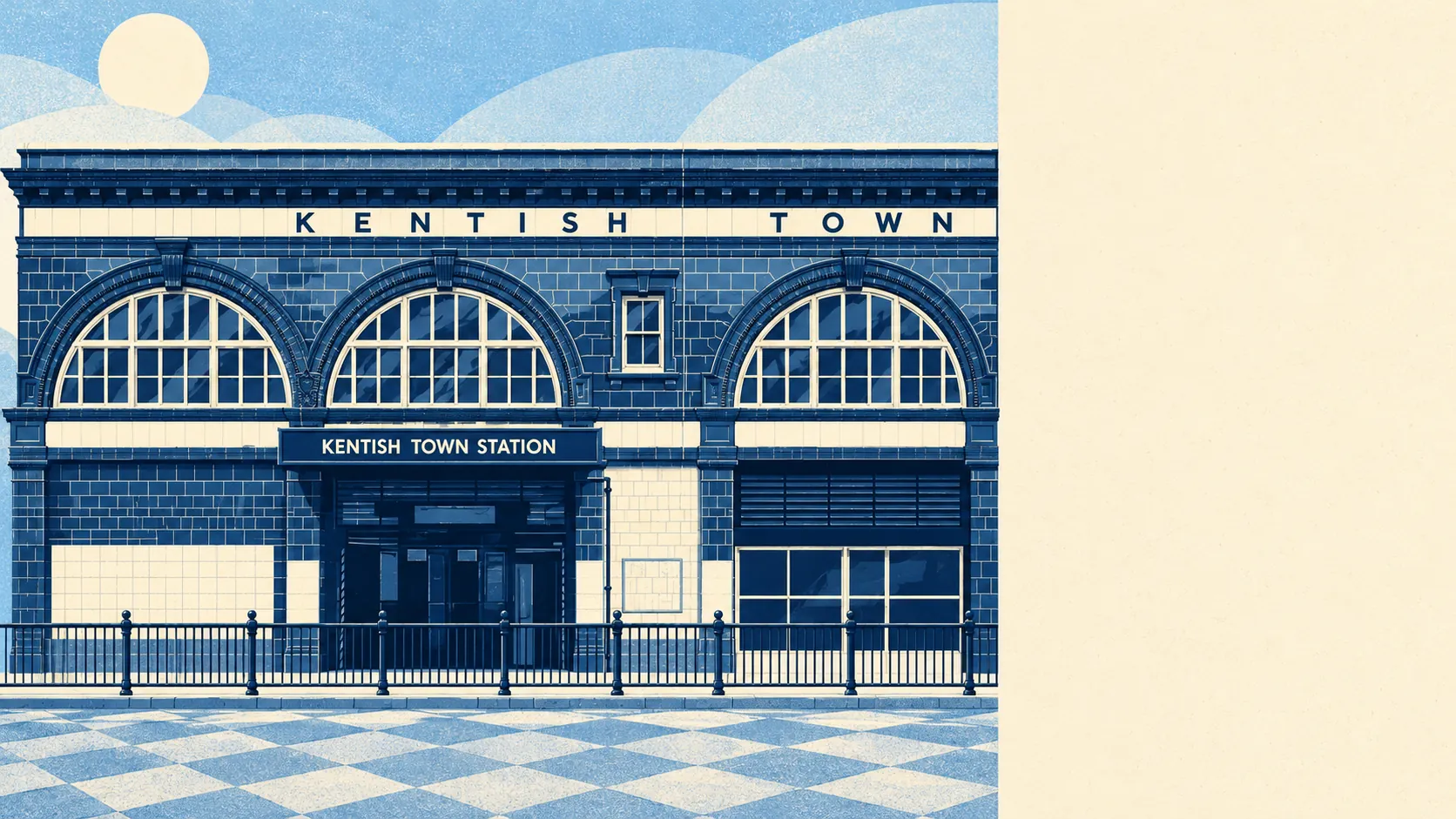
Kentish Town Rail Station has trains on the national network and an interchange with the Underground. Kentish Town West, Gospel Oak and Camden Road add more rail links within the area, and London St Pancras International, London Kings Cross and London Euston are close by. At the 2021 census only about 3% of working residents went to work by train, and about 7% took the bus, from 97 bus stops in and around the area. For a place with its own mainline station, more of its residents cycle to work than take the train.
The 2021 census showed how Kentish Town actually works. About 54% of working residents worked from home, about 11% walked to work, about 8% drove and about 6% cycled. About 61% of households have no car, and only about 6% have more than one. Kentish Town has the transport links and mostly manages without them.
Everything nearby is within easy reach. On the Department for Transport's modelled journey-time statistics, which date from 2019, the nearest town centre is about 8 minutes away by car, 9 by public transport, 8 by bike and 9 on foot. The same 2019 modelling puts a GP about 6 minutes' walk away, or 7 by car and 6 by public transport. A hospital is about 10 minutes by car and 16 by public transport, a food shop about 5 minutes' walk or 6 by car, and a place of work about 6 minutes by car or 8 by public transport. The distances in those figures don't change, but the public transport times are the least reliable of them, because services have changed since 2019.
The buses are frequent. Each stop averages about 376 scheduled departures on a weekday and about 20 an hour at peak, and every stop with service records also has buses at the weekend. These are current timetable figures, unlike the modelled journey times, and that level of frequency makes a timetable unnecessary.
The broadband is better than the trains are crowded. Gigabit-capable connections reach about 96% of Kentish Town's premises and superfast about 98%, and 0% fall below the legal minimum. Every network has 4G or 5G coverage across the whole area.
Noise is the cost of all that connection. About 17% of Kentish Town's postcodes are near or above 65 decibels of road noise, the level at which official noise mapping treats it as significant, and the loudest band recorded reaches 75 decibels. Rail noise is a separate and bigger source here, with about 36% of postcodes near or above 65 decibels from trains, also reaching 75. The Victorians bought up large amounts of land here to build the railway, and a third of today's postcodes still live alongside it. For any flat on your shortlist, find out which rooms face the tracks and visit once while the trains are running.
Kentish Town has 85 public charge points with 96 connectors between them, and none of them is rapid. Charging an electric car here is something you leave running overnight. A quick top-up while you shop isn't on offer.
In practice a typical working day here needs no car, and often no train either. Most things are within a short walk or bike ride, there are buses every few minutes for anything further, and the station is there when the city calls.
Kentish Town is well connected, better than average, and lets down only those who need rapid charging or quiet rooms on the railway side.