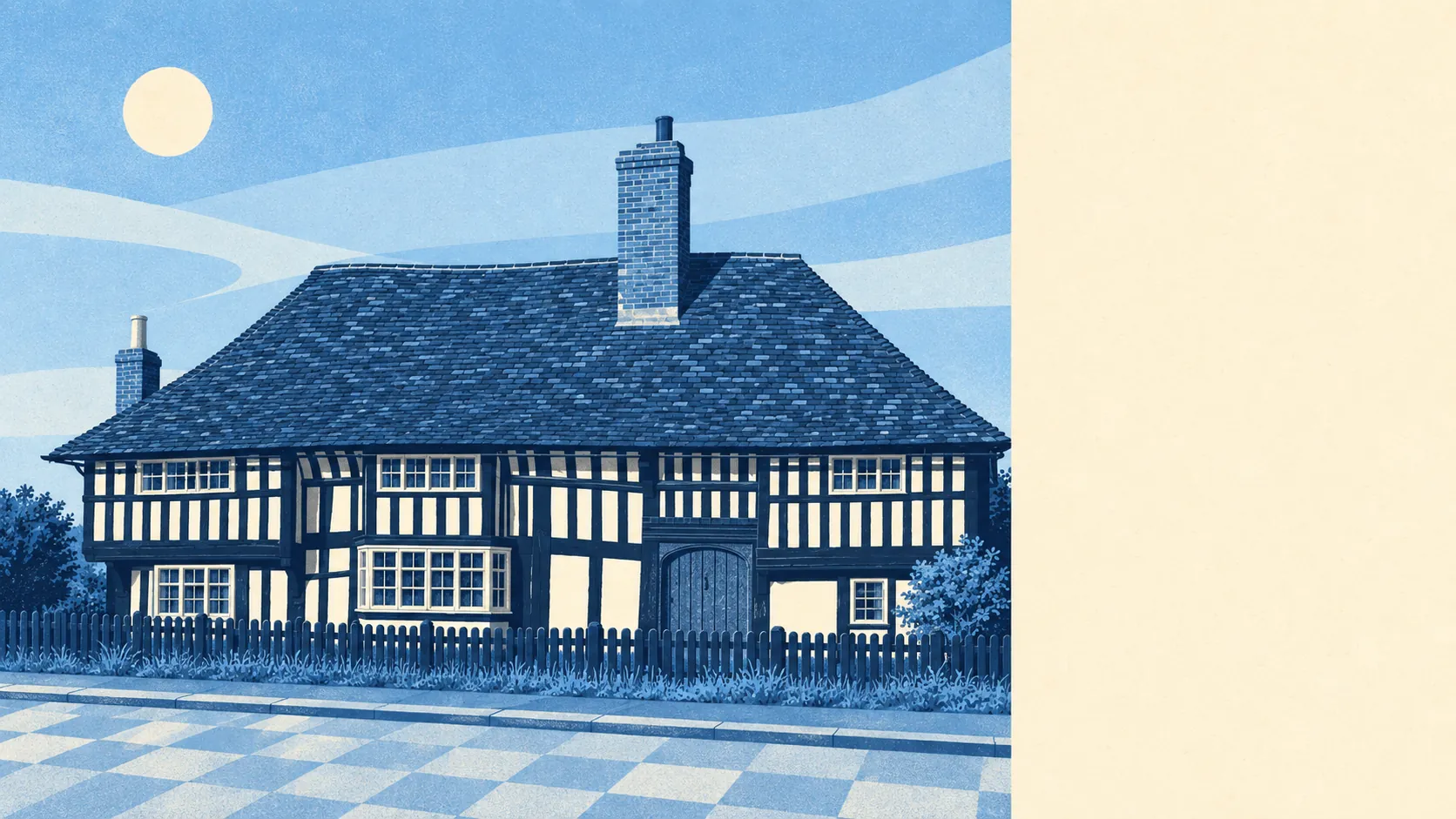
Harrietsham is a good place to live for anyone with a car and no extension plans. About three in four households own their home. Half of working residents drive to the job. The typical resident is nearly fifty. This is a village people settle into, not one they renovate their way out of.
The housing across the Harrietsham area is houses, and plenty of them detached. On the council-tax valuation list, which covers every dwelling rather than only the ones that have changed hands lately, 27% are detached, 25% semi-detached, 17% terraced, 12% bungalows and about 9% flats. A quarter were built before 1930. Bungalows outnumber flats, a ratio estate agents call village character and everyone else calls the retirement plan arriving early. On energy certificates, 54% of rated homes sit in bands A to C, 28% in band D and 18% in E or worse. Only 59% of homes are on mains gas and 5% rely on electric-only heating, so ask what heats the place before the oak beams do their work on you.
The Land Registry recorded 117 sales in the year to early May 2026, at a median of about £398,000. Detached homes went for around £555,000, semi-detached for £370,000 and terraces for £335,000. Flats managed six sales at a median of roughly £182,000, which is less a market than a rumour. Council tax sits most often in band C, and only 16% of homes are in bands A or B. Cheap council tax is not something this village does.
Renting is a thin option. Only 13% of households rent privately, so the choice of homes on any given week is short. The typical private rent across the Maidstone area was about £1,290 a month in April 2026, up 4% on a year earlier, and that is a borough-wide figure from the Office for National Statistics rather than a village one. Across the same borough, four-bedroom-plus homes averaged about £1,960 a month. Given what the housing stock here looks like, the bigger number is the one to budget against.
Recorded crime in the Harrietsham area ran at about 81 per 1,000 residents between June 2025 and May 2026, roughly 14% below the Maidstone average. Anti-social behaviour made up 23% of recorded incidents against 16% nationally, the category that fills the parish newsletter rather than the evening news. Kent Police charged in about 16% of cases over the same year against a national 12%, a force-wide figure rather than this village's own, but a reassuring one.
Schools are the strongest thing going. Ofsted has graded 221 of Kent's 245 rated settings good or better, 38 of them outstanding. Across the ten primary schools in the surrounding postcode districts, the average maths score at the end of primary school was about 104. Harrietsham Church of England Primary School sits in the village, with Lenham Primary School and The Lenham School nearby, and Invicta Grammar School and Queen Elizabeth's Grammar School are within the wider catchment conversation. The nearest primary is about eight minutes by car or 23 on foot. Secondary is a 49-minute walk, which turns parents into a taxi firm with one client.
Harrietsham Rail Station sits on the line between London Victoria, Maidstone East and Ashford International, and about 3% of working residents use a train to get to work. Around 52% drive and 36% work from home. The station is a comfort, like a fire extinguisher: good to have, rarely touched. The area has 93 bus stops averaging nine weekday departures each, and only 48% see a weekend service. Department for Transport modelling from 2019 puts the nearest town centre about 23 minutes away by car and 51 by public transport. Gigabit broadband reaches 53% of premises, superfast 82%, and about 2% fall below the legal minimum service. Mobile coverage from all four operators reaches about 98%.
On flood risk, 6% of postcodes carry a high rating on at least one indicator including surface water. In the Environment Agency's river-and-sea flood zones, about 1% of postcodes fall in zone 2 and none in zone 3. The River Len runs through the village south of the M20, and a surface-water check on any specific address is worth the ten minutes. The Kent Downs Area of Outstanding Natural Beauty covers about 32% of the area, and the average home is roughly 560 metres from public green space. The Marley works on the eastern side and the M20, High Speed 1 and A20 corridor are the other half of the scenery, and no listing photo will frame them.
The heritage count is where ambitions go to be politely refused. The wider area holds 520 listed buildings, 14 of them Grade I and 33 Grade II*, including Bell Farm House on East Street and the Church of St John the Baptist in the village itself. There are four conservation areas in the surrounding patch, at Bredgar, Doddington and Newnham, Kingsdown and Milstead, and the Downs designation layers another set of rules on top. A glass-box kitchen extension here is less a building project than a correspondence course.
About 75% of households own their home, the median age is 49 and median household income was about £60,000 in the financial year to March 2023, a gross figure modelled by the Office for National Statistics. The area's position on the national deprivation index slipped between the 2019 and 2025 editions, which the parish's comfortable income and home-ownership figures do not immediately suggest. This page also covers Hollingbourne, Kingswood and Lenham, and the figures above describe Harrietsham and those surrounding villages together.
Harrietsham suits buyers who want a family house with a garden near good schools, drive to work or work from home, and are happy to buy a home in roughly the shape they want to keep it. Couples trading up from a Maidstone terrace for a detached house on the edge of the Downs will find the arithmetic works in their favour.
It does not suit anyone whose plans start with a rail season ticket and no car, anyone who needs a flat, or anyone whose dream home currently exists only as an architect's sketch. Buyers who want an evening bus back from town will find the timetable writes its own verdict.
Harrietsham is above average, and the reasons are specific. Its real strength is schools, with Kent's grading record and a primary in the village doing the job. The weak spot is the freedom to extend or alter a home, hemmed in by listings, conservation areas and the Downs. Buy the house you want, not the one you plan to turn it into.