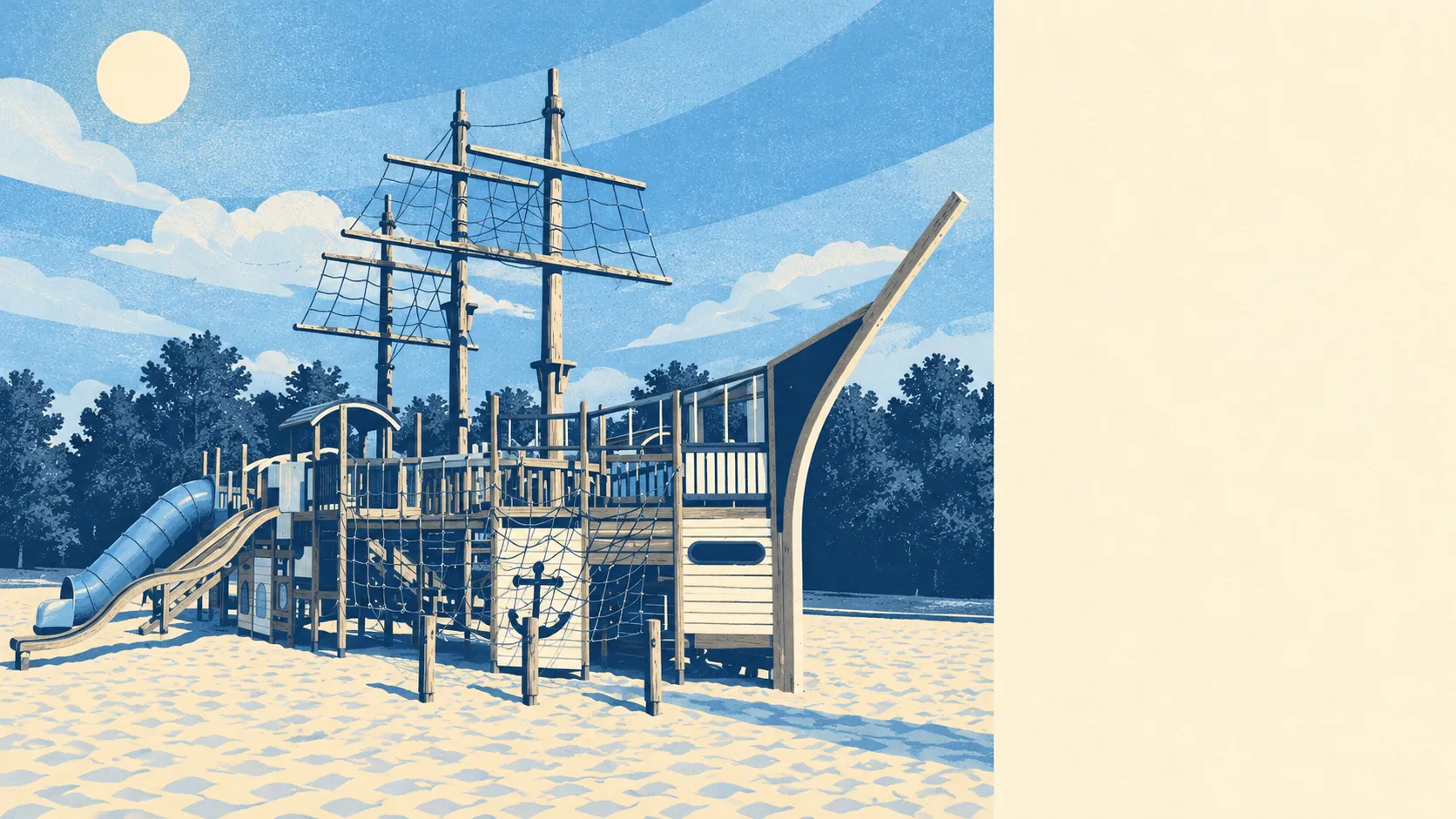
Grays has more green space on its doorstep than most people would guess about a Thames-side town. The nearest park is about two minutes' walk from the average front door. A couple of dozen green spaces lie within a kilometre. The river is a short walk further on. People think of Grays as being near Lakeside, and the people who live here think of it as being near a park.
Across the town, the average home is about 150 metres from the nearest public green space, with about 23 green spaces within a kilometre. That covers parks, playing fields and pocket greens, and in a town this built-up, most streets are close to more than one.
Water is a little further. The nearest blue space averages about 640 metres away, and about 18 bodies of water lie within a kilometre of the average home. The riverside runs from houses through marshland where wild birds live to wharves and storage yards, and it looks across the Thames at Broadness Lighthouse in Kent. The best view from the Grays bank of the river is a lighthouse on the opposite one.
The National Cycle Network is about 560 metres from the average home, and about 45% of postcodes are close to a route. The bike is there for anyone who wants it.
The rated-premises records count 697 shops in the Grays postcodes, along with 27 pubs and 48 restaurants. Shops far outnumber places to eat or drink, and the town's daytime business shows in its high street. The biggest shopping centre in the borough is at Lakeside in West Thurrock, so Grays town centre is the alternative for an everyday shop.
Fine-particle air pollution across Thurrock averaged about 8 micrograms per cubic metre in 2024, a figure that covers the whole council area including its ports and roads.
The town's character is part working river and part county town. Grays Beach and the view from the top of the Derby Road Bridge face the water. Inland are the Thameside Theatre, the only theatre in Thurrock, the Thurrock History Museum, The White Hart and the former State Cinema. The town also covers the village of Orsett to the north-east and the Southfields area, where the Grays suburbs give way to fields. For a town that hosts the borough's administrative offices, the Thurrock History Museum is a reminder that the place had a past before the paperwork.
Most residents also have a garden of their own. Across the town's neighbourhoods there are about 71,900 square metres of private garden for every 1,000 residents, the result of a housing stock built mostly as houses with plots. Combined with a park within a short walk, that gives most households two kinds of outdoor space.
The business rates list holds 940 premises in the area. The largest group is 333 shops, followed by 151 offices, 77 warehouses and 74 industrial units. These are premises on the valuation list, so some may be empty. Warehouses still feature prominently, as you would expect for a town with port trade nearby.
Of the 212 food outlets inspected for hygiene, about 56% hold the top score of five and about 4% sit at the bottom of the scale. A pool that size covers a few streets of takeaways and cafés, and most of them are doing the basics properly.
The area has no protected-landscape designations: no area of outstanding natural beauty, no site of special scientific interest, and no ancient woodland. The green space in Grays is parks and playing fields rather than protected countryside, and it is much closer to people's homes.
The surroundings are one of the strongest features of Grays. Most homes have a garden, a park within a few minutes' walk, and the river close by.