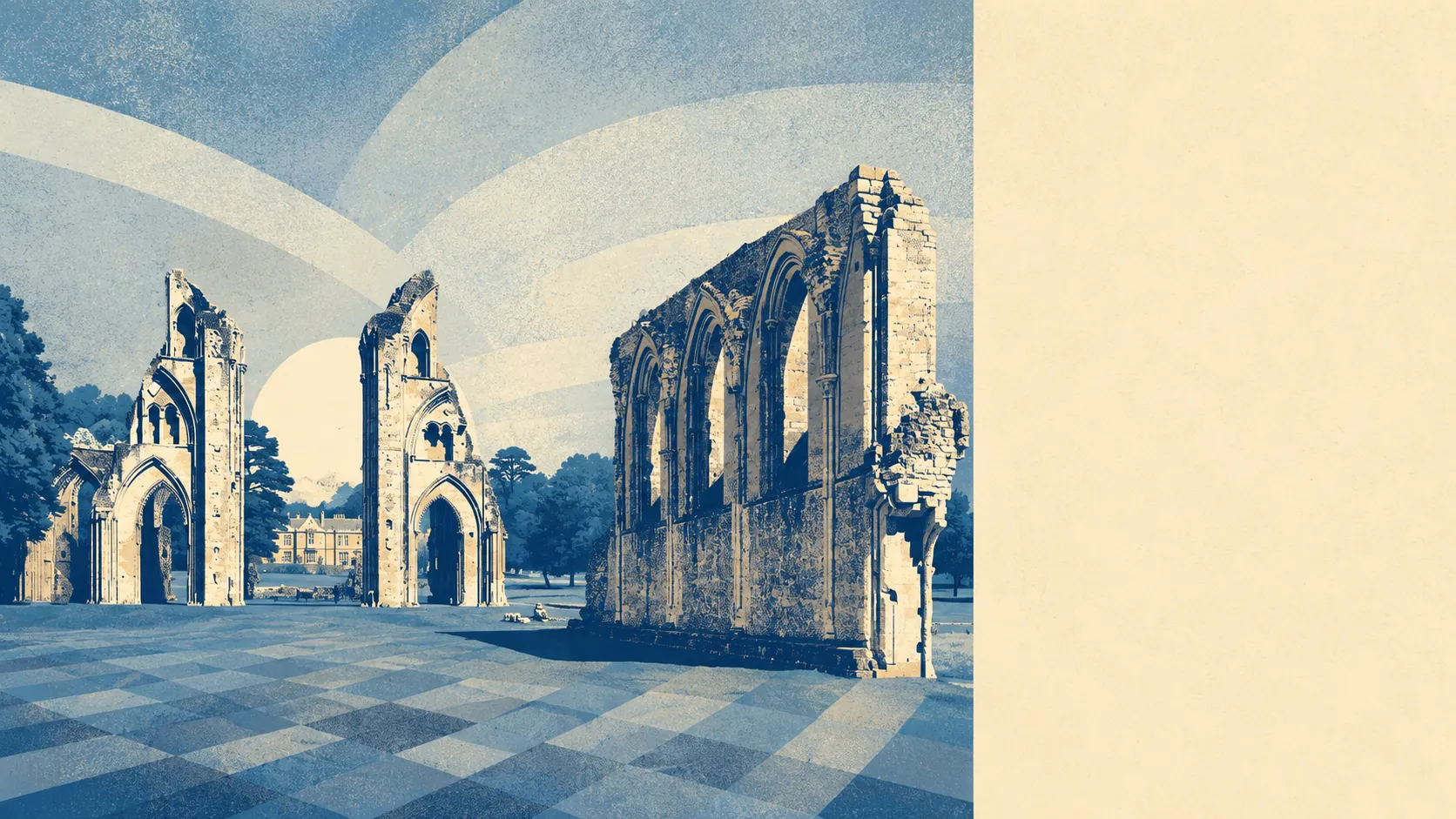
Yes, unless you bought one of the interesting ones. Most of the town is ordinary later housing where the usual rules apply and a rear extension is a conversation with a builder rather than a committee. The historic core runs on a different regime altogether. Listed frontages, a conservation boundary and scheduled monuments all sit within a few minutes' walk of each other. A town that spent a thousand years building things worth protecting now has to ask permission before touching any of them.
There are 157 listed buildings in Glastonbury. Nine hold grade one, eight are grade two star, and the remaining 140 are grade two. That last tier is where most buyers actually collide with the system, because grade two is the one ordinary people can afford to buy. Listing covers the whole building rather than the pretty side facing the street, so consent can be needed for internal walls, staircases, windows, doors and roof coverings as well as anything bolted to the outside. Replacing rotten sash windows with something double-glazed and sensible is exactly the sort of job that turns into an application, and occasionally into a refusal.
One conservation area covers the town's historic centre. Designation does not freeze a building, but it does trim back some of the permitted development rights that apply elsewhere, and it brings demolition and work to trees within the boundary into the consent regime. The practical effect is that the same extension drawing can be routine on one street and a full application two streets over, with nothing visible on the ground to explain why.
Six scheduled monuments sit in and around the town. This is the strictest tier of protection in the system and it applies to the monument and its setting rather than to houses, so for most buyers it matters only if the plot backs onto one. If yours does, the consent regime is separate from planning permission and considerably less flexible.
The live evidence says people build here anyway. Somerset's planning register recorded 531 applications across the area between April 2024 and June 2026, of which 252 came in during the most recent twelve months. That is a town actively altering itself, not one frozen behind a heritage cordon. Extensions, conversions and the general business of making old houses work for modern life are all happening at a steady rate.
The practical sequence is the same one people skip and then regret. Establish before you make an offer whether the property is listed, whether it sits inside the conservation boundary, and whether either applies to an outbuilding or wall you were planning to remove. Outside those constraints, the standard permitted development rules do the heavy work and most single-storey rear extensions never trouble a planning officer. Inside them, assume consent is required, assume the process takes time, and assume the answer to uPVC is no. An architect who has worked in the town before is worth more than one who has not, for reasons that become obvious at the first pre-application meeting.
Freedom to alter a home here comes out middling, which is the honest position for a town with this much history and this much ordinary housing around it. Buy in the newer stock and you have the same latitude as anywhere in Somerset. Buy something with a date on it and you have bought a building the country has an opinion about.