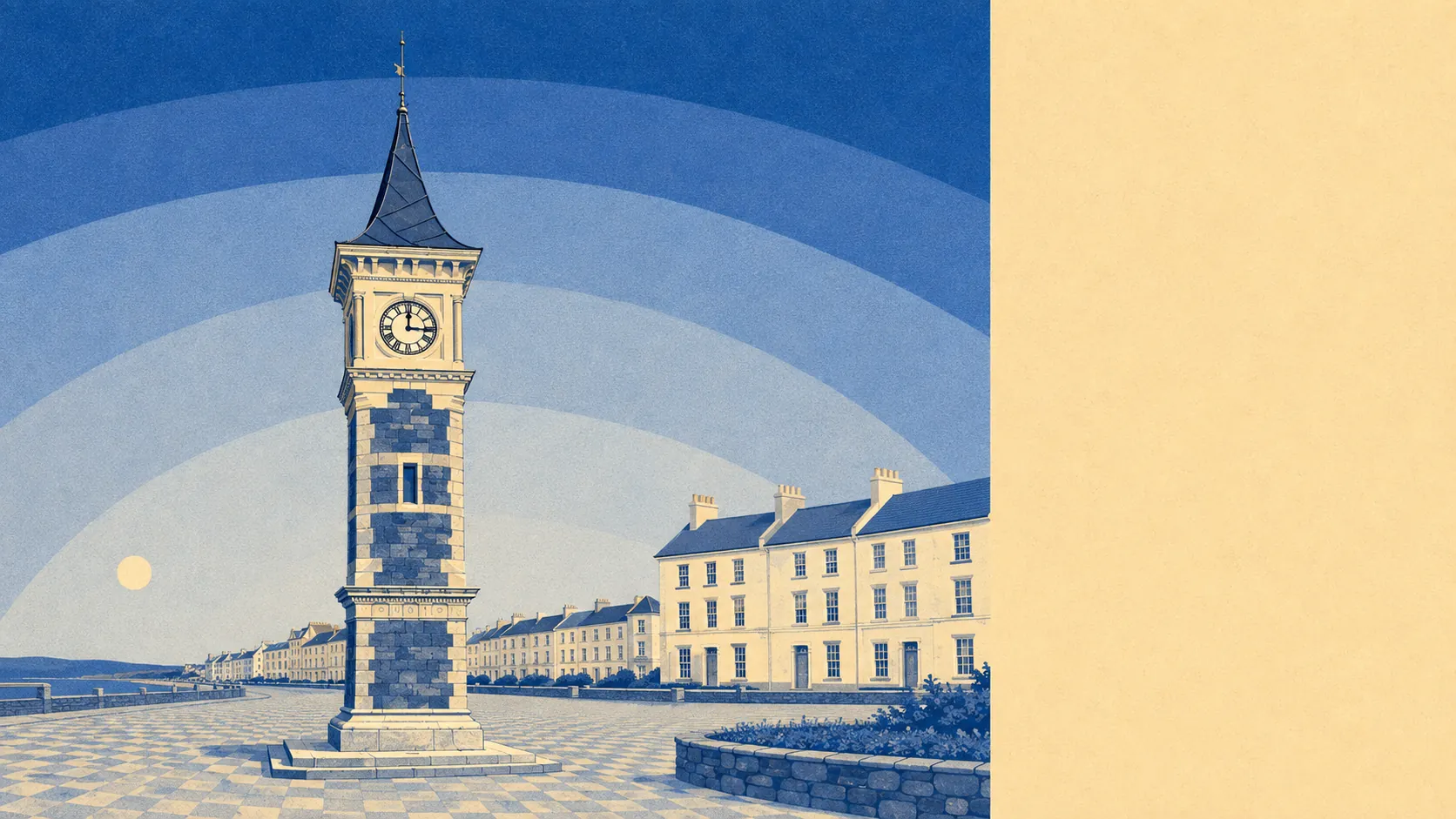
Yes, and the catch is underfoot. The lower town stands on mudflats the estuary used to own, reclaimed a bit at a time, and buildings down there still pump water out of their basements when the tide is high. Seven in ten households own. The typical resident is fifty. A quarter work from home. This is not a resort with a town attached to it. It is a town that happens to have two miles of beach in front of it.
The housing is more mixed than the seafront suggests. Counted across every dwelling on the council tax valuation list, rather than only the ones certificated since 2008, flats make up 26% of the stock, terraces 24%, semis 18%, detached houses 17% and bungalows 15%. Around 26% went up before 1930 and only 5% between 2000 and 2008, so the Victorian streets climbing the Beacon sit alongside a thick band of post-war building and very little that is genuinely new. Mains gas heats 79% of homes and 9% run on electricity alone. Energy ratings split almost down the middle: half the certificated stock sits in bands A to C, 39% in band D, and 12% at band E or worse. An electric-only flat in a converted period house is the version of Exmouth that looks cheap in June and stops looking cheap in January.
The Land Registry recorded 446 sales in the twelve months to late May 2026, at a median of about £314,000. Underneath that, the ladder has real rungs: flats around £182,000, terraces £260,000, semis £323,000, detached houses £465,000. Council tax lands most often in band C, with 34% of dwellings in bands A or B, which is a gentler bill than the seafront postcards imply. The wider House Price Index put the average at about £344,000 in May 2026, flat over the year at down 0.1%, and up 15% across five years.
Renting is measured across the whole East Devon area rather than Exmouth alone, and the typical private rent there was about £970 a month as of April 2026, up 7% over the year. By size, that runs to roughly £900 for a two-bed and £1,120 for a three-bed. Treat it as the district's temperature, not the town's own reading.
On safety, the published rate is 63 recorded crimes per 1,000 residents for the twelve months to May 2026, roughly 27% above the East Devon average of 50. East Devon is mostly villages, and Exmouth is the place with the pubs, the bus station and the Saturday night, so it carries the district's numbers on its own shoulders. Violence and sexual offences account for 46% of recorded crime against 35% across England and Wales, though that heading is a broad statutory grouping that sweeps in common assault without injury. Devon and Cornwall Police charged in 8% of cases against 12% nationally, which is a force figure rather than a local one, and not a comforting one either way.
Schools are the strongest thing in the file. Ofsted has graded 172 settings across Devon, of which 138 are good or better and three are outstanding, with 31 requiring improvement. The maths score for eleven-year-olds averaged 102.4 across the nine primaries in the district, among them Withycombe Raleigh, Marpool, Brixington Primary Academy and Littleham. Exmouth Community College is the only secondary, with an Attainment 8 score of 46.1, and it absorbs the lot. The Deaf Academy took over the old Rolle College site and moved down from Exeter, which is a quietly unusual thing for a town this size to have. A primary is about nine minutes' walk away on average, the secondary twenty-two.
Exmouth Rail Station is the end of the Avocet Line into Exeter, and 1% of working residents use it. Half the town drives to work, 12% walk, 3% take the bus and 24% never leave the house. There are 243 bus stops, averaging 51 weekday departures each, and 227 of the 228 with published timetables run at weekends too. Broadband is a non-issue: gigabit connections reach 96% of premises, superfast 99%, and 0.1% sit below the universal service minimum. The town centre is nine minutes by car, the main employment centre twelve.
Water is the thing to read carefully, because two different measures both apply. On the postcode indicators, which include surface water, 24% of postcodes carry a high rating on at least one, 18% medium and 35% low. Separately, on the Environment Agency's river-and-sea mapping, 16% of the area sits in flood zone 3 and 1% in zone 2. Eighty flood events have been recorded, the most recent in February 2014, from the sea, by overtopping of defences. The shoreline policy is to hold the line. Against that, the green side is excellent: green space averages 155 metres away with about 24 patches within a kilometre, open water 312 metres, and the East Devon Area of Outstanding Natural Beauty clips 2.5% of the area. Radon sits in the lowest band and there is no coal history to worry about.
Heritage constraints are moderate. There are 173 listed buildings, three at Grade I including A La Ronde, five at Grade II star and 165 at Grade II, plus one scheduled monument and two conservation areas covering Exmouth and Lympstone. Outside those boundaries you can get on with your windows. Inside them, the council received 365 planning applications in the last twelve months, and a fair number of those people found out what a conservation area thinks about a rear extension.
The character follows from the ownership and the age. Seven in ten households own, the median age is fifty, and household income ran to about £53,000 gross in the financial year to March 2023. A third of households are single people and 18% are pensioners living alone. Deprivation sat in the 6.2 decile in 2025, down from 6.8 in 2019, so the trajectory is the wrong way even if the level is comfortable. This page also covers Lympstone, up the estuary with its own conservation area, and Kenton and Starcross on the far bank.
It suits people who want a town that works in February. Somewhere with schools, shops, a station and water on two sides, at prices that would buy a garage in the places people compare it to. It suits downsizers, remote workers and families who want the secondary school question answered once and then dropped.
It does not suit anyone who wants a quiet resort. Exmouth is the district's centre of gravity, with the crime figures that go with being the place everyone else drives to on a Friday. And it does not suit buyers who will not read a flood map before they read a floor plan.
The history is stranger than the seafront lets on. Lady Nelson, whose husband found other arrangements, is buried at Littleham. Jane and Mary Parminter came home from a European tour in 1796 and built a sixteen-sided house lined with shells, which is what happens when nobody says no. The painter Francis Danby and the poet Patricia Beer both belong to the place too. It has always attracted people who wanted the sea and their own terms.
Exmouth earns its keep. Its real strength is what surrounds it, the green space, the estuary and the coast path all within a few minutes of the front door, backed by schools that hold up. The weak spot is flood risk, and it is not a technicality: it decides which streets are a bargain and which are a long conversation with an insurer. Buy on the high ground and this is one of the better-value towns on the south coast. Buy on the flat without checking, and the estuary will eventually remind you whose land it was.