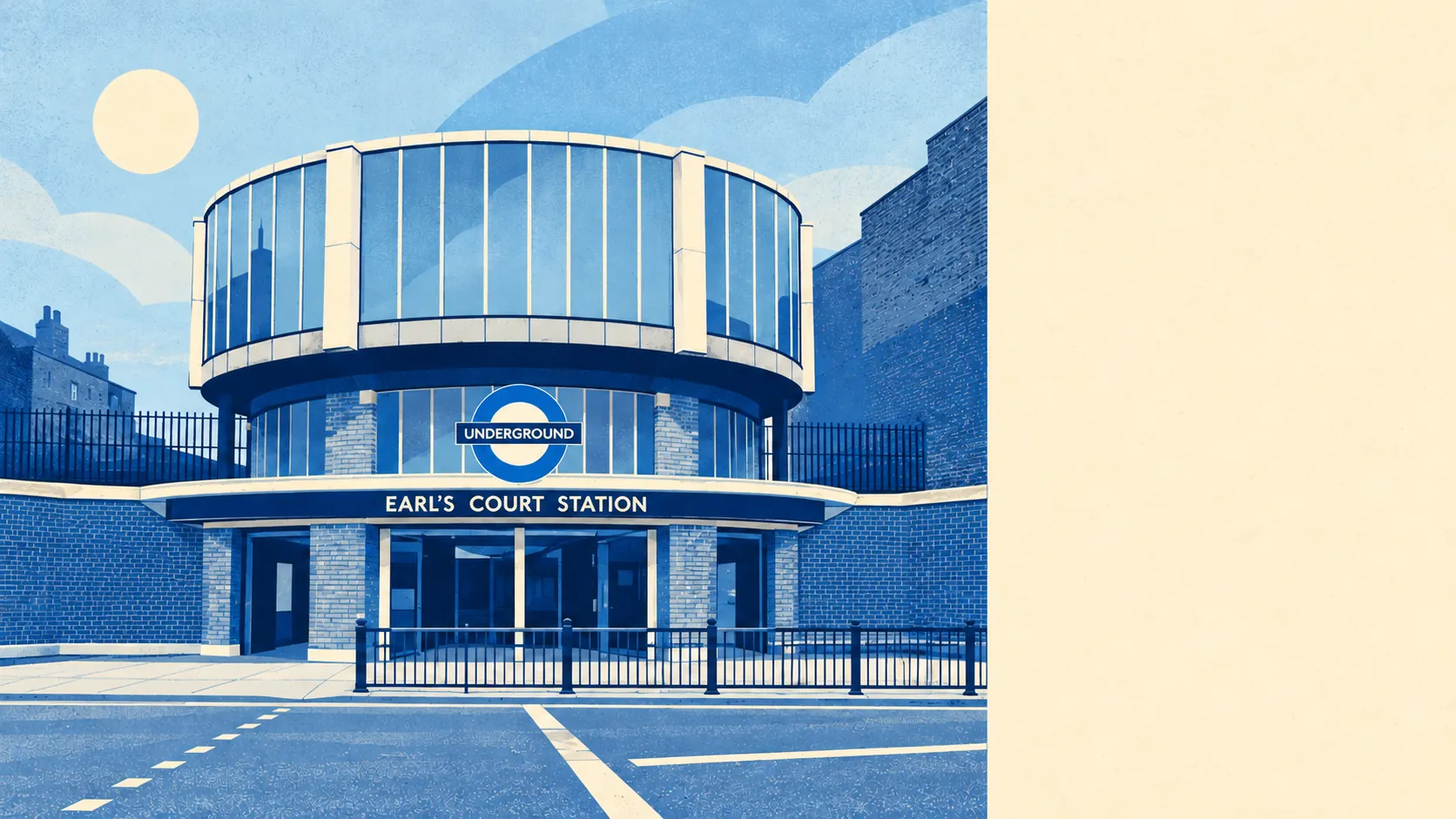
The area around Earl's Court is greener than a district this crowded has any right to be. There is a patch of green space a couple of minutes from almost every front door. Most of what lines the streets is shops and restaurants, with few pubs. Very few people have a garden of their own. A park within a few minutes' walk is how the neighbourhood makes up for it.
On average, the nearest green space is about 95 metres from an Earl's Court home, and about 41 green spaces are within a kilometre. Holland Park and Kensington Gardens are within reach, and Brompton Cemetery and The Boltons are closer still. For a district built almost entirely of flats, that is a lot of grass.
The nearest open water is about 540 metres away on average, and about five bodies of water are within a kilometre. None of them is a feature of the place. Earl's Court's own stream, Counter's Creek, was dug into a canal from 1826 and then lost to the railway.
The National Cycle Network is about 1.6 kilometres away on average, and no postcode in Earl's Court is close to it. None of the area is ancient woodland. Getting out here means the parks.
The premises rated for food and drink and trade in Earl's Court include 149 shops, 48 restaurants and nine pubs. Of the 148 food outlets with a hygiene rating, about 86% hold the top score, and none are rated low. The district eats out a good deal more than it drinks, and it is fussy about the kitchen.
Fine-particle air pollution across Kensington and Chelsea averaged about 9.4 micrograms per cubic metre in 2024.
The character is Victorian and tightly packed. Tall terraces have been divided into flats, and Old Brompton Road and Cromwell Road frame the district. Earl's Court lent its name to pleasure grounds that opened in 1887 and later to an exhibition centre and arena, which closed in 2014. To the east, the Natural History Museum, the Victoria and Albert Museum and the Royal Albert Hall are near enough to count as local. Few London neighbourhoods have a museum quarter next door.
Private outdoor space is scarce. Gardens in Earl's Court add up to about 10,900 square metres for every 1,000 residents, which is a balcony and a shared lawn for most people. Some flats come with a key to a communal garden square and many don't. Ask whether the flat you are looking at has one, because that key changes daily life more than any park on the map.
The valuation list for Earl's Court holds 436 rateable premises. Shops are the biggest group at 149, followed by 75 offices and 48 restaurants. These are premises on the council's rating list, so a count is not the same as a door that opens every morning. The mix still shows what the high streets are made of.
Of the 148 food premises with a hygiene rating here, about 86% have the top score of five, and none sit at the bottom of the scale. Eating out in Earl's Court carries little risk of a bad kitchen.
No area of outstanding natural beauty, site of special scientific interest or ancient woodland overlaps Earl's Court. The protected landscape that matters here is the registered parks and garden squares, and the most interesting one nearby is a Victorian cemetery.
The surroundings are the best thing about living in Earl's Court. A short walk reaches more green space than most of London can offer, and that makes up for the lack of private gardens.