Earl's Court is very easy to get out of, and most of the people who live here rarely need to. Buses come constantly. The broadband reaches almost every door. Most households don't own a car. Very few people commute at all, which is why the connections count for less than they look.
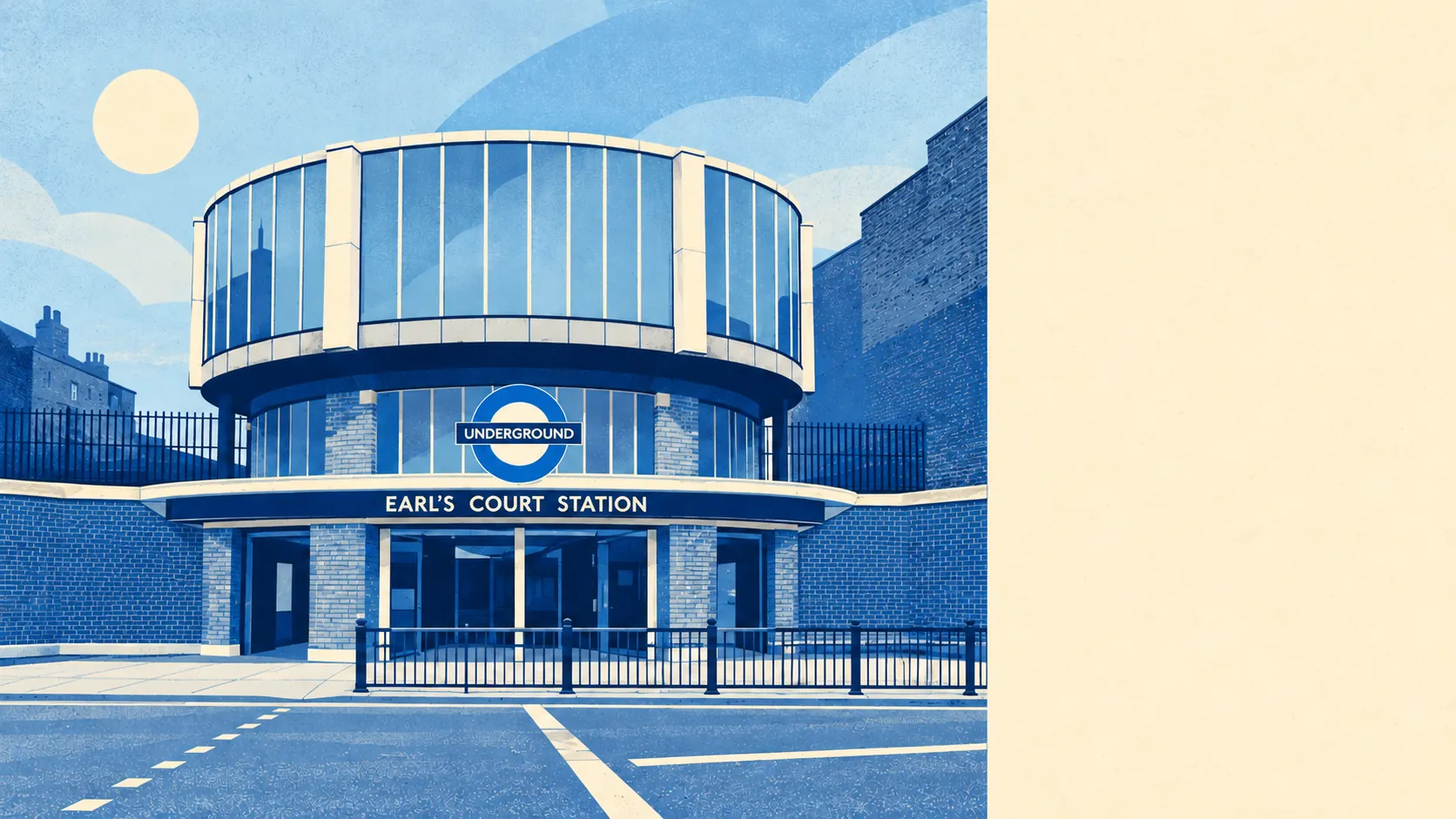
Earl's Court has its own Tube station by the old manor yard, and West Brompton and Kensington (Olympia) stations are both nearby. At the 2021 census only about 2% of working residents went to work by train. There are 53 bus stops in the area, and about 3% of commuters went by bus. The two shares are small for a district with this much transport.
The commute mostly happens at home. About 62% of working residents worked from home at the 2021 census. About 8% walked, about 6% drove and about 3% cycled. About two-thirds of households have no car, and only about 5% have more than one. The best-connected thing in a typical Earl's Court flat is the router.
The Department for Transport's modelled journey-time statistics put the nearest town centre about 13 minutes away by car or by bike, about 20 by public transport and about 25 on foot.
Gigabit broadband is available to about 92% of premises and superfast to about 98%. No premises fall below the minimum speed the law entitles households to, and every network covers the whole area for mobile. For a population that works from its sofa, that matters more than the trains.
The buses come constantly, not just the stops. The average stop in Earl's Court sees about 833 scheduled departures on a weekday, roughly 47 buses an hour at peak. Every stop has a weekend service. These are current timetables, and nobody here needs to learn one.
The Department for Transport's figures put a GP about 4 minutes away on foot or by public transport, and 7 by car. A hospital is about 11 minutes by car and 17 by public transport. A food shop is about 4 minutes' walk or 7 by car. A centre of employment is about 3 minutes by car and 10 by public transport. All of these are modelled averages for the area. Walking and driving distances don't change, but the public transport times come from 2019 and some services have been cut since, so the bus and train times are the least reliable. Even so, almost nothing a household needs here is more than a short walk away.
The traffic is the price of all that access. About 92% of Earl's Court's postcodes are near or above 65 decibels of road noise, the level official noise mapping treats as significant, and the loudest band recorded reaches 75 decibels. Rail noise is a separate source and reaches that level in about 7% of postcodes, peaking at 70 decibels. In the early 1960s Earl's Court Road was made one-way southbound and Warwick Road one-way northbound, so the main traffic runs both ways past the area on two separate streets. Find out which road a flat faces and which side the bedroom is on, because these noise figures cover the postcode, not the room.
The area has 86 public charge points with 96 connectors between them, and none of them are rapid. Charging an electric car here means leaving it overnight, though with two-thirds of households car-free that is a smaller problem than it sounds.
Day to day, most residents walk to the shops and the doctor and go to work through the router, with a bus for anything further. Anyone who still commutes has a station within reach and a bus at almost any hour.
Earl's Court is middling on connections. The buses and broadband are excellent, but the area's commuting habits don't use them much.