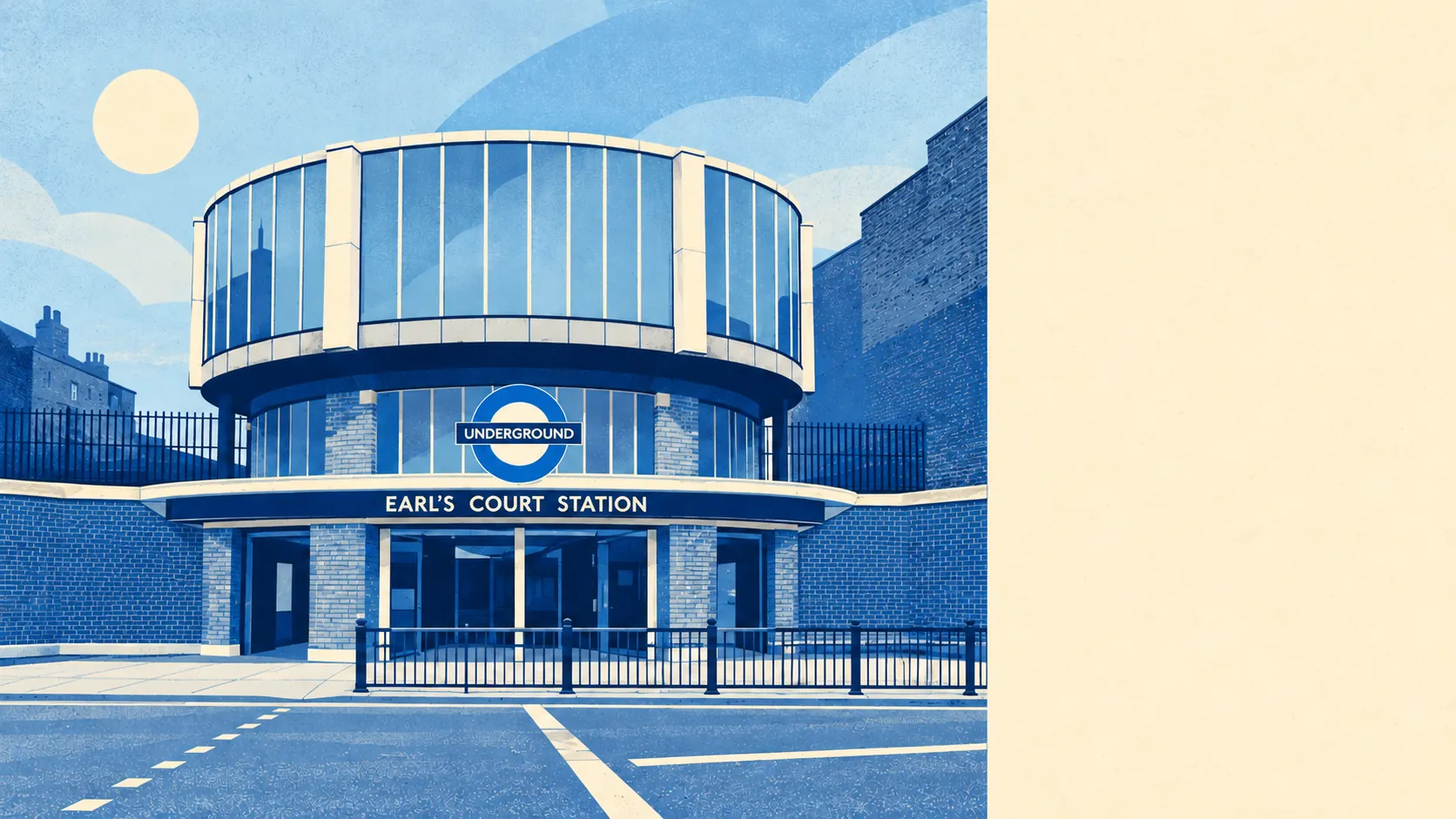
Earl's Court asks around £845,000 for a typical home, and the typical home is a flat with somebody else's footsteps on the ceiling. That price is the hard part for any buyer here. Get past it and the place mostly earns its keep. There is a park round almost every corner and a Tube station at the end of the road, and the streets are calmer than the reputation. It is expensive and crowded, and better than the address on the envelope suggests.
The Land Registry recorded 88 sales in the year to May 2026, at a median of about £845,000. Flats made up 82 of them, at a median of about £820,000. Only six terraced houses changed hands, at a median of £1,427,500, so a whole staircase to yourself is a rare purchase here. The official house price index for this area had average values about 11% lower over the year to May 2026, and about 5% below where they were five years earlier. That is a softer market than the asking prices let on. The most common council tax band is G, and only 4% of homes sit in bands A or B.
Renting costs about £3,600 a month across Kensington and Chelsea as a whole, a mean for the whole borough from the official rent index as of April 2026. Broken down by size, a one-bed runs to about £2,570 a month and a two-bed about £3,340. Rents across the borough were down about 2% on the year.
The council tax valuation list shows about 91% of homes are flats and only 5% are terraced houses. About 77% were built before 1930. Most of the stock is tall Victorian terraces chopped into flats, and you get high ceilings with all the heating that implies. Energy certificates put about 55% of certified homes in bands A to C and about 10% in E or worse. About 62% of homes are on mains gas, and about 16% heat with electricity alone. A cornice and a storage heater share a lot of rooms in Earl's Court, and only one of them makes it into the photos.
Flood risk here comes from rain, not the river. Of the postcodes in Earl's Court, about 10% carry a high risk on at least one flood indicator, surface water included, and about 18% a medium one. The Environment Agency's river-and-sea flood zones cover very little: well under 1% of the area falls in the highest zone, and none in the next. Heavy rain with nowhere to drain is the risk to ask about.
Ofsted has graded 22 schools and early-years settings across Kensington and Chelsea, and 20 of them are good or better, including eight rated outstanding. That is a borough-wide count. The two primary schools in the district averaged 109 in the Key Stage 2 maths tests. On the Department for Transport's modelled 2019 times, the nearest primary is about a six-minute walk. It is a strong set of schools for a district where so few households have children to send to them.
The Metropolitan Police recorded about 153 crimes per 1,000 residents in the year from June 2025 to May 2026. That published rate is about 16% below the Kensington and Chelsea average. The mix leans towards nuisance. Anti-social behaviour made up about 30% of recorded crime, against 16% nationally, and violence and sexual offences about 21%, against 35%. Burglary ran at about 6% of the total, against about 4% nationally. That makes it a district that gets on people's nerves more often than it hurts them.
Earl's Court has 131 listed buildings: one at Grade I, 17 at Grade II* and 113 at Grade II. One of them is on Historic England's Heritage at Risk register. For a flat owner in a listed house, a new window or an internal wall needs consent, and the building's history gets a say in the plans for your kitchen.
Only about 30% of households own their home here. About 51% rent privately and about 19% rent socially. The median age is 36, and nearly half of households are one person living alone. Household income in the area averaged about £88,700 a year before tax in the financial year to March 2023, a modelled figure from the Office for National Statistics. When Ernest Marples was transport minister in the early 1960s, Earl's Court Road became a one-way street heading south. A good share of the population has treated it as a direction of travel ever since.
Getting around takes no effort. Earl's Court has its own Tube station, and West Brompton station is close by. About two-thirds of households have no car. The 53 bus stops average about 833 departures each on a weekday, roughly 47 buses an hour at peak, and every stop has a weekend service. Cromwell Road carries the traffic out towards Heathrow. Gigabit broadband reaches about 92% of premises, which helps, because at the 2021 census about 62% of working residents worked from home.
Green space is closer than the density suggests. On average the nearest one is roughly 95 metres from a front door, and there are about 41 within a kilometre. Water is about 540 metres away on average. The best-known open space nearby is Brompton Cemetery, and The Boltons is a short walk too. In Brompton Cemetery the residents have more room each than anyone in the flats overlooking it.
History has never quite made Earl's Court respectable. The surgeon John Hunter kept a house and an animal menagerie on the old manor site in 1765. The Kensington Canal, dug from 1826, attracted little traffic and gave way to Mr Punch's railway, which closed six months after it opened. The exhibition centre that made the name famous closed in 2014. In between, the houses drew Beatrix Potter, Ellen Terry, Agatha Christie and Alfred Hitchcock, back when a house here still came as one front door.
Earl's Court is right for people who live alone or in pairs, don't drive, and want the Tube, the parks and good borough schools within easy reach. They have to accept paying Kensington prices for a slice of a Victorian house. Families who need a garden, and anyone hoping to own a whole house without a seven-figure budget, will do better further out.
The price is the catch. Around £845,000 buys a flat, usually a share of an old house, with listed-building rules and a heating bill to match. What the money buys around it is parks within a couple of minutes of most front doors, streets safer than the borough average, and a city that takes very little effort to reach. Earl's Court is worth living in if you can pay for it.