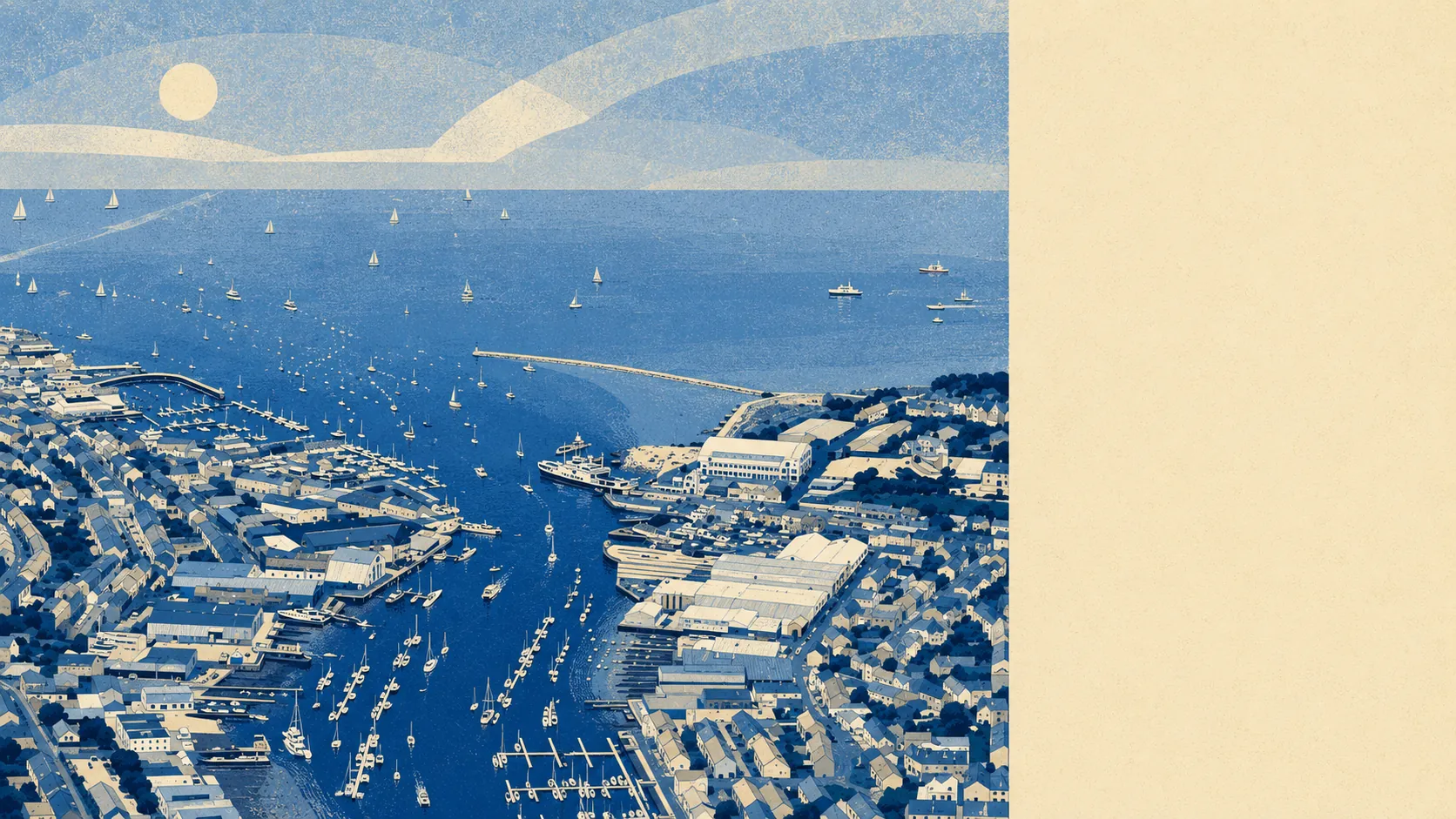
Owners, mostly, and older than the regatta branding implies. Seven in ten own their homes. The median resident is nearer fifty than forty. A third of households are one person living alone, and pensioners on their own account for about a sixth of all households. This is a town people move to and then stop moving, which is the polite version of saying the turnover is low.
Every population figure here comes from Census 2021. On tenure, about 70% of Cowes households own their home, roughly 22% rent privately and about 7% rent socially. That ownership level is the single most defining number about the place. It shapes how the streets look, how slowly the housing stock changes hands, and how many people at any given moment have a strong opinion about somebody else's extension.
The age profile follows from it. The median resident is 48, and the 25 to 44 age band makes up about 22% of the population of roughly 14,600. That is not a town emptied of working-age people, but it is a town where the largest life-stage group has finished with school runs. Falmouth has the students. Cowes has the people who have already done all that and now want a mooring within walking distance.
On money, typical gross household income ran at about £52,000 in the financial year to March 2023, with the equivalent net figure after tax closer to £40,500. Both are modelled for that year rather than a live reading of what anyone earns today. Gross is the number to hold when comparing against a mortgage calculator, and the net one is the number that actually decides whether the boat happens.
Household make-up is where the town's character is clearest. About 34% of households are a single person living alone, of which roughly 17% of all households are pensioners on their own, the same people counted twice over rather than two groups to be added together. Couples with children make up about 16%, and lone-parent households about 9%. A town where single-person households outnumber families with children by that margin is a quiet town on a Tuesday and a busy one in August, which is exactly what Cowes is.
On qualifications, about 35% of residents hold a degree-level qualification, roughly 14% hold none, and full-time students account for about 1%. That is a mixed working population with a professional layer, not a university town and not a place that emptied out when the shipyards changed hands. The BAE Systems site on Newport Road is part of why the professional share holds up on an island.
Health reads well. About 81% of residents report good or very good health, and around 5% report bad or very bad. Broadening out to the Isle of Wight as a whole, the local authority records a preventable mortality rate better than the England benchmark, and smoking prevalence at about 10%, which the same benchmark rates as similar to England. Those two are island-wide figures with a national comparison attached, not Cowes measurements.
Almost everybody here lives in an ordinary household. Only 109 residents live in communal establishments such as care homes, which is small enough that it changes none of the shares above.
The people are the least remarkable thing about Cowes, and that is not an insult. Settled, older, comfortably housed, professionally mixed, and thoroughly average in the ways that make a town easy to live in rather than interesting to write about.