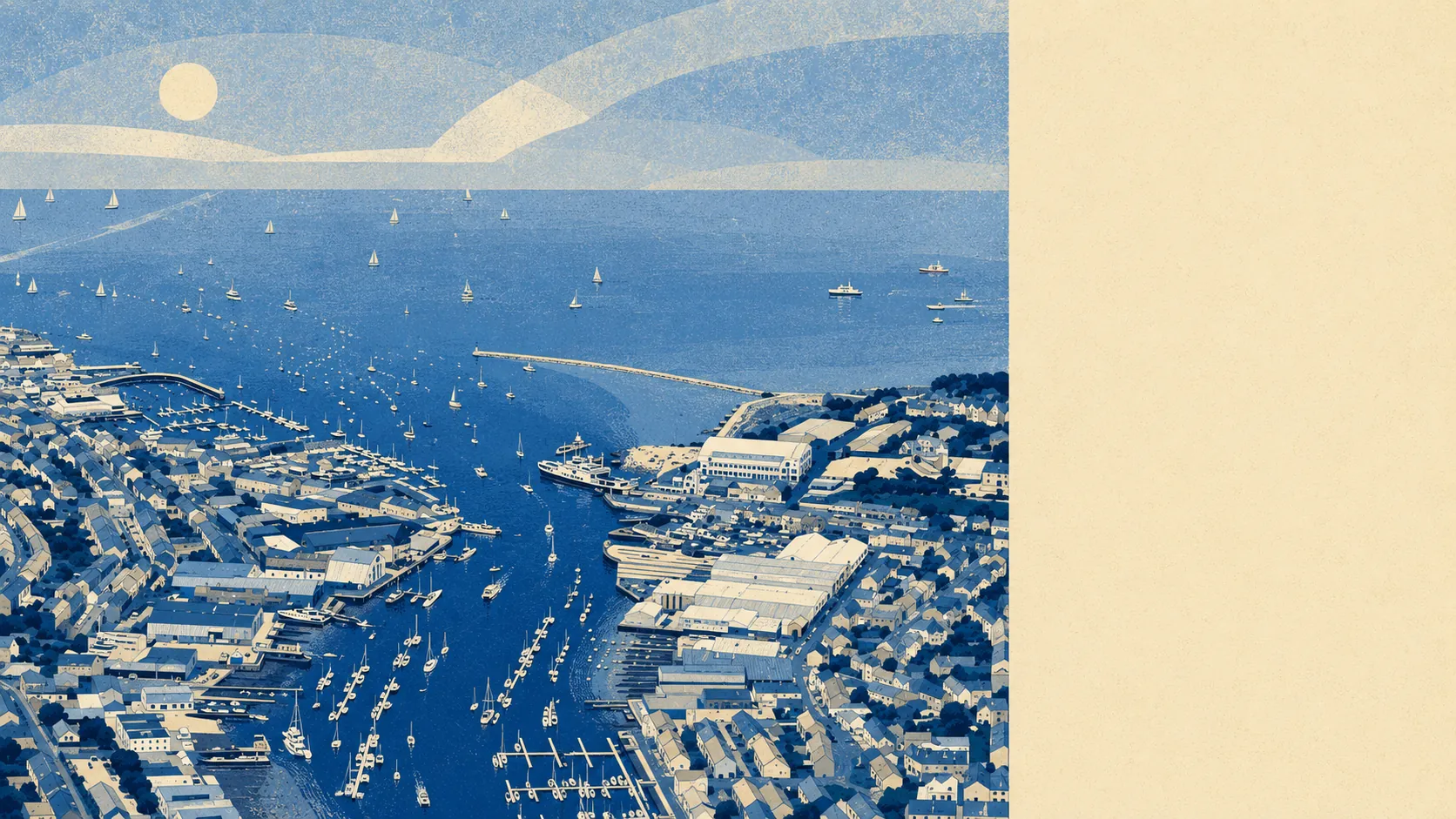
Cowes sells the regatta and delivers the post-war semi. Seven in ten own their homes. The median resident is closer to fifty than forty. Crime sits well under the island average, and the water is never more than a short walk away. The brochure is a yacht; the reality is a comfortable, slightly elderly Solent town that happens to have a famous week in August.
The housing tells the honest version. Across every dwelling on the council-tax valuation list, terraces run at about 25%, semis at 22%, bungalows at 20%, flats at 17% and detached houses at 15%, which is the spread of a working town rather than a waterfront resort. About 38% of that stock went up before 1930, so the pre-war seaport core is real, but it shares the street with everything built since. Around 80% of homes run on mains gas and about 8% are electric-only, which matters more than it sounds: an electric-only older property is a running-cost decision made for you by whoever last refurbished it, and it shows up on the bill rather than in the listing photos. On energy certificates, roughly 44% of the stock sits in bands A to C, about 40% sits in band D, and around 16% is band E or worse. Band D is doing more work here than any other single number about Cowes housing.
Prices are the reason people keep looking. The Land Registry's last twelve months put the typical Cowes sale at about £285,000 across 195 transactions, which is a real market rather than a handful of trophy sales. Flats came in around £185,000, terraces about £277,000, semis about £276,000 and detached houses around £399,000. The council-tax picture matches: band B is the most common, and about 40% of dwellings sit in bands A or B. A yachting capital with a band-B modal home is not a contradiction, it is the actual town.
For renters, the typical private rent across the Isle of Wight area runs at about £940 a month. That is the local-authority figure covering the whole island rather than a Cowes number, so treat it as the shape of the market and not the price of a specific flat above the High Street.
Safety is where Cowes quietly outperforms. The published rate is roughly 46 crimes per thousand residents in the year to May 2026, which sits around 44% below the Isle of Wight average. Hampshire Constabulary covers the area and its own charge rate runs at about 9%, below the England and Wales figure of around 12%, so the outcomes picture is less flattering than the incidence picture. Both things are true at once, and only one of them is about your street.
Connectivity is the trade you make for living here. About 48% of working residents drive to work, roughly 25% work from home, and the share commuting by train is essentially nil, because there has been no railway since the Newport line closed in 1966. What there is instead: 80 bus stops, an average of about 33 scheduled weekday services per stop, and weekend service at roughly 99% of them. The Cowes Floating Bridge chain ferry works the crossing to East Cowes through the day, and the Red Jet catamaran takes foot passengers to Southampton. Broadband is the surprise: gigabit-capable coverage reaches about 97% of premises and no premises sit below the universal service obligation. The fibre arrived long before the trains came back, and the trains are not coming back.
The environment is the best thing about the place and also the caveat. Green space averages about 170 metres from a Cowes postcode, with roughly 18 sites within a kilometre, and water is about 400 metres away with a great many access points within the same radius. Then the flood map. Around 17% of postcodes carry a high rating on at least one flood indicator including surface water, and about 11% carry a medium one. On the Environment Agency's river-and-sea zones specifically, roughly 6% of the area sits in Flood Zone 3 and about 1% in Zone 2, rising to around 12% under the climate-change allowance. Two flood events are on the recorded register, the most recent in March 2008 from the sea. Sea level at the nearest tide gauge at Portsmouth has been rising at about 2mm a year across a record running from 1962 to 2023. The shoreline management policy for the whole of the Cowes coastline is hold the line, which is reassuring until you consider that a policy is not a wall.
Heritage is lighter than the town's reputation suggests. There are 103 listed buildings, seven of them Grade II star and none Grade I, and no conservation areas registered within the area's boundary. Three entries sit on Historic England's at-risk register. For the overwhelming majority of Cowes homes, changing the windows is a conversation with the planning department rather than a negotiation with the national listing regime. If you buy one of the 103, it is the other way round.
The character follows from the numbers. About 70% of homes are owner-occupied, the median age is 48, and typical gross household income runs at around £52,000 in the financial year to March 2023. That is a settled town of people who arrived, bought, and stopped moving. Gurnard, two miles west along the bay, is covered by this page and pulls the age and ownership figures upward rather than down.
Cowes is for the buyer who wants water access without Solent-mainland pricing, who can work from home or has made peace with the ferry, and who reads a flood map before an estate agent's brochure. It suits the sailor, the retiree, the remote worker with good broadband and no commute to protect.
It is not for anyone who needs a railway station, a secondary school choice worth agonising over, or a town that stays awake in February. And if the plan is Lymington without Lymington's prices, this is the wrong ferry: Cowes charges for the postcode too, and the working harbour you actually wanted is Poole.
The history is better than the marketing. The town grew out of Tudor blockhouses Henry VIII put up around 1539 against French and Spanish raiders, and Cowes Castle is what survived. A vessel called the Rat o' Wight was built on the Medina in 1589 for Elizabeth I, which is where the boatbuilding started; the yachting came much later, when the Royal Yacht Squadron ran its first three-day regatta in 1826 and George IV presented a cup the following year. Thomas Arnold, later headmaster of Rugby School, was born at Westbourne in 1795. Uffa Fox designed boats here. Jeremy Irons and Celia Imrie are on the notable-residents list, which tells you something about what the place attracts and nothing about who you will meet at the Co-op.
The verdict is above average and comfortable with it. Its real strength is what surrounds it: green space on the doorstep, the Solent at the end of the road, and a crime rate that embarrasses the rest of the island. The weak spot is flood risk, and it is not a rounding error on an estuary mouth with a rising tide gauge. If you wanted Salcombe money you would have bought Salcombe. Cowes is the grown-up compromise, and it knows exactly what it is.