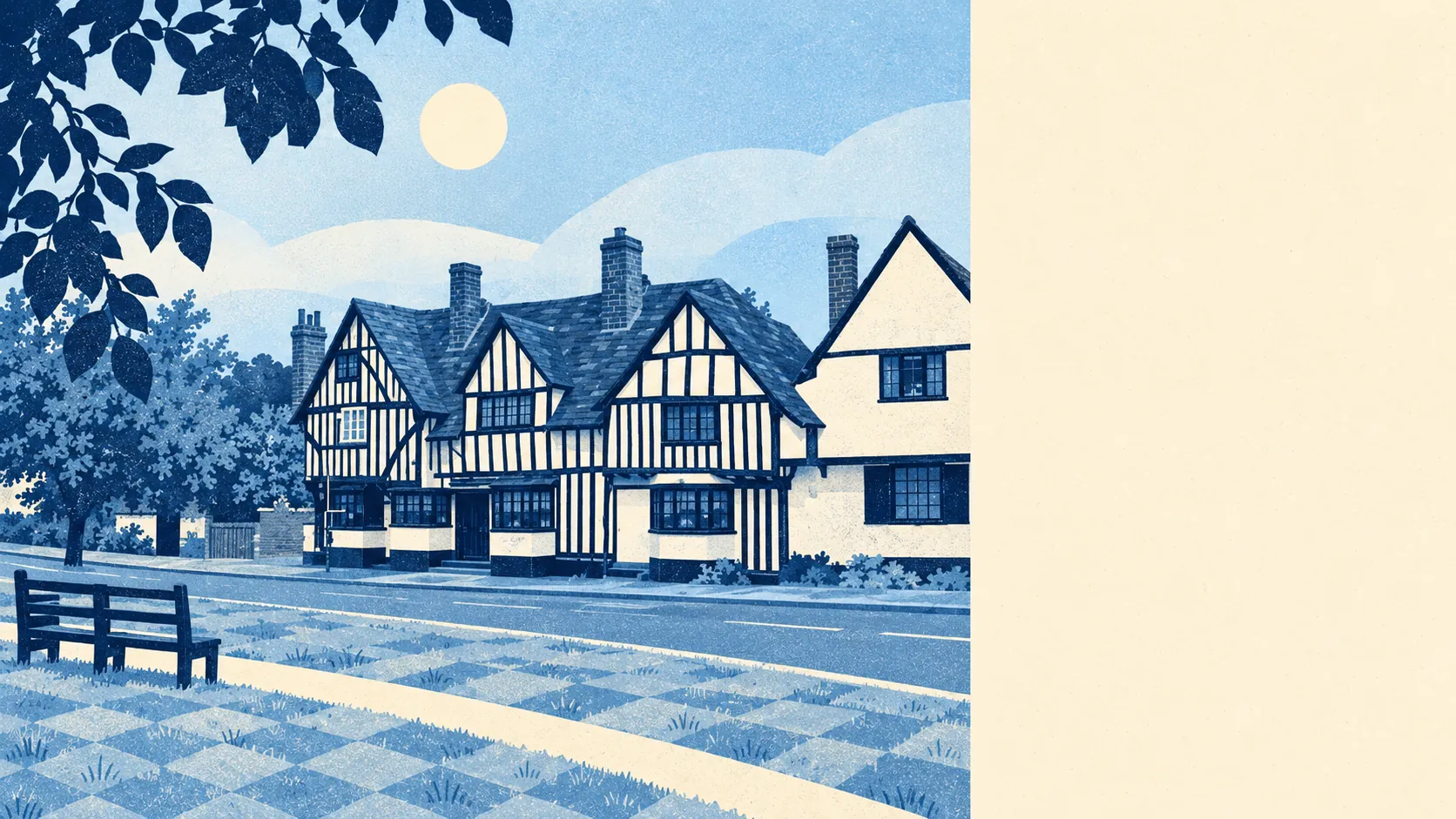
Codicote is a safe, comfortable village on a chalk ridge above the Mimram, and it works best for people who arrive with a deposit, a car and no plans to knock anything through. Crime runs well under the rest of the district. About seven in ten households own their home, and about half the workforce works from the kitchen table. The village gives you calm and a good postcode, and the planning rules decide how much of the house you get to change.
Start with the strongest part. Hertfordshire Constabulary recorded crime across the Codicote area at about 47 per 1,000 residents in the year to May 2026, roughly 30% below the North Hertfordshire average of about 67. That is the main reason families with children and anyone living alone keep picking this ridge. With half the working population at home all day, the neighbourhood watch is effectively a full-time job.
The weakest part is freedom to change your house. The area around Codicote holds 157 listed buildings, two of them grade I and five grade II*, and five conservation areas, including Codicote's own, Kimpton, Kimpton Bottom and Ayot St Lawrence. Inside them, new windows, a rear extension or a different roof covering can all need consent, and listed status puts even internal changes under the council's eye. The parish church of St Giles was extensively restored in 1853, and nobody inside a conservation boundary has been allowed that much fun with a building since.
Buying in is expensive. The Land Registry recorded 80 sales in the twelve months to mid-May 2026, at a median of about £565,000. Detached houses went for about £830,000, semis about £540,000 and terraces about £390,000. Only four flats sold, at a median near £150,000, so for most buyers the one-bed starter flat exists in theory only. Band D is the most common council-tax band, and only 7% of homes fall in bands A or B. A band D bill runs to about £2,450 a year.
Renting is a minority habit here. Only about 10% of households rent privately and about 16% from a social landlord. For a figure, the best available is North Hertfordshire's typical private rent of about £1,420 a month as of April 2026. That figure covers the whole district, Hitchin included, so it says little about a cottage on this ridge. Renters who do land here tend to be trying the village out before they buy.
The housing is mostly houses. On the council-tax list, 30% of homes are detached, 26% terraced and 22% semi-detached, with bungalows and flats at about 10% each. About 23% were built before 1930, so older stock is a real share without being the bulk. Among homes with an energy certificate, 57% rate A to C and 12% rate E or worse. Three-quarters are on mains gas and about 7% are heated by electricity alone, and that 7% is the group to ask about before booking a viewing on an older cottage. Node Court, a thatched model dairy farm built north of the village in 1928, was badly damaged by fire in 2015, and anyone pricing up thatch should keep that story in mind.
The people here have mostly made their money already. About 74% of households own their home and the median age is 48. The Office for National Statistics models gross household income for the area at about £71,000 a year, a figure for the financial year to March 2023, before tax. This is the sort of village people move to once the career has paid off and the children need driving to secondary school.
On flooding, the Environment Agency's river-and-sea flood zones 2 and 3 cover none of the Codicote area. The wider postcode indicators, which include surface water, put about 13% of postcodes at high risk on at least one measure. The Mimram is a well-behaved chalk stream. When water causes trouble here, it usually fell as rain and ran down the lane.
The surroundings are the best reason to live here after safety. Green space is about 300 metres from the average front door and water about 450 metres. The river runs through Codicote Bottom to the south-west, and the parish spreads out into hamlets such as Nup End and Rabley Heath, with Kimpton across the fields. Dog owners and people who want a walk before their first video call will be happy here.
Getting around means driving. The 48 bus stops average about 11 weekday departures each, and the 2021 Census found 2% of workers commuting by train against 44% who drove and 47% who worked from home. Welwyn North, Knebworth and Stevenage are the nearby stations, all reached by road. Superfast broadband reaches about 93% of premises and gigabit about 48%. The Department for Transport's 2019 model put the nearest hospital about 66 minutes away by public transport, and bus figures from 2019 have only aged since. Robert Newman, the comedian and political activist who once worked with David Baddiel, grew up in Codicote and neighbouring villages. Eleven buses a day will make an activist of anyone.
Schools are reasonable rather than exceptional. Codicote Church of England Primary School is in the village, and the 13 primaries across the surrounding postcode districts average about 105 in the Key Stage 2 maths test. The two secondaries counted in those districts average an Attainment 8 score of about 45, and Hitchin Girls' School is among the options for older children. Secondary school is about 15 minutes away by car and about an hour on foot, so the school run is a drive here.
Codicote is above average overall, and the trade is simple. It is one of the safer places in North Hertfordshire, with countryside a few hundred metres from most doors. In return, a fifth of the homes are old, plenty are listed, and the conservation rules cover the parts that make the place pretty. It is right for a household with two drivers and a remote job that wants its house roughly as it found it. If you are hoping to buy a wreck and rebuild it, or to live here without a car, Hitchin will make that easier.