Yes, if you wanted a town that works rather than one that poses for photographs. Two-thirds of households own. A third of workers commute as far as the spare room. There is a park round the corner from almost everyone. Chippenham is the town people pick with a spreadsheet open and then quietly grow fond of.
The housing stock refuses to pick a side. Across every home on the council-tax list, detached houses make up about 25%, semis 27%, terraces 26% and flats 16%, with bungalows at 7%. English housing rarely gets closer to a four-way tie. Only 13% was built before 1930, so buyers after period drama will find the Victorian streets small and outnumbered. The energy certificates follow the build dates: 56% of certificated homes rate A to C, 36% sit in band D, and 8% are E or worse. Mains gas heats 77% of homes, but 11% run on electric-only heating, and in an older property that is a question for the viewing, not for the first winter bill.
The Land Registry recorded 491 sales in the year to May 2026, at a typical price of £285,000. Terraces went for around £250,000, semis £285,000, detached houses £430,000 and flats £160,000. The flat is the cheapest way into town by a distance. The detached house is the one the listing photographs at golden hour. Band C is the most common council-tax band, and 35% of homes sit in bands A or B, so the bill lands in the middle rather than on your chest.
The typical private rent across the Wiltshire area was about £1,060 a month in April 2026. That is a county-wide figure, not Chippenham's own, and a two-bed near the station has no interest in what a cottage out past Devizes costs.
Safety is the soft spot. Police figures for the year from June 2025 to May 2026 put Chippenham at about 74 crimes per 1,000 residents, roughly 18% above the Wiltshire average. Part of that is the comparison itself: the county average is diluted by a lot of countryside where the nearest witness is usually a sheep. The mix leans towards nuisance. Anti-social behaviour makes up more than a fifth of recorded incidents here, against 16% across England and Wales. That is the stuff that ends up on doorbell footage rather than on the front page, and it clusters where a market town's evenings always cluster.
Chippenham Rail Station sits on the Great Western Main Line under Brunel's arches, and only 1% of working residents take the train to work. At the last census 45% drove and 36% worked from home. The station is for London meetings and weekends away. The rest of the week, Chippenham gets in the car. Broadband backs up the home-working habit: gigabit-capable connections reach 84% of premises and superfast 98%. There are 191 bus stops, averaging about 30 weekday departures each. The Department for Transport's modelled times put the nearest hospital about 35 minutes away by car, which is worth knowing if anyone in your household falls off things.
The River Avon made Chippenham, and it still gets a say. In the Environment Agency's river-and-sea flood zones, about 1% sits in Zone 3 and 5% in Zone 2. Across postcodes, on at least one flood indicator including surface water, 9% carry a high-risk flag and 13% a medium one. Most of the town is dry, but homes by the river and in the dips need the exact address checked before an offer goes in. Green space is where the town wins outright. The average home is about 160 metres from a park or green, with around 19 within a kilometre, and Bird's Marsh and Vincients Wood sit on the edge of town like they were put there on purpose.
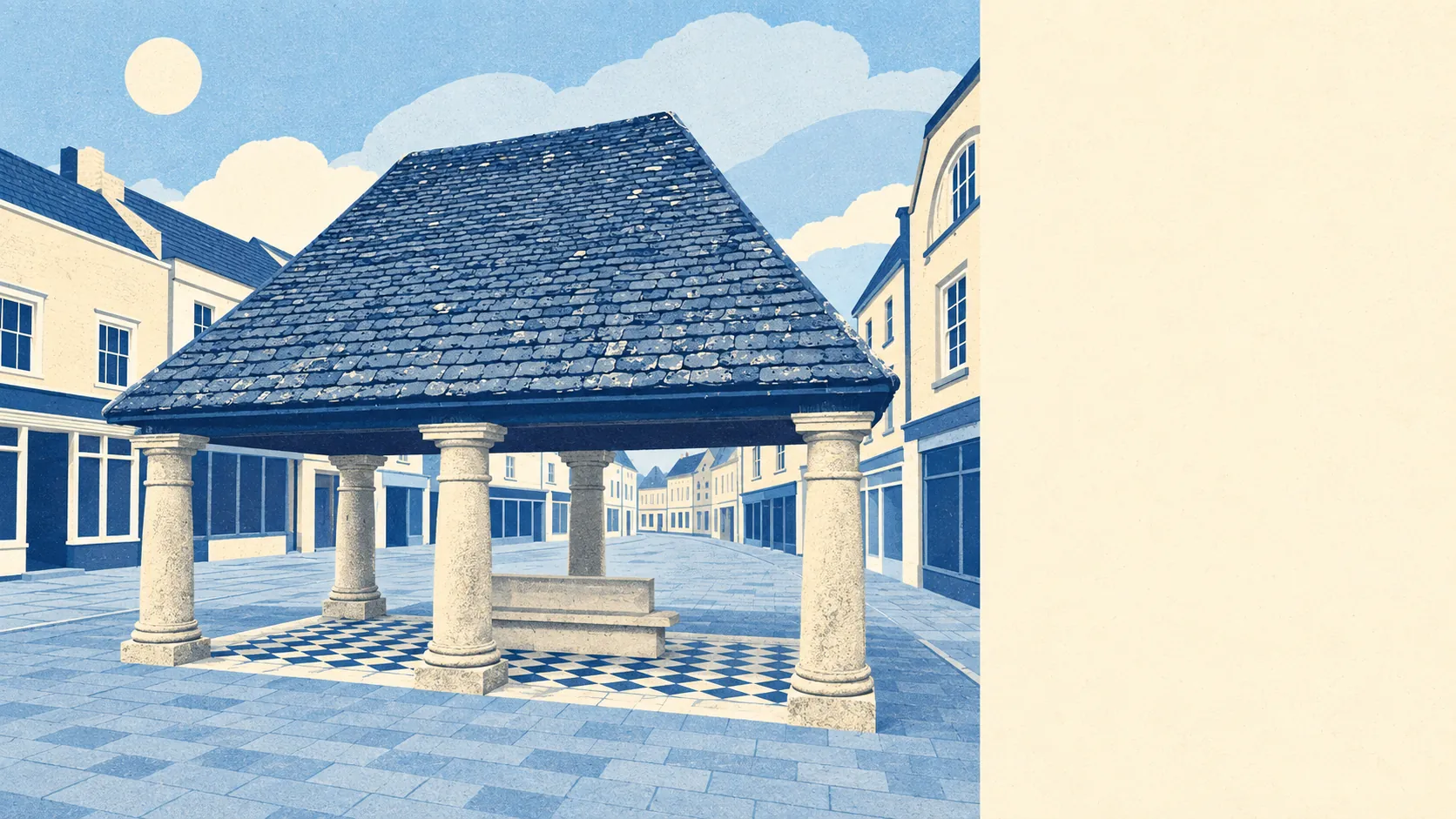
There are 316 listed buildings, three of them Grade I and 21 Grade II*, plus four conservation areas: Allington, Chippenham itself, Langley Burrell and Rowden. The Yelde Hall is the star, a medieval timber market hall that once kept the town jail underneath the council chamber, which says something about how the burgesses liked their meetings. If your house is listed or inside one of those areas, the windows you want and the windows you get will be settled by a conservation officer who has firm views on plastic frames.
About 68% of households own their home, the typical resident is 43, and modelled gross household income averaged about £62,000 in the financial year to March 2023. That is a settled town in its working years. The Friday and Saturday market still runs around Market Place and the High Street, although franchises hold most of the High Street and the independents have retreated to The Causeway and Upper Market Place.
This page also covers the villages in Chippenham's orbit: Biddestone, Grittleton, Hullavington, Kington St Michael, Luckington and Yatton Keynell. They lean on the town for the station and the big shop, and keep the quiet for themselves.
Chippenham suits buyers who want a proper house with a garden without needing the parents to remortgage, especially anyone who works from home or drives to Bath, Bristol or Swindon and likes having a main-line station for the days they don't. Families get a real choice of house types and a park within a short walk.
It suits people chasing a postcard less well. The chains own the high street, the historic core is small, and crime runs above the county average. If the dream is honey-coloured stone and a deli on every corner, Corsham or the villages will fit that better, and that is a trade worth making in either direction.
The town's history turns up in odd places. Arthur Rostron, captain of the Carpathia, which rescued the Titanic's survivors, is among its notable names, and so is Dominic West. Gabrielle Aplin went to Sheldon School and David Bishop to Hardenhuish. In 1747 a bribery scandal involving Chippenham's members of parliament helped bring down Sir Robert Walpole's government, which is more damage to a prime minister than most market towns manage in a millennium. At Rowden Hill in 1960, Eddie Cochran died after a car crash, and a memorial plaque marks the site.
Chippenham is an above-average place to live that has no interest in being called anything grander. Its real strength is the surroundings: parks close to nearly every front door, woods on the edge of town and the Avon through the middle. The weak spot is safety, where the town runs above the Wiltshire average and anti-social behaviour drives most of the gap. Buy the house, walk the woods, and look at the street at eleven on a Saturday night before you sign.