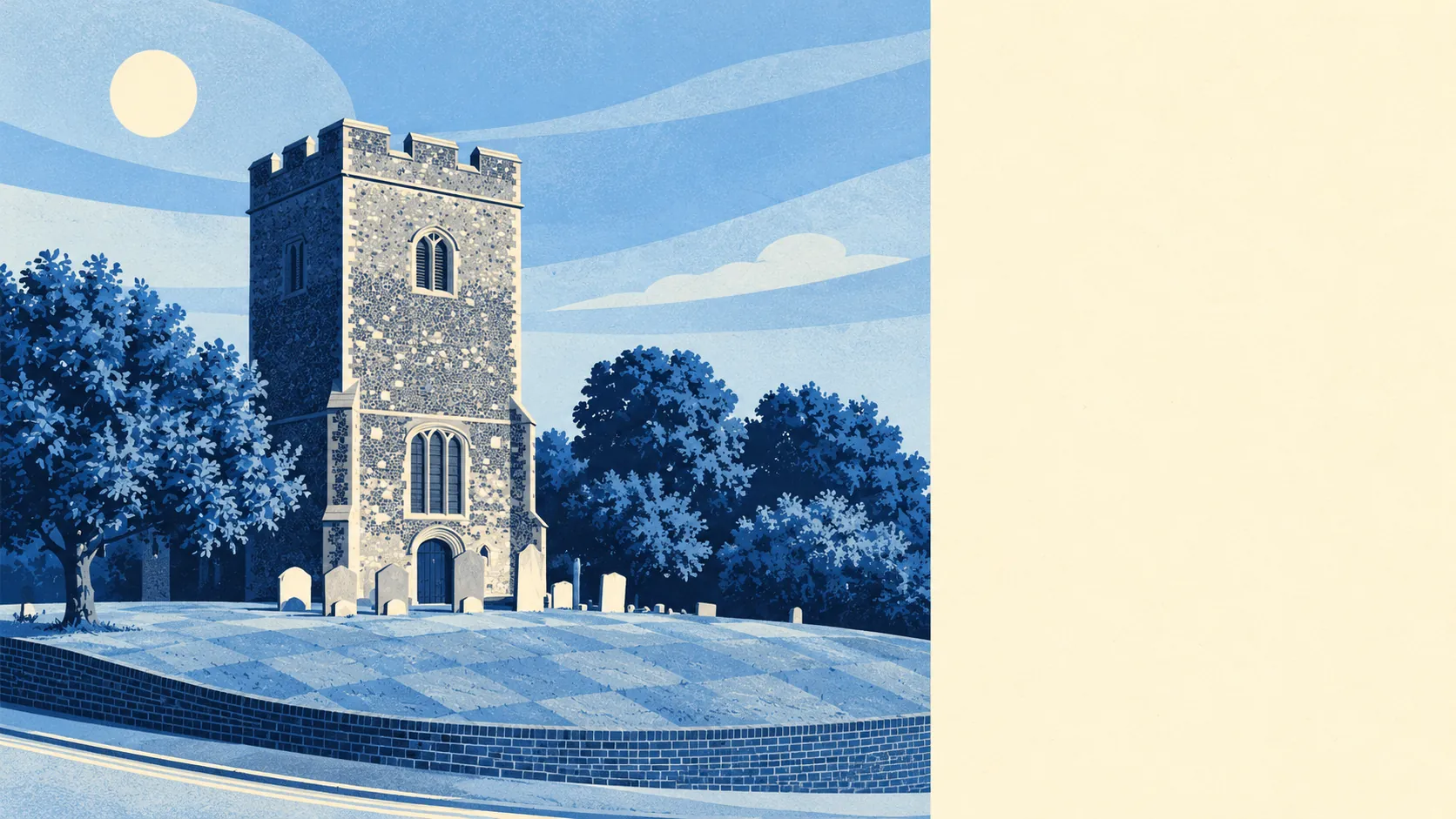
The area around Chadwell St Mary is greener than its post-war streets suggest, and most front doors are a short walk from a park. Green space comes round almost every corner. Water is within a long stroll. The marshes run below the hill. It is a dense estate town, and you can be outdoors in a couple of minutes.
The typical home in Chadwell St Mary is about 175 metres from the nearest public green space, with around 14 green spaces inside a kilometre. That is the distance of a short walk to the end of the road, and with that many to choose from, a dog owner can vary the route for a fortnight before repeating one.
Water is further off, at about 815 metres from the average home to the nearest blue space, with around 9 within a kilometre. Ponds, ditches and the marsh channels below the hill count here alongside anything grander, so the figure describes the water you can reach on foot, and a marsh ditch is not the Thames.
The National Cycle Network is about 1.7 kilometres away on average, and no postcode in Chadwell St Mary is counted as close to it. There is no ancient woodland in the area. Getting out into open country starts with a ride to the network.
The wider RM16 and RM18 postcode districts, which reach well beyond Chadwell into Grays and Tilbury, hold 191 shops, 14 pubs and 6 restaurants on the property records. That puts the evening out mostly in the pub, with dinner a trip into one of the larger towns.
Thurrock as a whole averaged about 8 micrograms of fine particles per cubic metre of air in 2024, a figure for the whole council area.
The places around Chadwell St Mary carry more of the history than Chadwell does. Orsett, West Tilbury and East Tilbury each have a conservation area, and the scheduled monuments in the area include Tilbury Fort, the ringwork and bailey at Orsett known as Bishop Bonner's Palace, a Second World War anti-aircraft battery at Bowaters Farm, and a group of ancient dene holes. Grays, Little Thurrock, Orsett Heath and Tilbury close in around the edges. The neighbouring villages got the conservation officers, and Chadwell St Mary got the view of them.
Private gardens are generous. Across Chadwell St Mary's neighbourhoods there are about 75,000 square metres of private garden for every 1,000 residents, measured across all seven of its small statistical areas. For a place of terraces and semis on a hill, the back gardens carry a lot of its outdoor life, and the post-war planners were generous with the plot sizes.
On the valuation list, Chadwell St Mary itself has 130 rateable business premises. The largest groups are 38 shops, 27 workshops and 19 warehouse and storage units, with clubs, car parks and a few others making up the rest. These are premises on the rating list, and some may be empty or used differently from their listed description. Workshops and warehouses on that scale make the place a working edge of Thurrock as much as a dormitory.
Of the 28 food premises with a hygiene rating, about 61% hold the top score of five, and none are rated at the bottom of the scale. Whatever the takeaway lacks in ambition, the inspector has no complaints about the kitchen.
No area of outstanding natural beauty, site of special scientific interest or ancient woodland overlaps Chadwell St Mary. The green space here is parks, playing fields, gardens and marsh edge, ordinary land that is open to use, and no national designation decides what happens to it.
For green space on the doorstep, Chadwell St Mary is very hard to fault. The parks are close, the gardens are big, and the marshes are there for anyone who wants a longer walk.