Camborne is a good place to live, and nobody is ever going to be jealous of your postcode. Six in ten own their homes. Three quarters of dwellings sit in the two cheapest council tax bands. Green space starts more or less at the end of the street. This is not a resort with a town bolted on. It is a town that happens to be in Cornwall, and it has never once pretended otherwise.
The housing is terraces and the terraces are the point. Around 40% of every dwelling on the council tax valuation list is terraced, with bungalows and semis at about 17% each, flats at around 15% and detached houses at roughly 9%. About 36% went up before 1930, which is granite, slate and window frames that have opinions. Energy performance splits the town: around 55% of certificated stock sits in bands A to C, about 29% lands in band D, and roughly 17% comes in at band E or worse. Around 68% burn mains gas. About 13% run on electricity alone, and electric-only heating in a house built before 1930 is a monthly bill rather than a footnote, so ask before the viewing rather than after the first January.
On price, the Land Registry's last twelve months to May 2026 put the typical sale at £215,000 across 196 transactions. Detached houses came in around £320,000, semis at about £217,500, terraces at roughly £193,000, and flats at around £121,250, which is less than a parking space costs in several English cities that have worse weather and no coast path. The most common council tax band is A, and about 76% of dwellings fall into band A or B. Camborne is one of the few places left where the council tax bill and the mortgage are in a sensible relationship with each other.
Renting is harder to pin to the town itself. The typical private rent across the Cornwall area sits at about £1,000 a month as of April 2026, measured as a mean across the whole council area rather than a median of what is advertised on Camborne's own streets. Cornwall includes a lot of coastline that charges accordingly, so treat that as a county-wide marker and not a local quote.
Safety is where the honest answer stings. The published rate is about 99 recorded crimes per 1,000 residents over the twelve months to May 2026, against roughly 74 across Cornwall, putting Camborne about 34% above the county average. That is the recorded rate as published, not a sum done on the back of a population figure. Devon and Cornwall Police charged or summonsed in around 8% of cases over the same period, against roughly 12% across England and Wales, which is a force statistic rather than Camborne's own, and is the sort of number that explains why people stop reporting things long before it explains anything about a street.
Getting about is a car proposition with decent bones underneath. About 62% drive to work, roughly 15% work from home, about 10% walk, and around 2% take a bus while about 1% take a train, which is remarkable for a town with its own railway station. Camborne Rail Station and Redruth Rail Station both sit on the main line, and there are 105 bus stops in the area averaging 44 scheduled weekday departures, with roughly 97% of served stops running something at weekends. The Department for Transport's 2019 modelling puts the nearest hospital at about 25 minutes by car and roughly 52 by public transport, and those public transport times age worse than the driving ones. Broadband is the quiet success: around 72% of premises can get gigabit service, about 93% can get superfast, and nothing falls below the universal service obligation.
Outside the front door, the surroundings are the best thing the town has. Green space averages around 130 metres away, with roughly 22 separate green spaces within a kilometre and open water at about 700 metres. There is no protected landscape or Site of Special Scientific Interest overlapping the area, which means the views are unbranded rather than absent. Flooding is modest and worth labelling properly: about 12% of postcodes carry a high rating on at least one flood indicator including surface water, and roughly 17% a medium one, while under 1% of the area sits in the river-and-sea flood zones mapped by the Environment Agency, with no recorded historic flooding. What every solicitor will raise instead is mining. Every postcode in the town has abandoned workings within 500 metres, averaging around 30 of them, 560 postcodes have a mine directly beneath, and the whole area falls in the highest radon band. Budget for the mining search and the radon test, and stop being surprised that a town built on the richest square mile in the old world has holes under it.
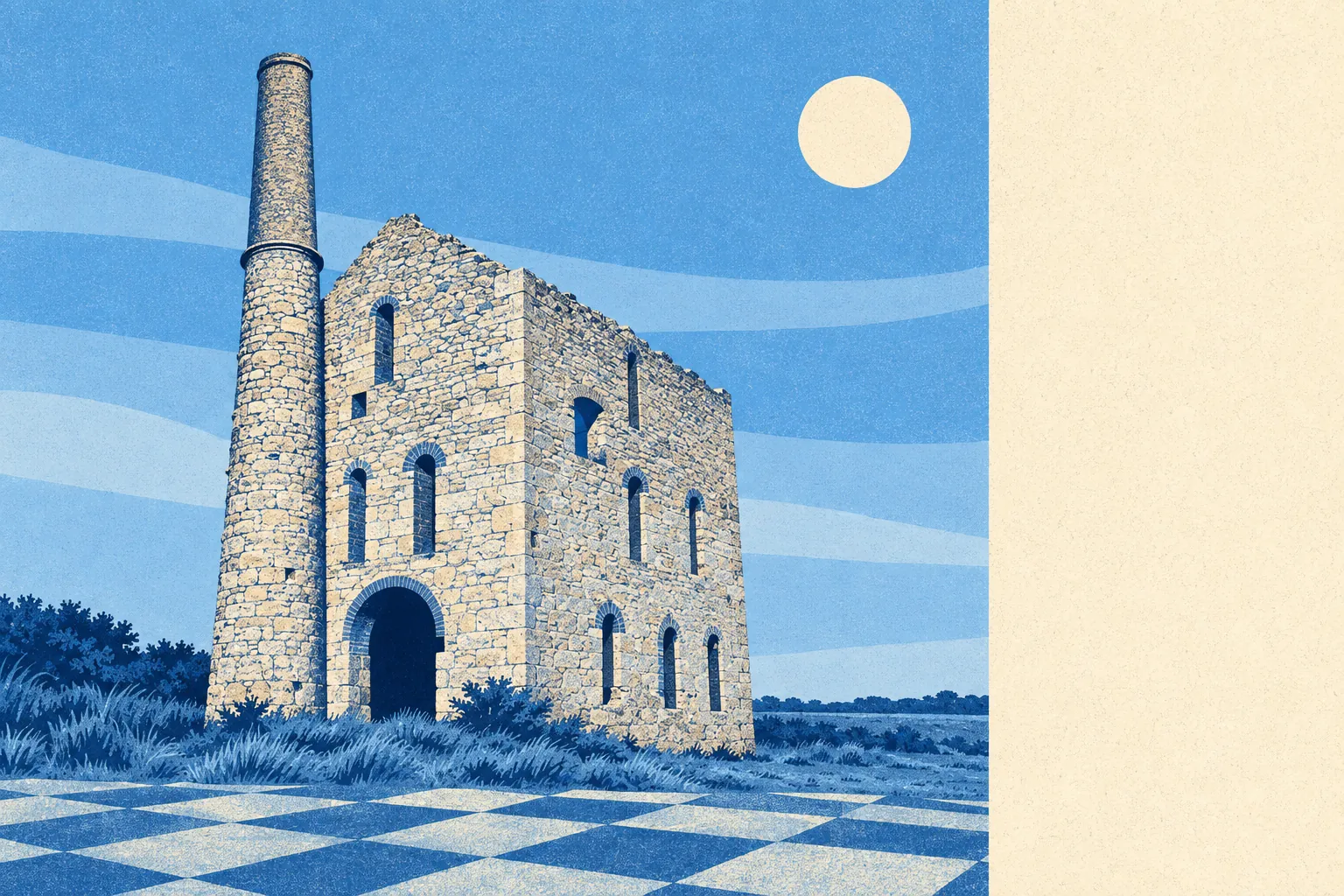
Heritage constraints are real but contained. There are 83 listed buildings, of which one is grade I, 12 are grade II star and 70 are grade II, plus five scheduled monuments and three conservation areas covering Camborne town centre, South Roskear and Tuckingmill. Inside those, replacement windows, solar panels and rear extensions become a conversation with the planning department rather than a weekend. Outside them, which is most of the town, you do what you like. The listed register here is dominated by engine houses, count houses and the Robinsons Shaft workings at South Crofty, so the protected buildings are mostly industrial rather than picturesque, and the difference shows.
Character comes from ownership and age. About 59% own their homes, the typical resident is 43, and household income runs to roughly £40,000 before tax for the financial year to March 2023, modelled by the Office for National Statistics. This page also covers Penponds, Praze-an-Beeble, Reawla, Tolvaddon and Troon, which between them are where people go when they want the same town with fewer streetlights.
It suits first-time buyers who have done the arithmetic and worked out that a terrace here costs less than a deposit elsewhere, remote workers who need gigabit and a coast path rather than a commute, and anyone who has been priced out of the postcard bits of Cornwall and would rather live somewhere real than rent somewhere photogenic.
It does not suit buyers who need the crime figure to flatter them, people who want a period house with a modern heating bill, or anyone whose plan depends on a train or a bus turning up at a convenient moment. Those buyers should look at the numbers early and save everyone the viewing.
The town has form for being awkward. In October 1873 thousands of miners and townspeople rioted against the police, ransacked the station, scattered the constables, and got the entire local force removed or transferred without a single rioter ever being convicted. Holman Brothers built industrial equipment here for two centuries and spent part of the Second World War making Sten guns. Arthur Woolf invented a high-pressure compound steam engine, Andrew Vivian ran Dolcoath, the poet John Harris came out of the mines, Joshua Cristall ended up president of the Royal Watercolour Society, and the Camborne School of Mines trained hard-rock engineers here until it moved to Penryn in 2004. South Crofty, the last working tin mine in Europe, shut in 1998.
Camborne is above average to live in, and the reasons are not the ones the town gets credited with. Its real strength is what surrounds it: green space within a short walk, open water not far past that, and none of the designations that turn a view into a permit application. The weak spot is safety, which sits well above the Cornwall average and is not going to be talked down by anyone honest. Buy here for the space, the price and the granite, and go in with your eyes open about the rest.