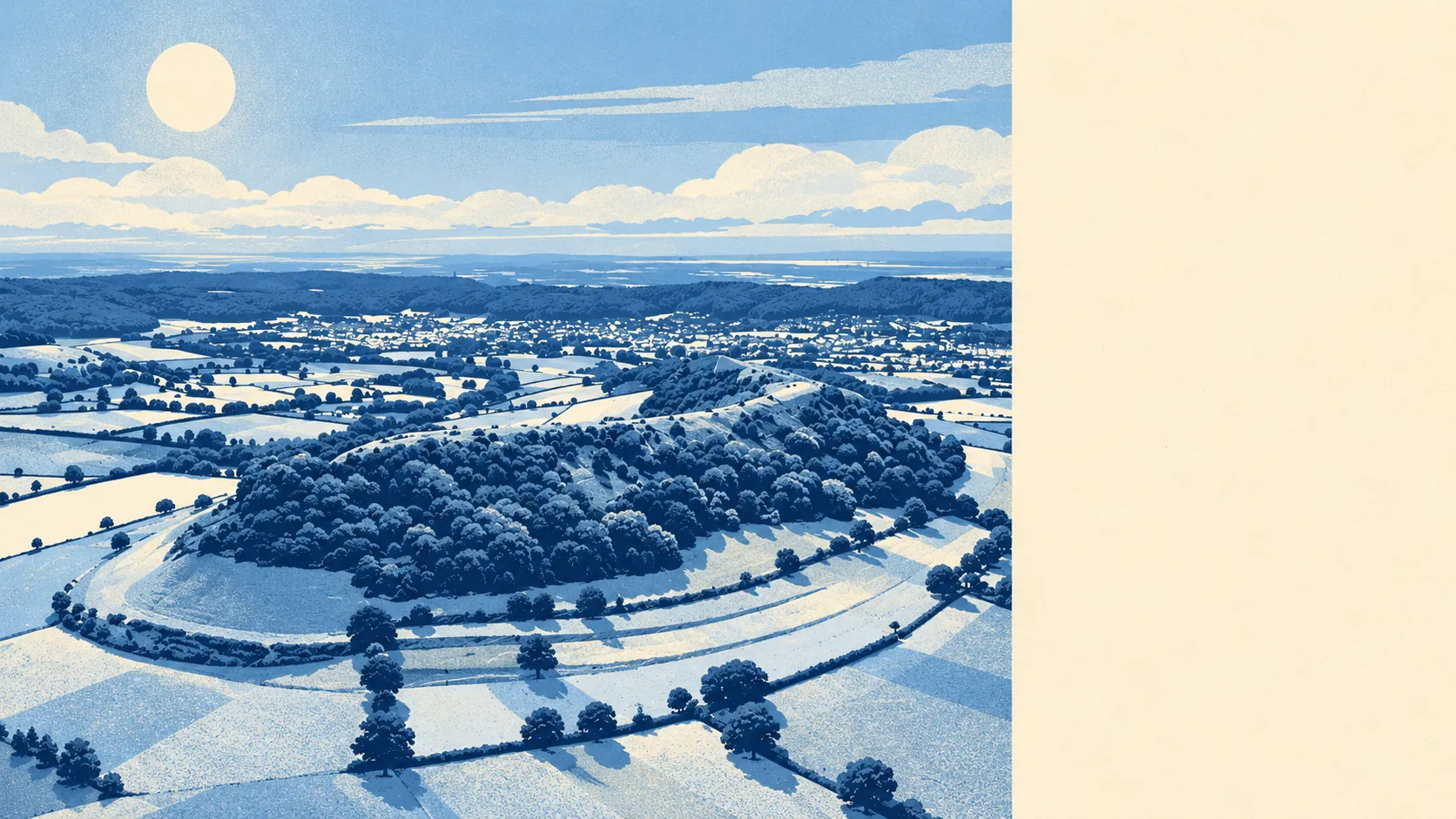
The countryside around Cam is the best thing about it, and it reaches almost every front door. Most homes have a park or a patch of green within a couple of minutes' walk. There is water within a short stroll as well. The Cotswold Way runs close by, with old hill camps on the skyline. The village itself is post-war and practical, and the setting is old.
Public green space is about as close as it gets. The average home in Cam is about 160 metres from its nearest green space and has about 16 of them within a kilometre. That is enough choice that a dog walk here can be planned by mood rather than by the one park everyone uses.
Water is nearly as close. The average home is about 480 metres from the nearest stretch of water, with about 13 such spots within a kilometre.
The National Cycle Network is further away, about 3 kilometres from the average home, and no postcode in Cam is close to it. There is no ancient woodland within the area either. People here reach the countryside on foot more than by bike.
The everyday amenities are larger than the word "village" suggests. The rated-premises list shows 98 shops, 13 pubs and four restaurants. In this part of Gloucestershire, the pubs outnumber the restaurants by quite a margin.
The air is clean. Fine-particle pollution across the Stroud district measured about 6 micrograms per cubic metre in 2024.
A thin edge of the Cotswolds area of outstanding natural beauty falls inside Cam's boundary, covering under 1% of it. There are no sites of special scientific interest and no ancient woodland here. The protected landscape lies around Cam, and mostly not in it. That leaves the scenery on the hills and the extensions on the estates.
Most of the character is in the hills around Cam. The countryside holds Uley Bury camp, Drakestone camp on Stinchcombe Hill, two long barrows and the West Hill Romano-Celtic temple. Stancombe Park lies nearby too. Slimbridge and Frampton on Severn are among the nearby villages, and conservation areas cover Dursley, Stinchcombe, Uley and Woodmancote close at hand. People were picking these hills for good reasons long before anyone built a semi underneath them.
Homes have their own outdoor space as well. Gardens in Cam add up to about 209,000 square metres of private ground for every 1,000 residents, a generous figure for somewhere with this many houses. Most homes come with a garden of their own on top of the green space down the road.
The business rates list holds 107 rateable premises across the area. The largest group, 29 of them, are industrial-type units, followed by 14 shops. These are premises on the list, not a count of businesses open today. Cam is still a working village, not just somewhere people sleep.
Of the 20 food premises with a hygiene rating, 70% hold the top score of five, and none is rated low. That is a short list, but a clean one.
The setting is one of Cam's real strengths: green space a few minutes from nearly every house, gardens on top of that, and hills worth the climb behind the rooftops.