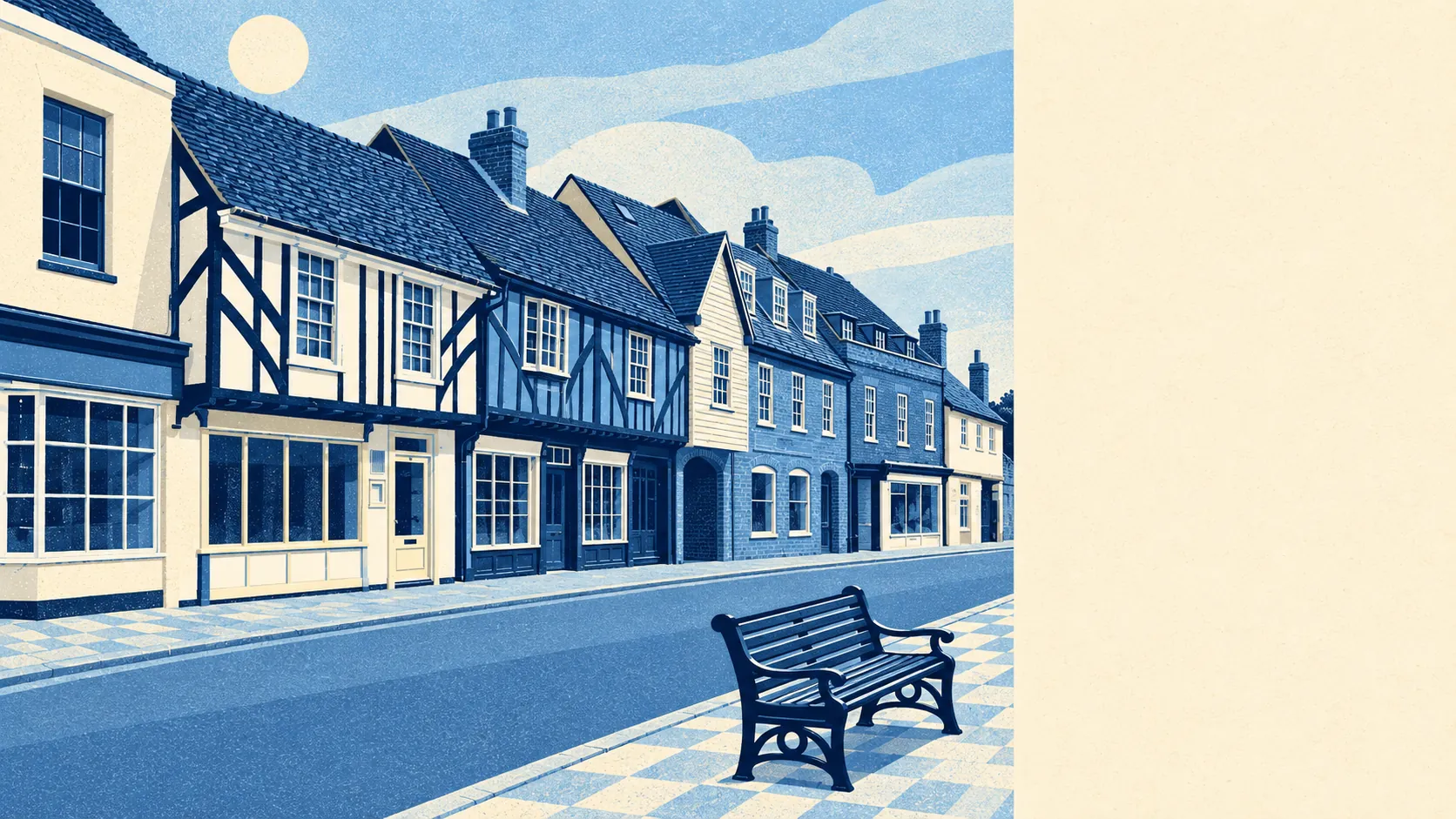
Buntingford's trouble is water, with about three in ten of its postcodes showing a high reading on at least one flood indicator. For a buyer, that line decides the insurance quote and the survey, however pretty the High Street looks on a sunny afternoon. Away from the wet patches it is a well-kept market town with green space close to most front doors, fast broadband and a bus timetable written in a spirit of optimism.
The flood numbers need sorting by type. Counting postcodes on at least one flood indicator including surface water, about 31% show high risk, 32% medium and 42% low. The Environment Agency's river-and-sea flood zones are much smaller: about 7% of the town falls in Flood Zone 2, none of it in Zone 3, and about 8% in the zone that allows for climate change. On the agency's own property count for rivers and the sea, five properties are at high risk. So the River Rib, which gave the town its ford and half its name, causes little of it, and the high readings come from the other indicators, surface water among them. The agency holds 13 recorded flood events, the latest in December 1968, when the main river overtopped a channel with no raised defences. The river has kept its head down since, and the risk worth asking about now comes out of the sky.
The Land Registry recorded 81 sales in the year to May 2026, at a typical price of about £430,000. Detached houses went for around £610,000, semis for about £450,000 and terraces for about £380,000, while the six flats that changed hands fetched around £215,000. Six flats in a year is a market in name only. Council tax clusters in Band D, which East Hertfordshire charges at about £2,455 a year, and only about 8% of homes are in Bands A or B, so cheap starter stock is thin.
East Hertfordshire's typical private rent runs to about £1,500 a month, a district-wide figure that has to cover Buntingford along with the rest of the council's patch. Only about 9% of households here rent privately, so the choice of rentals is short and goes fast.
The council-tax valuation list puts the stock at about 30% semis, 28% detached, 25% terraced, 11% flats and 7% bungalows, and only about 14% of homes were built before 1930. For a town that got its market charter from Henry III in 1253, the housing is surprisingly young. The old railway station went for housing, and so did the former Sainsbury's distribution centre, which had once been a Royal Army Ordnance Corps munitions factory known locally as "the Dump". About 71% of homes with an energy certificate are rated A to C, and about 6% are E or worse. Mains gas heats about 79% of homes, and about 5% rely on electricity alone. A munitions dump turned into family semis is about the most useful career change in the county.
Published police figures give Buntingford about 70 crimes per 1,000 people in the year to May 2026, level with the East Hertfordshire average. Anti-social behaviour makes up about 27% of recorded incidents, against about 16% nationally, while shoplifting accounts for about 5%, against 8%. The town has more nuisance than theft, which is a better problem to have.
About 75% of households own their home, the median age is 40, and household income for the financial year to March 2023 came to about £65,600 before tax, an Office for National Statistics model averaged across the wider area. Unemployment is about 2%. In 1360 Elizabeth de Burgh handed the market to the townspeople to run themselves, and the place still has the look of people who expect to be consulted.
The railway left in 1964 under the Beeching cuts, and it shows. About 1% of working residents commute by train, about 54% drive and about 34% work from home. The 19 bus stops average about 17 weekday departures each, with fewer than one bus an hour at the peak, and about 74% of stops get a weekend service. The Department for Transport's modelling, done in 2019 and older on the bus side than it looks, puts the nearest large town centre about 17 minutes away by car and 35 by public transport, and the nearest hospital 31 minutes by car or about 76 by bus. Gigabit broadband reaches about 90% of premises, and about 99% get indoor 4G or 5G from every operator. Working from home is the obvious answer in a town the trains walked out on.
There are 114 listed buildings: 2 at Grade I, 5 at Grade II*, and 107 at Grade II. The Buntingford and Aspenden conservation areas cover the old core. St Peter's Church is a rare brick church from the age of the 17th-century Puritans, and the almshouses, the Manor House and the Red House date from the Georgian and medieval town. Listing means any alteration to the building, inside or out, needs consent, and conservation-area status tightens what can change on the street side. Anyone buying a Georgian frontage with plans for new windows is about to meet the system in person.
Schooling runs on Hertfordshire's three-tier model, one of only two towns in the county that use it. Children go to first school, then middle school from Year Five, then Freman College from Year Nine. Buntingford First School, Layston Church of England First School and Millfield First and Nursery School cover the youngest years. At the district's one primary-phase school with published results, the average Key Stage 2 maths score is 102, and at its one secondary the average Attainment 8 score is about 53. Across Hertfordshire, Ofsted grades 203 of 227 inspected settings good or outstanding, a county-wide figure. Seth Ward was a pupil at the old grammar school, went on to become Bishop of Salisbury, and endowed the school again in 1684.
Most homes are about 130 metres from green space and about 190 metres from water. The Rib valley runs south through Aspenden to Westmill, Wyddial straddles the Prime Meridian to the north-east, and Cottered, Rushden and Sandon fill the farmland to the west. The page also covers Anstey, Buckland, Great Hormead, Meesden, Puckeridge and the three Pelhams: Brent, Furneux and Stocking. Fields come within a short walk of almost everyone.
James Henry Monk, later Bishop of Gloucester and Bristol, was born in Buntingford, and so were the cricketing twins Herbert and Charles Pigg. Arthur Hinsley, Archbishop of Westminster, chose Hare Street House, between Buntingford and Great Hormead, as his country retreat and died there in 1943. Particulars rarely get a recommendation that good.
The town works for families who want a garden and space, drivers, and home workers who need a fast connection and like a footpath at the end of the road. Train commuters and anyone without a car should look along a line that still has a station.
Flood risk is the thing to price in here. Surface water gives a third of the town a high reading, so the house you love may be fine and the one two streets over may not. Get past that and Buntingford is a solid, middling choice with its best asset on the doorstep, as long as you don't need a train out of it.