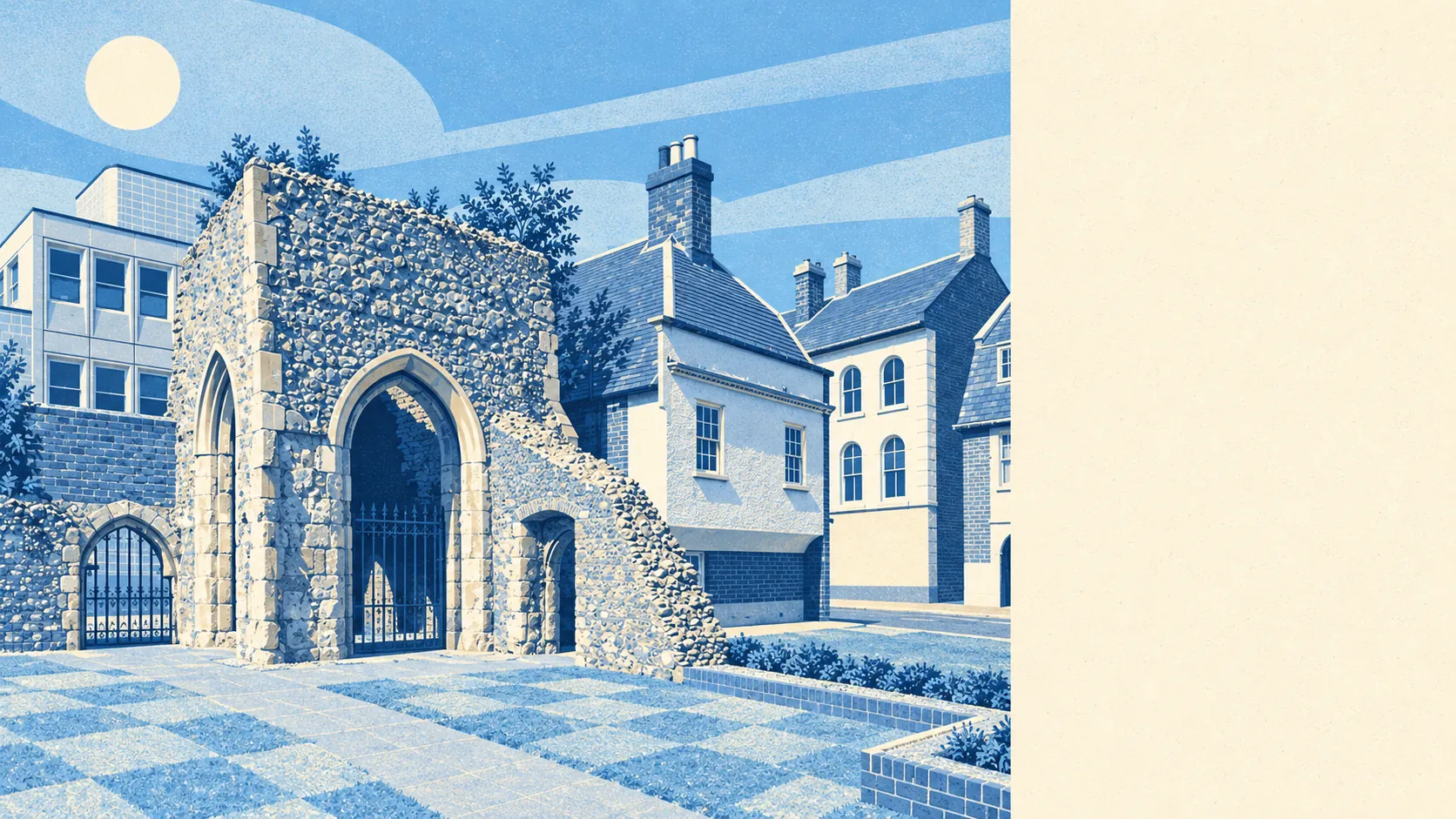
You can extend in Brentwood, but more of the town comes with conditions than its post-war semis suggest. The listed buildings are in the hundreds. Several conservation areas cover the older corners. Every square metre sits on clay that moves. The council's planning team clearly isn't short of work.
Historic England lists 186 buildings in and around Brentwood. One is Grade I, 14 are Grade II* and 171 are Grade II. Listing covers the inside of a building as well as the outside, so a new kitchen wall, replacement windows or a rear extension on a listed house all need listed building consent on top of any planning permission. Most of that stock is old inns, churches, halls and farmhouses rather than ordinary family homes, but the scattered cottages among them can turn up anywhere from the High Street to the villages.
Nine conservation areas fall within the area, among them Brentwood Town Centre, Hutton Village, South Weald, Great Warley, Herongate, Thorndon Park and Warley Place. Inside them, demolition, some external changes and work to trees need extra consent, and the council looks harder at materials and how an extension looks from the street. A side extension that would barely be noticed on an estate in Pilgrims Hatch can mean months of correspondence about roof pitch in South Weald. Check the council's conservation area map for the exact property, because the boundaries can cut through a single lane.
Two scheduled monuments are in the area. That is the strictest level of protection there is, and it matters mainly if your land runs up to one.
People here are clearly building anyway. The council received 2,759 planning applications between April 2024 and June 2026, and 1,216 in the last twelve months. The town's builders are not waiting for permission to arrive by itself.
The ground is a bigger factor for most extensions than the heritage rules. The British Geological Survey puts the whole area in shrink-swell class 3, a moderate hazard. Clay soils swell when wet and shrink in dry summers, and nearby trees make it worse. That generally means deeper foundations than a builder would dig on firmer ground, plus a structural engineer's assessment and early agreement with building control. It adds cost and time but it is ordinary for this part of Essex. Brentwood's pilgrims walked here on the same clay, and they never had to argue about foundations.
Two listed buildings in the area are on Historic England's Heritage at Risk register. That means buildings in poor repair, where restoration may get grant support and will get close scrutiny. They matter to whoever owns them, not to someone extending a semi down the road.
In practice, the semis, terraces and bungalows that make up most of Brentwood can often use permitted development rights for modest rear extensions and loft conversions, subject to the national limits and a prior approval check. Only 14% of the town's homes were built before 1930. Step into a conservation area or onto a listed property, though, and those rights shrink or vanish, and every change goes through a full application.
Brentwood gives you less freedom to extend than its ordinary housing suggests. Heritage controls bite in the older pockets, and clay ground under the whole town makes every extension a foundations job first.