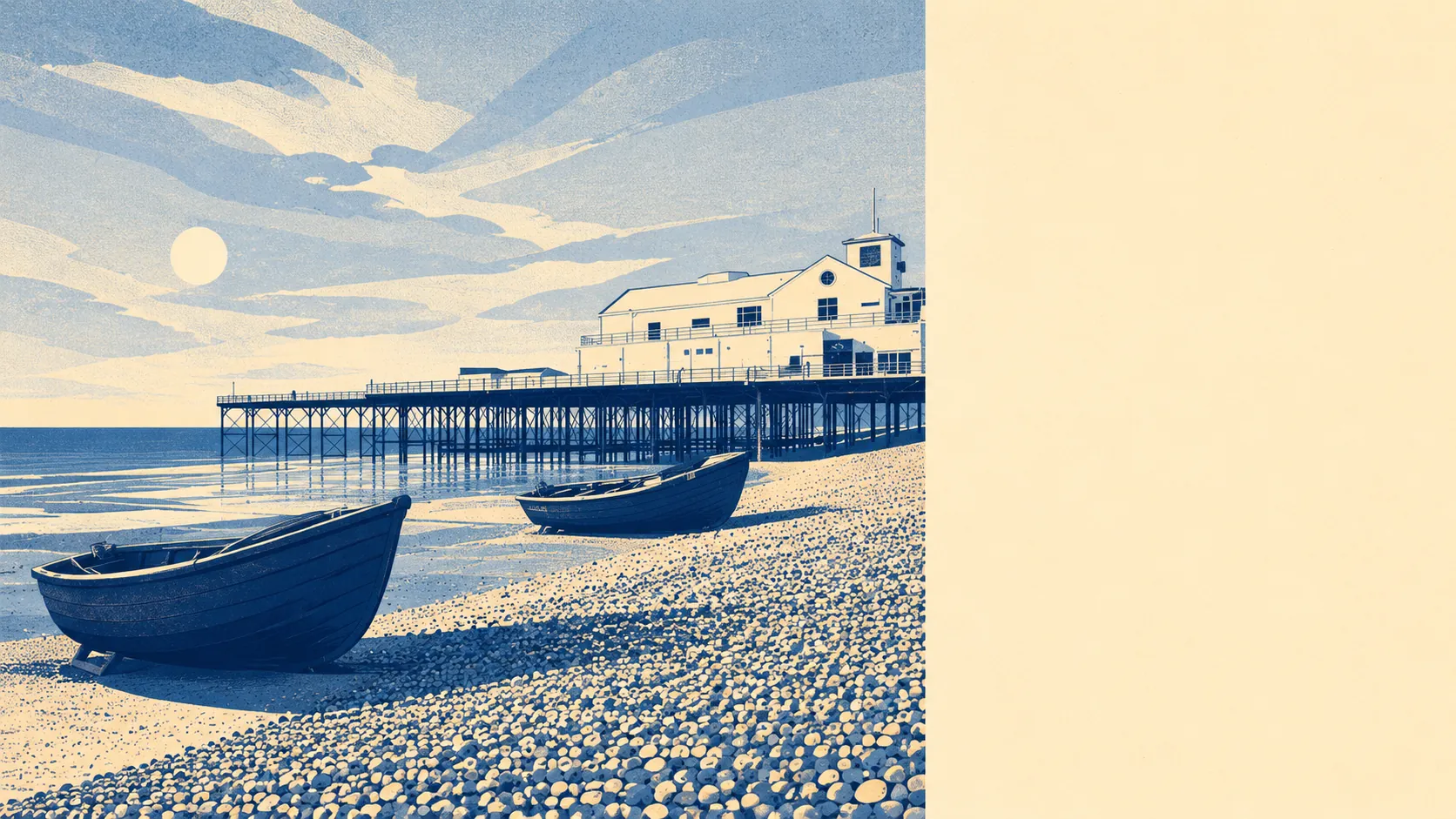
The area around Bognor Regis is flat coastal country at the bottom of West Sussex. The typical home sits within 200 metres of a park or open space. Eighteen green spaces lie within a kilometre on average. The median distance to the coast is about 750 metres. The surroundings carry the town more than the town carries them.
On green space, the figures are properly good. The typical address in Bognor Regis sits about 195 metres from a park, common, playing field or other open space, with an average of 18 such spaces within a kilometre of any given front door. Water is just as close: about 270 metres to the nearest blue-space asset (a river, pond, watercourse or stretch of coastal water), with an average of 49 within a kilometre. The national cycle network is about a kilometre from a typical home, with around three in ten addresses close enough to use it without a journey first. None of the formal landscape designations register inside the town's own boundary: no Area of Outstanding Natural Beauty, no Site of Special Scientific Interest, no ancient woodland on the map. The protection here is geography rather than designation.
The character of the area is small-villages-and-coast more than it is suburban-belt. To the east of the town, Felpham, Middleton-on-Sea and Elmer continue the same low-rise coastal pattern, with flat farmland sitting behind. Felpham carries Blake's Cottage on the listing register, which gives it a literary footnote the rest of the area cannot match. To the west, Aldwick and Pagham trade the seafront strip for a quieter shoreline, with Pagham Harbour and the Phoenix Caisson, the abandoned D-Day Mulberry Harbour pontoon stuck on the beach since 1944, marking the western boundary. Inland villages, including Barnham, Yapton, North Mundham, Runcton, Woodgate, Climping, North Bersted and South Bersted, sit at distances that make each one its own small place rather than a continuation of the town, each with its own pub, its own parish church and most with their own conservation area. The town centre itself carries Hotham Park as its green heart, the Royal Norfolk Hotel as the seafront landmark, and a clutch of conservation stretches around The Steyne and Waterloo Square that nod to the early twentieth-century resort years. The Cathedral cities and the wider South Coast are within an hour by road or rail in either direction, and the inland villages thin out into farmland faster than they do around larger south-coast towns.
The surroundings are the part of Bognor Regis that needs no defending. Open coast on one side, a chain of small villages on the other, a park within 200 metres of nearly every front door, and a flat geography that makes all of it walkable, cyclable and quietly liveable.