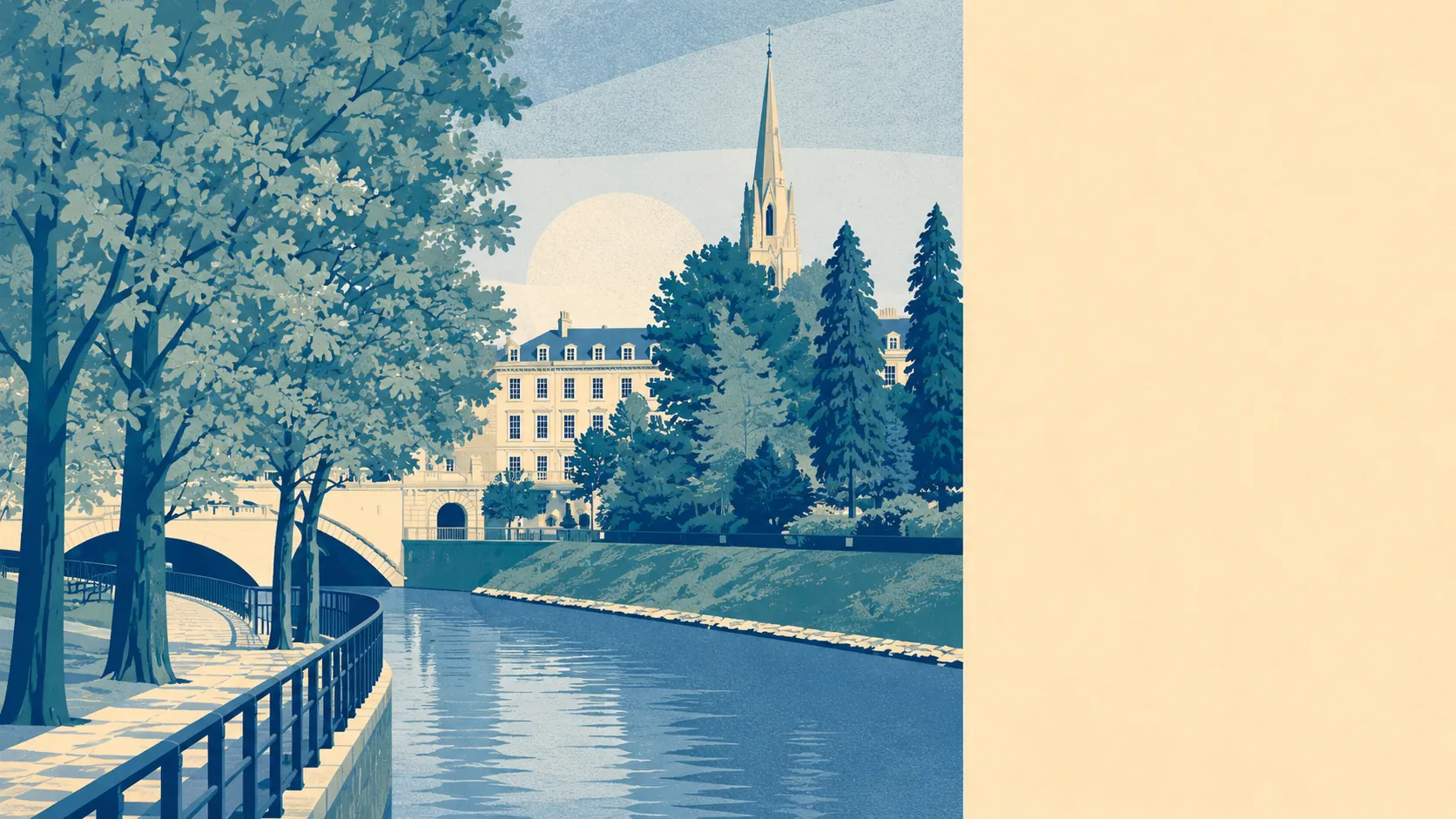
Batheaston is Bath's overflow car park with a river running through it, and that undersells it badly. Most people here own their homes outright. Almost half the working population never leaves the house to work. Crime runs at roughly half the rate of the wider district. It is not a suburb pretending to be a village, it is a village that got a bypass and decided that was enough excitement for one century.
The housing is the ordinary sort, which in this part of Somerset is the surprise. The council-tax valuation list, which covers every dwelling rather than just the ones sold recently, puts terraced houses at around 26% of stock and detached at about 26% too, with semi-detached at roughly 19% and bungalows at about 13%. Flats make up around 15%. About 34% of the stock predates 1930, which is lower than the Georgian-postcard version of Bath would lead anyone to expect: a good deal of Batheaston went up in the post-war decades and looks it. On energy certificates, band D is the single largest group at about 43% of certificated property, with roughly 20% sitting at band E or worse and about 37% reaching band C or better. Around 74% of homes run on mains gas. Only a small share, roughly 8%, are on electric-only heating, which matters because an older stone-built house on electric heating is a running cost you want to know about before the second viewing rather than after the first winter.
On price, the Land Registry's last twelve months of sales record a median of about £425,000 across 41 transactions, with the wider Land Registry house price index putting the average at roughly £406,000 as of May 2026, up about 1% over the year. The type split does most of the work: terraced houses came in at a median of around £350,000, semi-detached at about £510,000, flats at roughly £268,000, and detached at approximately £1,169,000 across just six sales, which is a small enough number of transactions that it describes those six houses more than it describes the village. Median price per square metre, for the sales that could be matched to a floor area, sits at about £4,300. Council tax is banded low relative to the price tags, with band B the most common and around 27% of dwellings in bands A or B combined. A band D bill runs to roughly £2,380 a year.
Renting is a different market entirely. Typical private rent across the Bath and North East Somerset area runs at about £1,880 a month as of April 2026, up around 8% on the year. That is an area-wide figure covering the city as well as the villages, so it reflects Bath's own rental pressure rather than Batheaston's specifically. By size across the same area, one-bedroom homes average around £1,200 a month and three-bedroom homes about £1,800.
Safety is where Batheaston does genuinely well. The published rate over the twelve months to May 2026 is roughly 47 crimes per thousand people, against about 90 per thousand across Bath and North East Somerset as a whole. Burglary makes up a larger share of the local mix than the England and Wales pattern, at about 11% of recorded offences against roughly 4% nationally, though on a total this small a handful of incidents moves a percentage several points and none of it should be read as a settled characteristic. Avon and Somerset Constabulary charges in around 11% of cases, close to the national figure of about 12%.
Schools are the strongest thing in the file. Ofsted has graded 41 settings across Bath and North East Somerset and rated 39 of them good or better, four of those outstanding. Locally, Batheaston Church School serves the village itself, with Bathford Church School and Swainswick Church School in the neighbouring parishes and St Mark's Church of England School and Oldfield School among the secondary options. Key stage two maths across the local districts averages about 106. Journey times are short for primary, at roughly 10 minutes on foot, and considerably longer for secondary, at around 26 minutes by public transport.
Connectivity is the weak spot, and it is not close. There is no station here: Bath Spa is the nearest and only about 1% of residents commute by train. Roughly 35% drive to work, about 4% take the bus, and around 49% work from home, which is less a lifestyle statement than a solution to the commute. There are 25 bus stops in the area with an average of about 287 scheduled weekday departures per stop and weekend service at every one of them, so the buses into Bath are real. Broadband is the other half of the problem: about 96% of premises can get superfast, but only around 42% can get gigabit. For a place where half the workforce is at a desk at home, that gap is the single most consequential number here.
The Environment Agency's mapping puts roughly 3% of the area in the river-and-sea flood zone three and about 2% in zone two. On the broader postcode indicators, which include surface water, around 13% of postcodes carry a high rating on at least one measure and about 30% carry a low one. Seven flood events are on record, the most recent in October 2000, caused by channel capacity being exceeded where no raised defences existed. The compensation is the setting: green space averages about 260 metres away with roughly nine sites within a kilometre, water is about 240 metres away, and around 13% of the area falls inside the Cotswolds Area of Outstanding Natural Beauty. Landslide susceptibility is classed at level three across the area and radon sits in the highest band, both of which a surveyor will want to discuss.
Heritage is a genuine constraint rather than a decorative one. There are 181 listed buildings in the area, eight of them grade two star, and two conservation areas covering Batheaston and Bathford. If a house sits inside either, window replacements, extensions and anything visible from the street go through consent. The upside is that the streetscape cannot be ruined by a neighbour; the downside is that it cannot be improved by you either, at least not quickly.
The character follows from the ownership pattern. Around 77% of homes are owner-occupied, the median age is about 46, and median household income runs to roughly £72,000 gross before tax. Roughly a quarter of households are single people and about 14% are single pensioners. It is a settled place with low turnover, which is pleasant if you are settling and slow going if you are trying to meet people.
It suits families who want Bath schooling and Bath scenery without Bath prices, home workers who can live with superfast rather than gigabit, and anyone whose idea of an evening out involves a walk up Solsbury Hill rather than a taxi home.
It does not suit anyone who needs a train, anyone buying a period house without reading the conservation area boundary first, or anyone who thinks the bypass took the traffic away permanently.
The history here is better than the village lets on. Anna, Lady Miller ran a fortnightly literary salon that attracted David Garrick and the poet Anna Seward and was thoroughly mocked for it, which is a very Batheaston combination of ambition and being taken down a peg. Eagle House, remodelled by John Wood the Elder as his own home, later sheltered suffragettes released from prison after hunger strikes, and Mary Blathwayt's family planted a tree for each of them, Emmeline Pankhurst and Millicent Fawcett among the names. The trees were later cleared for a housing estate. William Lonsdale the palaeontologist and John Josias Conybeare, who translated Beowulf and was vicar here, are both on the roll.
Batheaston is a good place to live, and the ratings on this page bear that out on balance. Its real strength is the community itself: low crime, high ownership, strong schools, and green space at the end of every street. The weak spot is transport and connectivity, and it is a real one, because no station and patchy gigabit is a specific bet on a specific kind of life. Make that bet knowingly and the village rewards it. Make it accidentally and you will spend a lot of time on the A4.