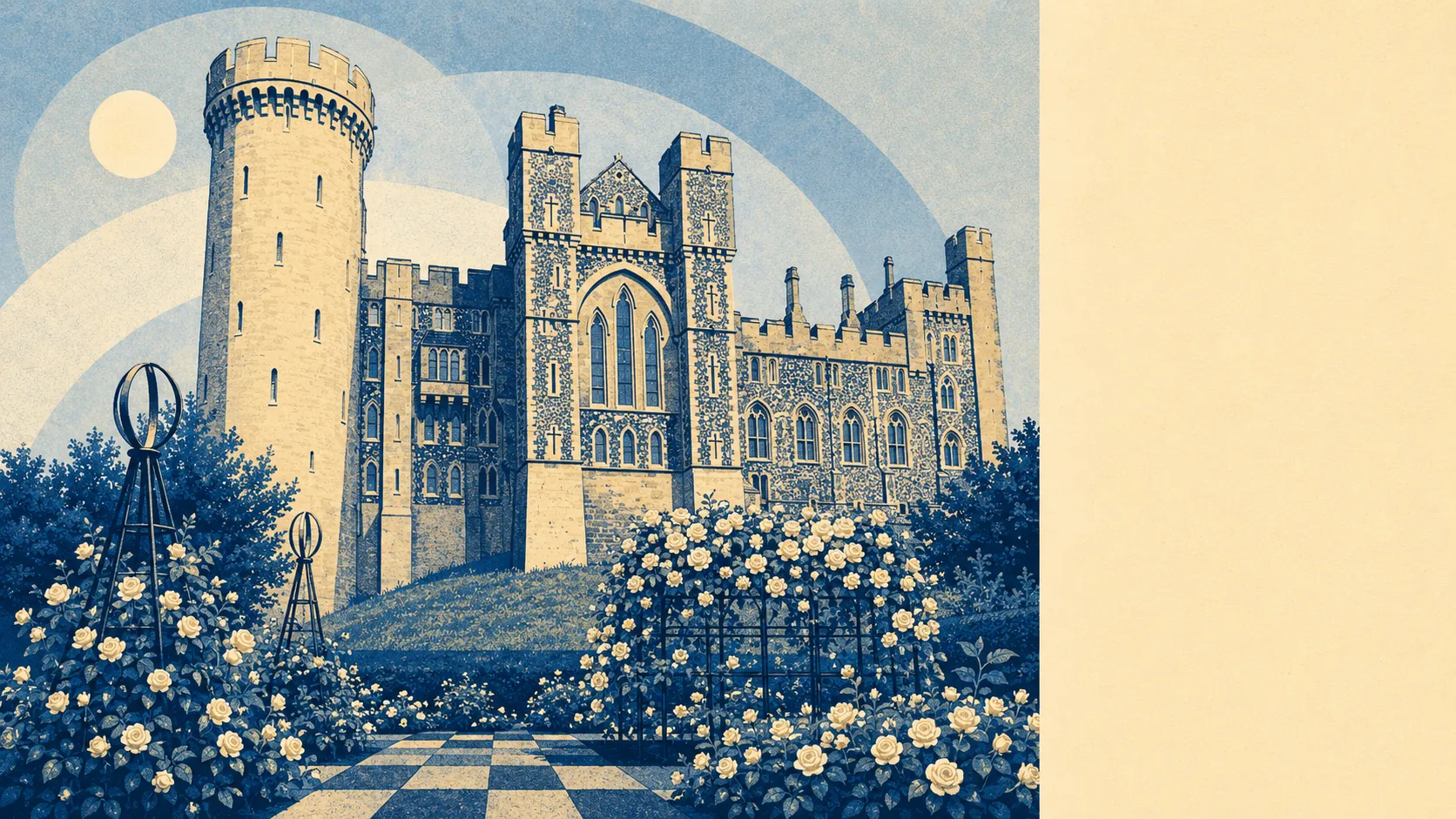
Arundel is a market town that pretends it's still Victorian and mostly gets away with it. The castle is a real castle. The cathedral is a real cathedral. Two hundred and two listed buildings sit inside a single conservation area. The A27 goes round it and the world goes past it, which is exactly how Arundel likes things.
The housing stock is what you'd expect from a town shaped in the Norman period and last substantially rebuilt when petrol was still leaded. Houses dominate at about two-thirds of the stock, flats make up around a quarter, and bungalows fill in most of what's left. The energy ratings tell you what a market town with a lot of pre-1930 stock looks like on a certificate: about two in five homes sit at band D, another one in five at band E or worse, and only about four in ten manage band C or better. Roughly a third of homes were built before 1930, which is the polite way of explaining why the boiler is always the topic at dinner.
Prices land where a market town in West Sussex, with a castle over its shoulder and a river running through it, ought to land. The typical sale over the last twelve months came in at roughly £408,000 across about fifty transactions. Detached houses cleared roughly £875,000. Terraces went for about £460,000, semis for around £385,000, and flats for around £235,000. Council tax puts the modal home in band C, but only about one home in seven sits in bands A or B, which tells you the cheap end here isn't very cheap.
Rent runs to about £1,220 a month as the typical private rent across the Arun area, which is a local-authority figure pooling Arundel with Littlehampton, Bognor Regis and the rural parishes. Arundel itself sits at the upper end of that picture rather than the middle; the Bognor terraces drag the average down and Arundel's listed cottages push it back up.
Safety is fine on the published numbers. The recorded crime rate works out at roughly 85 per thousand residents over twelve months, which is around six per cent below the Arun local-authority average. That number is the police-published rate; do not do your own arithmetic with the resident population because the denominators don't match. What it means in daily life is what a small market town with a modest evening trade and a lot of retired people generally means: quiet.
Getting anywhere involves Arundel Rail Station, which sits on the Arun Valley Line and puts you on trains to London Victoria, Brighton, Chichester, and the string of coastal stops through Ford, Barnham, Littlehampton, Amberley and Angmering. The A27 congests. About one in fifty residents commutes by train and around four in ten drive to work, but the biggest single group at around thirty-eight per cent works from home, which is what a town like this looks like once the professional-class incomers arrived with laptops. Broadband is fine: nearly every property can get superfast, roughly a third can get gigabit, and hardly anyone falls below the universal service floor.
Environmentally, the town is greener than most places and wetter than it looks. Green space averages roughly a hundred metres from the door and the typical home has close to eighteen patches of green within a kilometre. The wet is the price of being on the Arun. About a quarter of postcodes carry some level of high flood risk and another quarter carry medium, and about one in seven of the town's postcodes sits inside Environment Agency Flood Zone 3. Buy near the meadows and you will need to think about insurance and understand where the last serious event went.
The heritage picture is the town's defining constraint. Two hundred and two listed buildings, of which four are Grade I and five are Grade II starred, all sitting inside the Arundel conservation area. That means Arundel Castle, Arundel Cathedral of Our Lady & St Philip Howard, Fitzalan Chapel, Hiorne Tower, the Norfolk Hotel, and rows of high-street Georgian and Victorian frontages, plus the medieval churches in the surrounding parishes. Practically speaking, changing your windows involves consent, changing your roof involves consent, changing your front door involves consent, and painting the wrong colour will produce a letter. The upside is that the town will look much as it does now for a long time, which is exactly what buyers here are paying for.
Character-wise, the numbers describe a town owned by people who have been here a while and are not going anywhere. About seven in ten homes are owner-occupied, the median resident is fifty-four, roughly a quarter of homes are single pensioner households, and the typical total household income comes in around £58,000. About one in seven households has no car and about four in ten households have two cars or more, which is the split between the terraces in the old town and the semis on the plots below the A27.
The page also covers the parishes and hamlets that share Arundel's postcodes and its rhythm: Amberley to the north with its thatched cottages and its rail station, Ford just south along the river, Madehurst tucked into wooded valleys three miles north-west, Poling out toward the A27, Tortington between the Chichester and Ford roads, Walberton and its clustered medieval church, and Warningcamp on the east bank of the Arun. Each has its own conservation area, its own church, and its own opinion about the bypass.
Who it's for: people who wanted a real market town rather than a village pretending to be one, who don't mind an EPC in the middle of the alphabet, who can live with a train timetable that isn't quite theirs and a river that occasionally is, and who understand that the price of a Grade II front door is that it stays a Grade II front door.
Who it's not for: people who wanted a driveway and a garage, people who wanted the London commute to work five days a week, people who wanted a nightlife, and anyone who thought the castle would come with a discount because it's next door.
Historically the town has attracted the kind of resident who liked its scale. Christopher Alexander, the architect. Mary Chater, composer and Justice of the Peace for the town from 1945 to 1961. Derek Davis, potter and painter. Judy Geeson, the actress. It is not a place people move to in a hurry, and not a place they leave in one either.
The verdict comes out at 3 out of 5. Nothing about Arundel is bad. The surrounding area and green-space access are the strongest thing about the place at 5 out of 5. House prices and value are the weakest at 2 out of 5, which is what you get when the town has a castle, a cathedral, and about two hundred listed buildings between them and the buyer. If you want the postcard, you pay for the postcard.