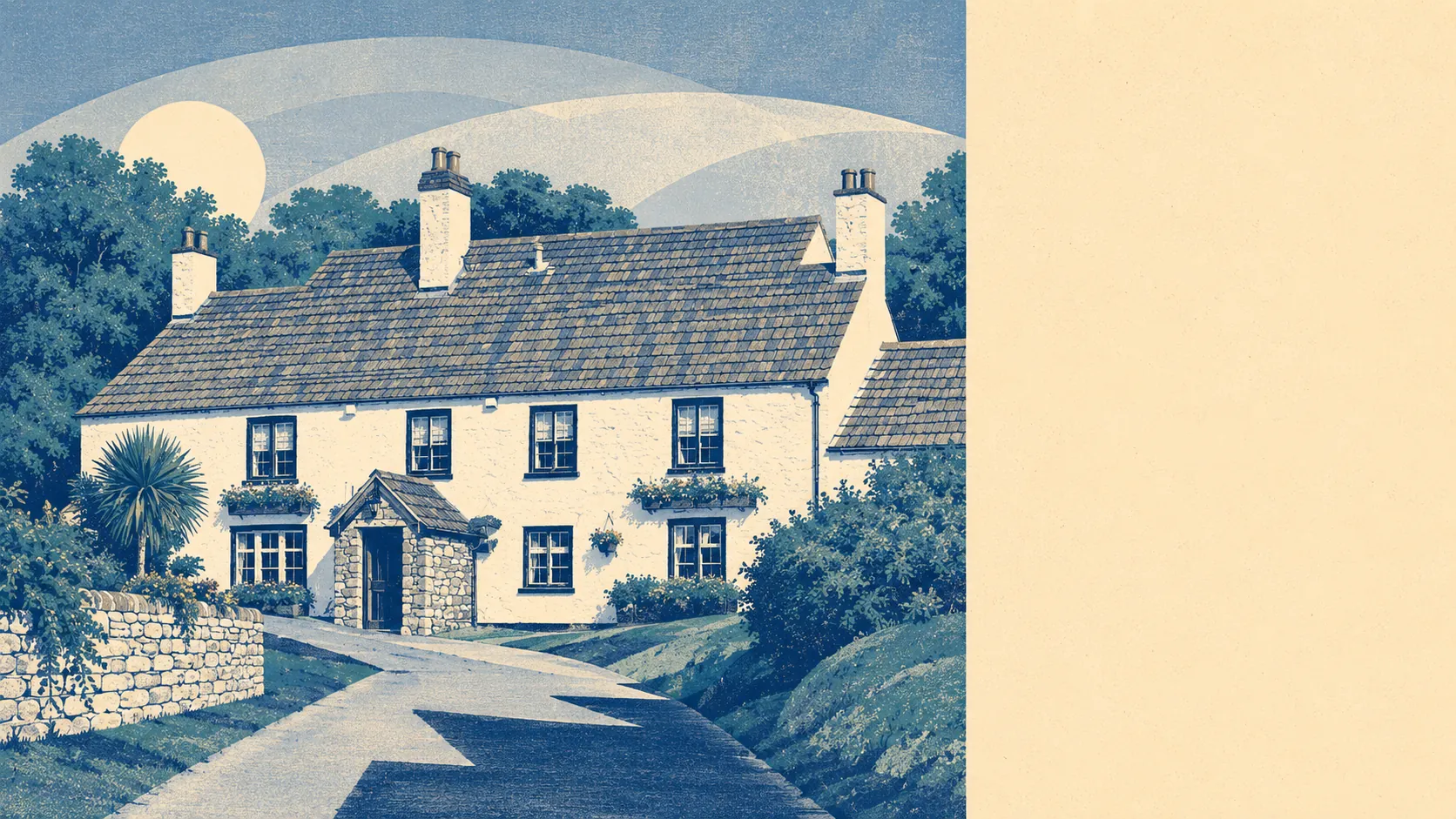
Yes, if you can afford the entry fee and you like your countryside served with a side of motorway. The green space starts about 200 metres from most front doors. Crime runs well under the county picture. The typical house sold last year went for well over half a million. Almondsbury is a village that priced itself like a village people fight to get into, and then parked itself next to the junction where the M4 crosses the M5.
The housing stock explains a lot of that price. Detached houses run the place at around 45% of every dwelling on the council-tax list, with semis at roughly 19% and terraces at about 17%. Flats barely register, at around 5%, and bungalows sit at about 11%, which is a stock built for people with cars and children rather than people with a suitcase and a lease. Around 21% of it went up before 1930, so the village core is genuinely old and the rest is not. Energy performance splits about evenly: roughly 46% of certificated property sits in bands A to C, around 27% in band D, and about 26% in band E or worse. Just under two-thirds run on mains gas. Only about 3% are electric-only, which is the number worth knowing, because an electric-only older house in this stock is the one that will surprise you in January.
The Land Registry's last twelve months put the typical sale at £610,000 across 27 transactions, which is not a deep market. The split by type is where it gets brutal: detached homes came in at a median of £760,000, semis at £429,000, terraces at £387,500. That is not a gentle gradient, it is a cliff, and which side of it you land on depends almost entirely on whether the house has walls it shares. Council tax follows the same logic. The most common band is F, and only about 18% of dwellings sit in bands A or B combined. A band D bill runs to roughly £2,550 a year, band F and above rather more.
Renting is the escape hatch nobody uses much here. Typical private rent across the South Gloucestershire area is about £1,450 a month, up around 4% over the year. That is an area-wide figure rather than the village's own, and given the local stock skews detached and family-sized, the three-bedroom figure of roughly £1,530 is the one that will feel closest to reality on the ground.
Crime is the easy part of the answer. The published rate is about 49 recorded crimes per thousand residents over the twelve months to May 2026, which sits roughly 41% below the Avon and Somerset average for the wider authority. That is a genuinely strong position and one of the cleanest results in the whole picture. The mix carries the usual caveat that violence and sexual offences is a broad statutory grouping that tops the list nearly everywhere, and with a total of 236 recorded crimes the shares move around on small numbers.
Connectivity is where the honesty gets uncomfortable. Almost half the working population drives to work, at around 47%, and roughly 44% work from home. Train use registers at almost nothing. Bristol Parkway, Patchway and Filton Abbey Wood stations all sit within reach, but they sit outside the village, and the commuting pattern shows exactly how many people bother. Buses are better than the reputation suggests: 31 stops in the area, 23 of them with published service data averaging around 127 weekday departures each, and every one of those keeps a weekend service. The Department for Transport's modelling puts the nearest town centre at about 15 minutes by car and around 31 by public transport. Broadband is the quiet win. Gigabit service reaches about 71% of premises, superfast covers all of them, and nothing falls below the universal service obligation.
On flooding, the Environment Agency's river-and-sea flood zones cover none of Almondsbury. Zero percent in zone two, zero in zone three, and no recorded historic flooding. The broader postcode indicators, which include surface water and other sources, are less absolute: around 12% of postcodes carry a high rating on at least one flood indicator, roughly 16% a medium one. Surface water is the risk here, not the river. Green space is the compensation and it is substantial. The average postcode sits about 200 metres from green space with nearly eight separate green spaces inside a kilometre, and water is about 490 metres away. Radon sits in the elevated band across the area, which is a testing matter rather than a dealbreaker. Ground conditions are otherwise unremarkable, though about 8% of the area falls within the coalfield consultation zone and a handful of postcodes have a recorded mine directly beneath.
Heritage constraints are real but contained. There are 25 listed buildings in the area, one of them Grade One and the other 24 Grade Two, and a single conservation area at Lower Almondsbury. If your house is inside that boundary or on the list, window replacements and extensions become a conversation with the council rather than a decision you make on a Saturday. Outside it, the usual rules apply and the Green Belt does more to constrain what gets built than any heritage designation does.
The neighbourhood character follows the stock. Around 81% own their homes, the typical resident is 46, and median household income runs to roughly £63,400. Working from home at that rate, in houses that size, with that ownership level, produces a place that is quiet on a Tuesday afternoon in a way that people either find restorative or unnerving within about a fortnight.
It suits families with equity behind them, people who work from home or drive to work, and anyone who wants a lot of green within walking distance and does not need a station platform within the same walk. It does not suit first-time buyers, people who want a flat, or anyone whose commute depends on trains they can reach on foot. The rental market is thin, so it is a poor landing pad for anyone testing the area before committing.
The village has a longer memory than the motorway suggests. Saint Mary's church dates from 1140, and its lead-covered spire was added before 1619. Miles Partridge was a courtier to Henry the Eighth who won the bells of Saint Paul's off the king in a gambling bet and then broke them, which remains an admirably petty way to make a political point. Cattelena, who died in 1625, ran a small dairy business here. And in 1817 the village was comprehensively taken in by a woman calling herself Princess Caraboo, one of the more elaborate hoaxes of the period. Alex Kapranos of Franz Ferdinand is the modern entry on that list.
Almondsbury is above average as a place to live, and the reason is the ground it sits on. Its real strength is the surroundings: green space at the door, water nearby, no river flood zone, and a crime picture well under the county norm. The weak spot is price and value, where a shallow market and a median well past half a million mean you pay a premium and get thin choice for it. Buy here for what is outside the house, because that is what the money is actually purchasing.