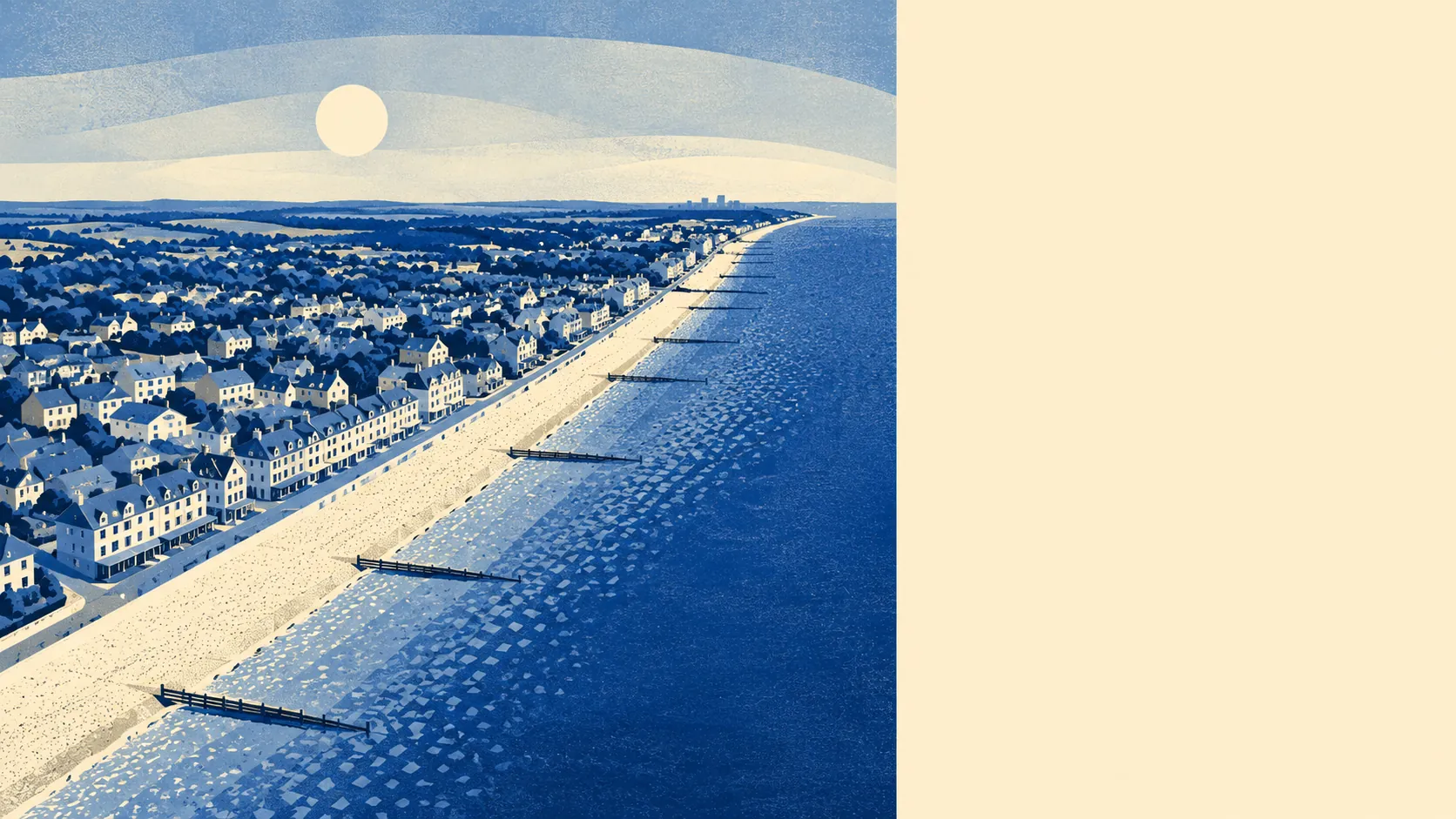
Bungalows, blue cedars, and a king's convalescence. Median age sixty-two. A bit over one in three homes is a bungalow. Nearly nine in ten households own. Not Sandbanks. Not Whitstable. The genteel western flank Bognor borrowed its Regis from.
The stock is post-war and bungalow-heavy in a way that tells you everything. Houses make up about four in ten of the homes, bungalows about a third, flats just under one in five. Most of it went up between the early fifties and the early eighties, when the seaside village got its big push. About three in ten energy ratings come in at band C or better. Roughly half sit at band D. About one in six is band E or worse, which is what a place looks like when it builds a lot in the seventies and stops bothering with the insulation budget twenty years later.
A typical sale lands at about £390,000 across the eighty-eight homes that changed hands in the last year. Detached buyers pay around half a million. Semis go for the high three hundreds. Terraces sit around £325,000. Flats around £220,000. Council tax mostly sits in band D and above, with only about one home in fifteen in band A or B, which is the polite way of saying nobody bought here for the council tax.
Typical private rent across the Arun area is about £1,220 a month. That is the local-authority figure, not the village's own, and Aldwick rents thinner because most of it is owner-occupied retirees rather than landlords. If you are renting here you are in the small minority, and the available stock is what is left over after the buyers have had their pick.
Crime runs at about forty incidents per thousand residents a year, which is roughly fifty-five percent below the Arun average. The village is one of the quieter postcodes on the south coast. The reason is mostly structural: a place where the median age is sixty-two and about one in five homes is a single pensioner does not generate the kind of activity that fills a police report.
Three in ten work from home, which is the actual transport network for nearly a third of Aldwick. More than half drive to work. One in eighty takes the train, one in twenty walks, one in fifty cycles. There is no station in the village. The nearest are at Bognor Regis, Barnham and Chichester, all a short drive but none in your pocket. Bus stops cluster around fifty across the area. Superfast broadband reaches every postcode, and gigabit reaches about three-quarters of them. It is the kind of place where you do your meetings from a glassed-in garden room and pretend you commute.
Roughly one postcode in a hundred sits in a high flood band. About two in a hundred sit in medium. Around one in four touch a low risk somewhere along their edge. The coast is close enough to be the point of moving here. Green space averages about two hundred and sixty metres from the front door. Blue space, the sea and Pagham Harbour and the rifes running inland, sits closer still. The wind off Pagham Harbour is the loudest thing on most streets most days.
Sixteen listed buildings sit in the area, all of them Grade II. Two conservation areas cover the village core and the Aldwick Road stretch into Bognor. If you own one of the listed properties you are talking to the council about every window. If you own anything inside the conservation area you are talking to them about the front elevation. If you own one of the post-war bungalows that make up the bulk of the stock you can mostly do what you like, which is the cheerful secret of Aldwick: heritage where it matters and a free hand everywhere else.
Roughly nine in ten households own their home. Median age is sixty-two. Median household income is about £49,000 a year, which is what an area looks like when most of the money is already saved rather than still being earned. About one home in five is a single pensioner. Couples with children make up about one home in nine. The village is calm, ordered, and quiet because the people in it have largely passed the stage of life where calm and ordered and quiet felt like punishments.
If you are retiring or downsizing into a south-coast bungalow with a manageable garden, a sea breeze, and council-tax bills you will not enjoy but will absorb, Aldwick is one of the better-value versions of that life on this stretch of coast. The detached at half a million makes more sense once you compare it to what the same property costs in Sandbanks, or even in the smarter parts of Worthing.
If you want oyster bars, indie record shops, late-night anything, or a station at the end of your road, you have come to the wrong place and the algorithm should have told you. Move to Worthing if you want a town that is still trying to be a town. Move to Frinton-on-Sea if you want Aldwick with slightly tighter manners and no Bognor next door. Move to Whitstable if you wanted hipster gentrification and got confused on the train map.
King George V convalesced at Craigweil House in 1929. The visit was significant enough that Bognor was permitted to add the suffix Regis afterwards. The house has since been demolished. Queen Mary planted a blue cedar that same year as a marker. Duff Cooper took the title Viscount Norwich of Aldwick in 1952. Albert Grant lived at Aldwick Place and died there in 1899. Raine Spencer, socialite, daughter of Barbara Cartland, and stepmother to Diana, Princess of Wales, lived here until her death in 2016. The residents list reads like a B-roll of twentieth-century English drawing-room life, which is exactly the kind of village this is.
On the headline question, Aldwick rates four out of five. The local community scores the maximum five: low crime, high ownership, well-off, well-housed, an honest village answering only to its own pace. The lowest mark is transport at two and a half, a place built for residents who have already arrived rather than ones still commuting somewhere. It is not Sandbanks and it is not pretending to be Whitstable. It is Frinton with a Sussex accent and a blue cedar, sold at Worthing money, and the people who would be happy here mostly already know that.