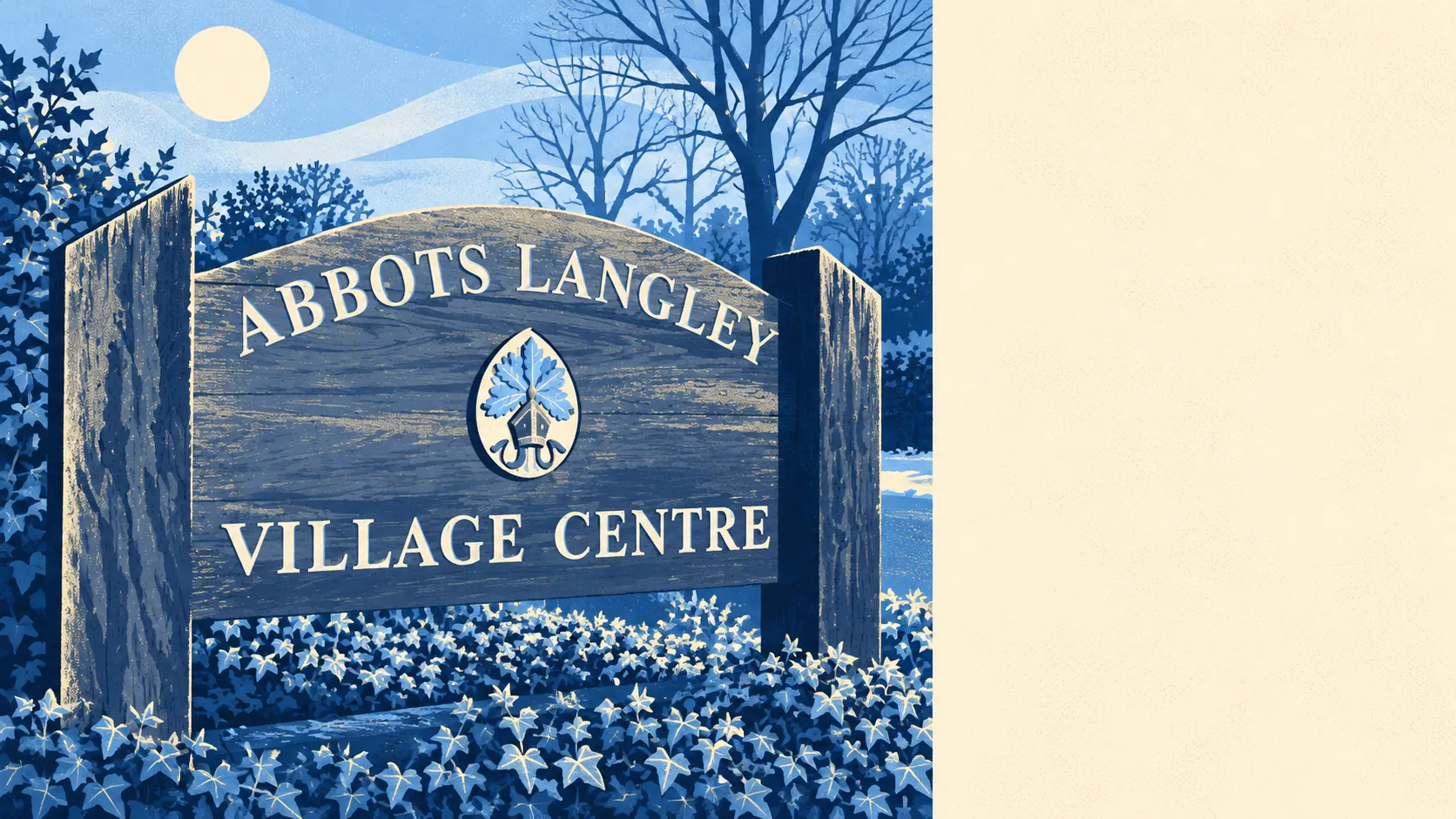
Abbots Langley gets the big, expensive risk right and lets the small, irritating one through. None of it falls in the river or sea flood zones. Its police log runs to about 79 crimes for every 1,000 residents, and antisocial behaviour takes a bigger share of that than it does nationally. Dry basements, busy bus shelters.
The flood picture is the easy part. On the Environment Agency's river-and-sea flood zones, 0% of the Abbots Langley area is in zone 2 or zone 3, and none of its postcodes falls in an area with recorded historic flooding. A wider postcode measure counts surface water as well. On that one, about 4% of postcodes are at high risk on at least one indicator, 7% at medium and 23% at low. Here the water comes from a cloudburst on the road outside, and from no river at all.
Safety is where it slips. Police.uk figures for the year to May 2026 put the area at about 79 crimes per 1,000 residents, roughly 15% above the Three Rivers average of about 69. Violence and sexual offences make up 37% of the total against 35% nationally. That heading is a broad legal grouping that includes common assault without injury. Antisocial behaviour is the one that stands out, at 21% of recorded incidents against 16% across England and Wales. Across the whole county, Hertfordshire Constabulary charges about 11% of the offences it records, a shade under the national 12%, and ranks 23rd of 42 forces. That's mid-table: no relegation worries, and no trophies either.
Changing your house comes with paperwork. In and around the parish there are 150 listed buildings, three of them grade I and eight grade II*, plus 11 conservation areas, among them Hunton Bridge, Grove Mill and High Street and King Street. Inside those lines, new windows, extensions and demolition all go through the council first. On Tibbs Hill Road stands a Prince Albert's Model Cottage, copied from a design shown at the Great Exhibition of 1851 as model housing for the poor. The cottage has aged better than its mission statement.
The Land Registry recorded 106 sales in the year to late May 2026, with a typical price of about £459,000. By type, terraces went for about £426,000, semis £580,000, detached houses £911,000 and flats £250,000. The gap between a semi and a detached house is where the comfortable part ways with the very comfortable. Band D is the most common council-tax band, and only about 7% of homes are in bands A or B, so cheap bills are hard to find here.
Renting is costly too. Across Three Rivers district, the Office for National Statistics puts typical private rent at about £1,810 a month in April 2026, an average for the whole district and not this parish alone.
The council-tax list gives the housing mix: terraces 27%, semis 24%, flats 22%, detached houses 18% and bungalows 7%. Only about 11% of homes were built before 1930, which is a small share of old houses given all those conservation areas. Of the homes with energy certificates, about 48% are rated A to C, 37% D and 15% E or worse. About 81% heat with mains gas and 8% run on electricity alone. Most of the stock is post-war, with central heating and cavity walls. The old cores get the protection; nearly everyone else lives in what came after them.
The Census shows how people get to work. About 48% of workers drive, 39% work from home, 2% take the train and 1% the bus, even with Kings Langley, Garston and Watford Junction stations in the surrounding area. There are 361 bus stops. Each gets about 54 departures on a weekday and roughly three in the peak hour, and 76% have a weekend service. On the Department for Transport's modelled times from 2019, the nearest town centre is about 17 minutes by car and 30 by public transport, and bus timetables have changed since then. About 90% of premises can get gigabit broadband. The car still wins the commute, and the home office is the only thing coming close.
About 70% of households own their home, the typical resident is 42, and modelled gross household income averaged about £68,800 in the financial year to March 2023. Couples with children make up about 24% of households and pensioners living alone about 15%. The parish looks like people who bought, stayed, and now have a view on the hedge next door.
The schools are steady. Abbots Langley School, Tanners Wood Junior Mixed and Infant School, Divine Saviour Roman Catholic Primary School and Bedmond Academy, out in Bedmond, are the primaries. The four schools in the area averaged about 103 on the end-of-primary maths tests. Across the county, Ofsted grades 203 of 227 graded settings good or better, but that is Hertfordshire's record and says nothing about any one school here. The modelled walk to a primary is about nine minutes. To a secondary it's about 27, so parents spend those years arguing about bikes.
Most front doors are about 166 metres from the nearest green space, and the average home has around 25 within a kilometre. Water is about 530 metres away. Getting out for a walk is easier here than finding a parking space at the school gate.
It works best for owner-occupiers who drive or work from home, want a garden and plan to stay. It fits people less well if they rely on the train, want a Victorian house to strip back, or need streets where nothing much gets reported to the police.
Taken together, Abbots Langley is a better-than-average place to live. Floods are the risk you can mostly forget about here, while the antisocial behaviour is something you will notice. That is a fair deal for anyone who cares more about the house than about the street outside at night.