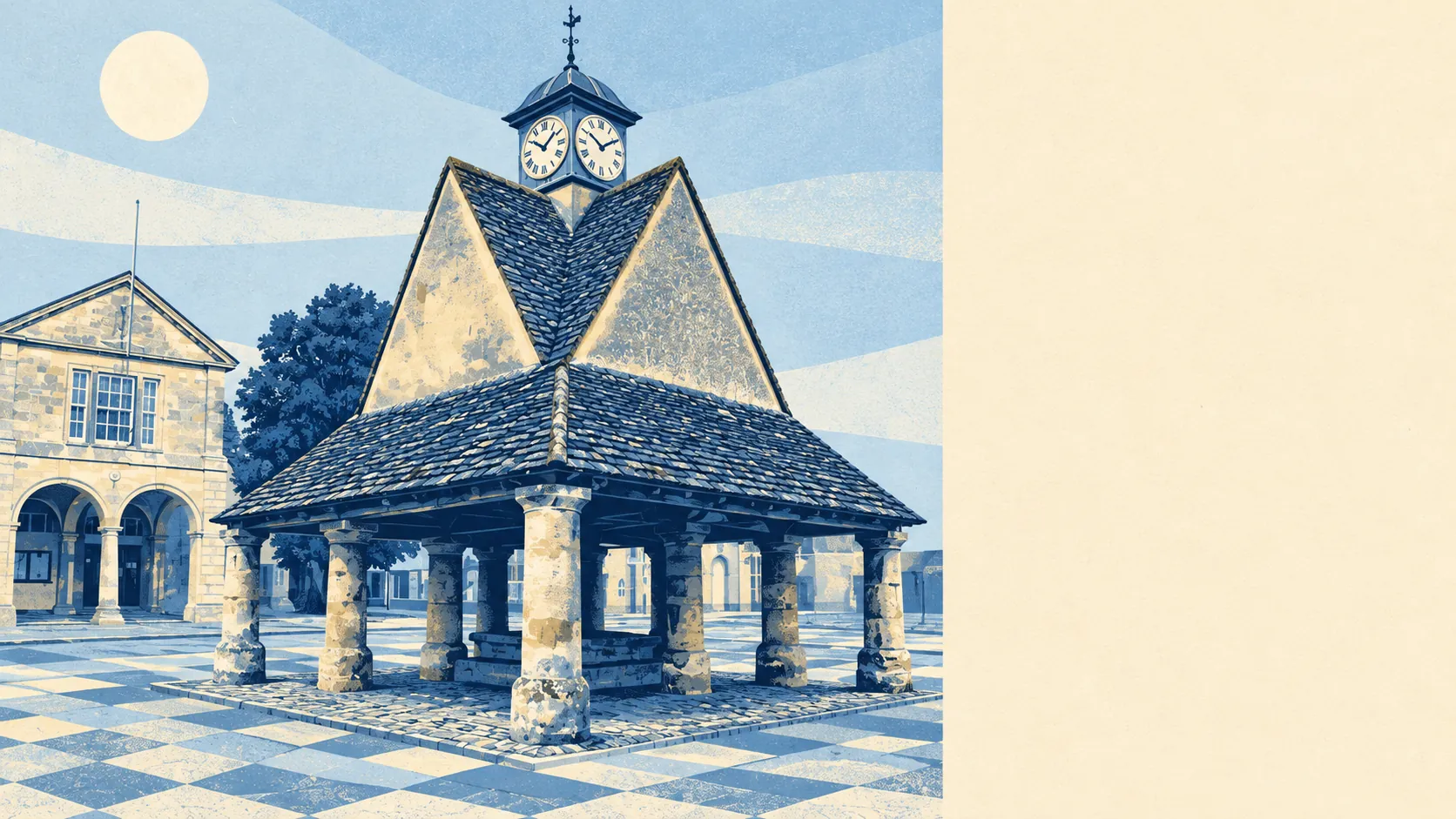
The country around Witney starts almost at the front door. A typical home is a couple of minutes' walk from green space. The River Windrush and its water meadows run through the town. Villages with ruined manors and Norman churches ring it. Witney is a market town with a working high street, set in farmland that nobody has formally protected, so you can enjoy it without a visitor centre.
The average Witney home is roughly 150 metres from public green space, with around 22 green spaces within a kilometre. That is parks, playing fields and riverside land spread through the estates as well as round the edge. Few households here have to drive anywhere to walk the dog.
Water is about 250 metres away on average, with around 50 bits of river, stream, pond and lake within a kilometre of a typical home. The town's name means "Witta's island", and the Windrush still splits into channels across the meadows, so the water is spread through the town rather than kept along one bank.
The nearest stretch of the National Cycle Network is about 1.5 kilometres from the average home, and only about 9% of homes are close to it. Bikes mostly ride on the roads and lanes out to the villages, and the network serves Witney's cyclists only patchily.
The rated-premises list counts 328 shops, 57 pubs and 22 restaurants in Witney. That is a high street built for buying things and for a drink afterwards. A night out here more often means a pub than a booked table.
West Oxfordshire's fine-particle air pollution averaged about 6.4 micrograms per cubic metre in 2024, a district-wide figure that covers the town and the farmland around it.
The town's character comes from its stone, its river and the villages around it. Witney and Cogges have a medieval moated manor and priory site. Minster Lovell, up the Windrush, has the ruins of Minster Lovell Hall and its dovecote. The villages this page also covers, Ducklington, Hailey, Crawley, Curbridge, North Leigh, Hardwick, Standlake, Stanton Harcourt and Yelford, fill the rest of the valley. Eynsham Hall's park, a Roman villa with its bath house and a section of Grim's Ditch are all in the wider area. Minster Lovell Hall has been a ruin for centuries and is still the most photographed building in the area.
Private gardens are generous. Witney has about 106,000 square metres of garden per 1,000 residents, measured across all 20 of its small statistical areas. Most homes are late-twentieth-century houses on estates laid out with lawns front and back.
The business-rates valuation list counts 1,159 rateable premises in the area. Beyond shops and pubs, the biggest groups are 270 office premises, 143 warehouse and store premises and 127 industrial premises. A rateable premises can be empty, so the list shows what the town has room for, which may be more than what is trading today. Witney still runs on work as well as on shopping.
Of the 187 food outlets with a hygiene rating, about 94% hold the top score, and under 1% are rated poorly. In practice, almost anywhere in town is safe to eat.
No area of outstanding natural beauty, no site of special scientific interest and no ancient woodland overlaps Witney. The countryside here is river meadow and working farmland. Nobody has protected it for its rarity, so walkers find fewer signs and fewer car parks full of other walkers.
The surroundings are Witney's best feature: green space, river and a ring of old stone villages, all within a short walk or ride of the average front door.