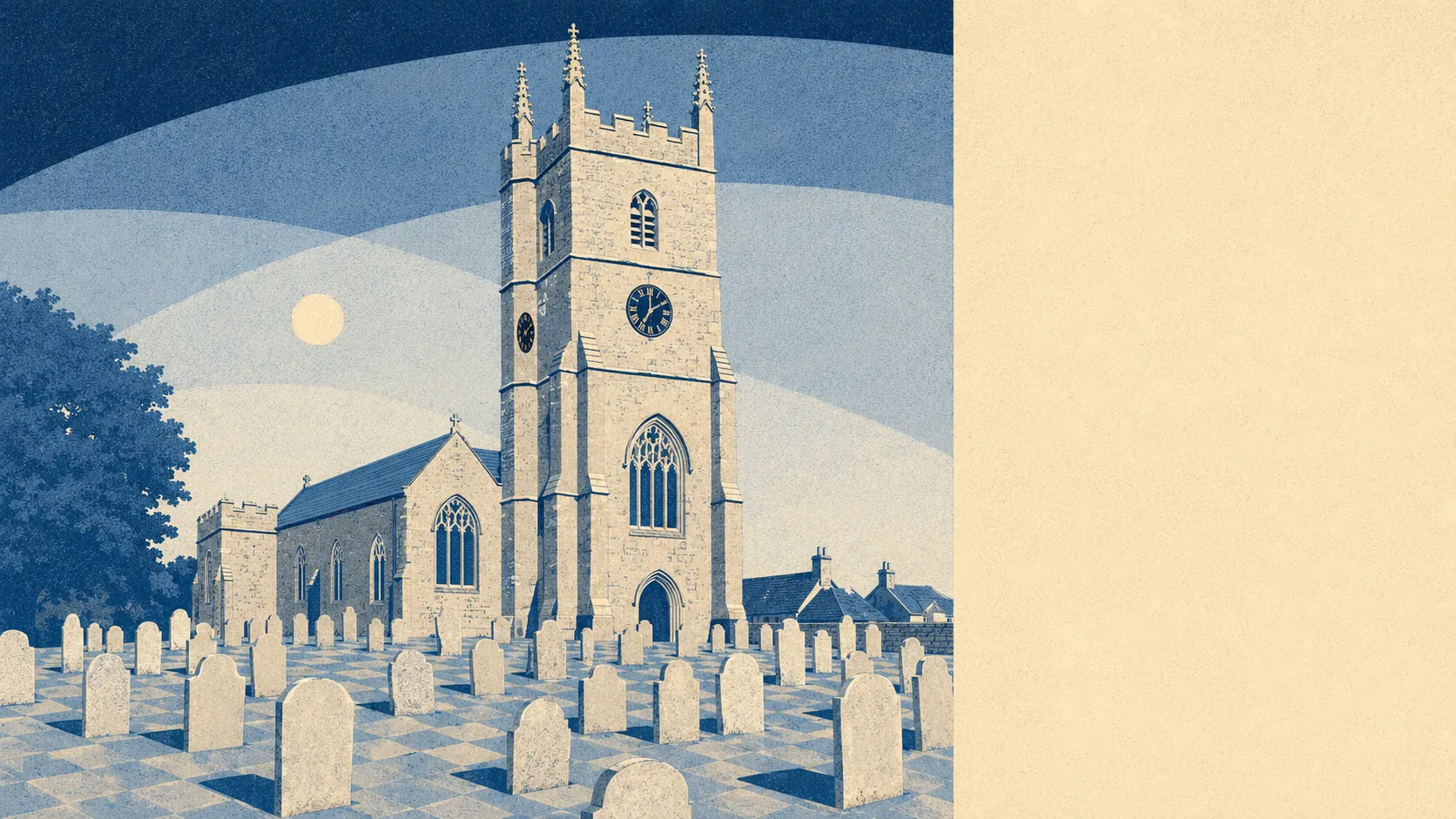
Winkleigh is a good place to live if nothing you need is ever urgent. Seven in ten own their homes. Nearly half the households keep two cars or more. A third work from home, and rail commuting here rounds to nothing. This is not a commuter village pretending to be rural. It is a village people move to once the commuting is behind them.
The housing stock is low, wide and detached. On the council tax valuation list, which covers every dwelling rather than only the ones certificated since 2008, about 34% are detached, 24% are bungalows, 18% are semis and 15% are terraces. Flats barely register at 3%. Nearly four in ten homes went up before 1930 and another 17% arrived between 2000 and 2008, so the place grew in two bursts with a long pause in the middle. Heating is where the countryside charges its fee. Only 7% of homes are on mains gas, one in ten run on electricity alone, and 3% have no central heating at all. That shows up in the certificates: among homes with an energy performance certificate, 30% sit at band D and 41% at band E or worse, against 29% managing band C or better. A bungalow with electric heaters and no gas main is a lovely thing to look at in July.
The Land Registry's last twelve months, to late April 2026, record 25 sales at a median of £295,000. Detached houses accounted for 17 of them, at a median of £325,000. The four terraces that changed hands came in at a median of £200,000. Twenty-five sales is not a market, it is a queue, and one peculiar farmhouse can drag the whole median about. Council tax settles mostly in band D, with about a third of dwellings in bands A and B, and a band D bill of roughly £2,600 a year.
Renting is the thinner option. Typical private rent across the Torridge area runs at about £790 a month, up around 3% over the year to April 2026. Across that same area a one-bedroom place sits near £560, a two-bed near £740 and a three-bed near £905. Those are area figures rather than the village's own, and in a parish this size the rental market is whatever happens to be empty that week.
Recorded crime runs at about 45 offences per 1,000 residents over the twelve months to May 2026, roughly 19% below the Torridge average of 55. Both are published rates, not something worked out by dividing incidents by the people who live here. The sting sits further down the process: Devon and Cornwall Police charge someone in about 8% of cases against 12% nationally, and the force ranks last of the 42 in England and Wales on that measure. Low crime and low charge rates are the same rural arithmetic. Not much happens, and when it does, the nearest response is a drive away.
Getting anywhere is the weak spot, and it is not close. Department for Transport modelling from 2019 puts the nearest town centre at 31 minutes by car and 70 minutes on public transport, the nearest hospital at 52 minutes by car, and a secondary school at 20 minutes by car against 63 by bus. Eggesford is the nearest railway station, which is why 54% drive to work and 1% take the bus. There are eight bus stops, six with published timetables, averaging about eight scheduled departures on a weekday, none of them in the peak hour, and half the stops carry any weekend service. Broadband is in better shape than the roads: 96% of premises can get superfast, though only 8% can get gigabit, and under 1% fall below the minimum standard. Almost every premises gets a mobile signal from at least one operator, and about 95% get one from all of them.
Flood risk here is the sky rather than the river. None of the area sits in the Environment Agency's river-and-sea flood zones, and none falls inside a recorded historic flood extent. On the postcode indicators, which include surface water, about 8% of postcodes carry a high rating and 16% a low one. Green space is the opposite of a problem: the average postcode sits about 170 metres from open green space with roughly 11 of them within a kilometre, and water about 510 metres off. Ground conditions are quiet, with nothing in the higher hazard classes for shrinking clay or landslip and the nearest recorded mine several kilometres away. Radon is the one to act on. The area sits in the high band, with 98% of postcodes at band three or above, so a radon test belongs on the same list as the damp survey.
Heritage is present without being oppressive. There are 53 listed buildings, one Grade One and the other 52 Grade Two, a conservation area covering Winkleigh itself, and three scheduled monuments. The names in the neighbourhood run to Court Castle, Croft Castle, Millsome Castle and a wartime air traffic control building on the old airfield. Listing means consent for alterations owners routinely assume are cosmetic, and a conservation area extends the council's interest to demolition, trees and the face of the street. Buy the late twentieth century bungalow and none of that touches you. Buy the Grade Two cottage and the paperwork comes attached.
About 70% own their homes, the median resident is 53, and household income runs at roughly £42,300 a year before tax, modelled for the financial year to March 2023. Around 29% of households are a single person and 16% a single pensioner, while couples with children make up 14%. Deprivation sits in the fourth decile nationally and has not shifted between 2019 and 2025. Unemployment is about 2%, which in a place where a third work from home is less a labour market than a collection of spare bedrooms with desks in them. This page also covers Monkokehampton, the smaller parish on the River Okement, which is quieter again.
It suits people who have accepted the car as the price of the view: retirees, remote workers with a decent line, families content to drive to secondary school twice a day, anyone whose week is built around a garden rather than a platform.
It does not suit anyone who needs a hospital quickly, a teenager depending on a bus in the peak hour when there are none, or a buyer expecting a gas main and a band C rating for the money. The stock is old, off the gas network and expensive to warm, and no amount of countryside improves a storage heater in February.
For a village this size the notable list is peculiar. William Davy, an eighteenth century clergyman and author, and John Eveleigh, later Provost of Oriel College at Oxford, both belong to it. So do Gordon Charles Steele, a Royal Navy captain awarded the Victoria Cross, and Godfrey Bremridge, a flying ace of the First World War. Ted Hughes, Poet Laureate from 1984, lived locally. A Victoria Cross, a flying ace and a Poet Laureate is a strong return for somewhere with one primary school and a cider works on the Hatherleigh Road.
Winkleigh is average in the way a well-built shed is average: what it does, it does properly. Its real strength is the ground it stands on, with green space at the end of most lanes, water close by, no river flood zone and nothing undermining the garden. The weak spot is leaving, where the car is not a preference but the entire infrastructure. It is a good place to live for people who have already made that swap, and a long slow disappointment for anyone still standing at the stop.