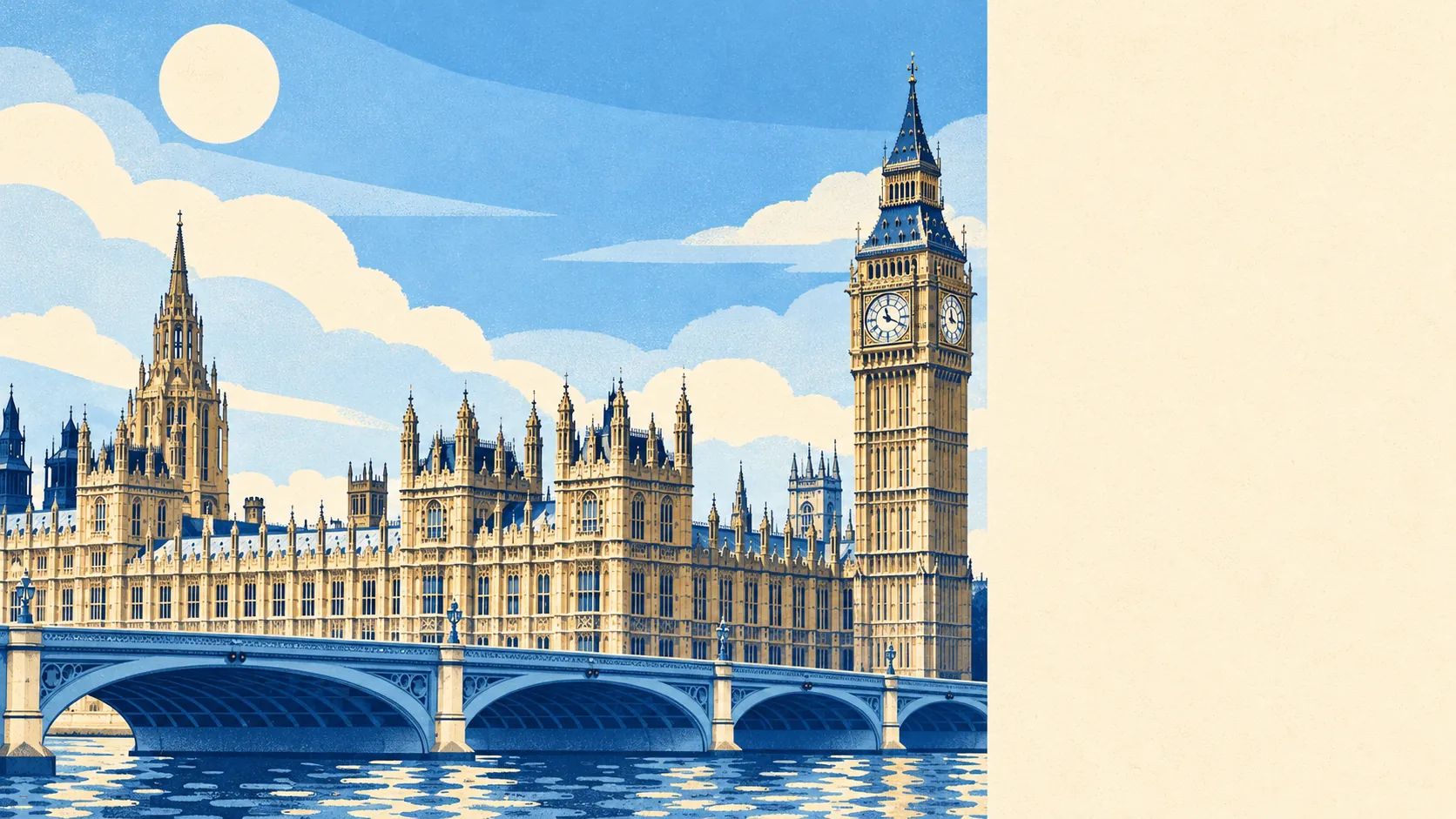
The area around Westminster is some of the best public outdoor space in the country, attached to a seat of government. Royal parks fill the gaps between palaces. The river is a few minutes away. Private gardens barely exist, so the parks do that job for everyone. It is a busy, working, office-heavy place that happens to have the grounds of a palace on its doorstep.
Green space is close to every front door. The average home is about 160 metres from a park or public green space, with around 47 of them within a kilometre. St James's Park, Green Park and Victoria Tower Gardens are the local ones, and Hyde Park is a short walk west. In most of Britain a garden square counts as a park; here the palace has three of them as its front garden.
Water is close too. The average home is about 340 metres from open water, with around 65 bodies of water within a kilometre, from the Thames itself to the lake in St James's Park. The Serpentine in Hyde Park was made by damming the River Westbourne, so one of London's best-loved lakes is a lost river that was put to work.
For cycling further afield, the National Cycle Network is on average about 700 metres away, and about 32% of postcodes are close to it. There is no ancient woodland in the area, which is fair enough for a place laid out around an abbey and a palace.
The rated premises tell you what the streets are made of: 435 shops, 39 pubs and 103 restaurants, set against about 2,690 offices. That mix explains the rhythm of the place. It fills at nine, eats at one and empties at six, apart from the tourists, who keep their own hours.
Westminster's air carried 9.7 micrograms of fine particles per cubic metre in 2024, a figure for the whole council area, busy main roads and quiet squares together.
The character comes from the scale of what is here. The Palace of Westminster, Westminster Abbey and Buckingham Palace sit within a walk of each other, Trafalgar Square and the National Gallery mark the northern edge, and St James's and Whitehall fill the space between with clubs, ministries and parade grounds. Charles Booth's poverty map of 1889 showed every income band living on neighbouring streets here, and Peabody Trust blocks still sit a short walk from grand modern developments. People here share their landmarks with the whole country and their pavements with most of it.
Private outdoor space is scarce. Gardens come to about 4,200 square metres per 1,000 residents, which is very little, because almost every home here is a flat. A balcony is the most anyone can expect, so the royal parks really are the back garden.
The valuation list shows 3,893 rateable premises in the area, with offices the largest category by a distance and shops well behind. Those are premises on the rating list, and some will be empty or between tenants at any moment, but the shape is clear: this is a place built for work, with homes squeezed in around it.
Eating out is generally clean. Of 476 rated food premises, about 78% hold the top hygiene score, and about 6% sit at the low end. In an area full of people grabbing lunch between meetings, most kitchens have to keep up with the inspectors.
No protected landscape overlaps the area: no area of outstanding natural beauty, no site of special scientific interest and no ancient woodland. What it has is grander and more manicured than any of those, parks with royal history that were never wild in the first place.
The surroundings are Westminster's great asset: parks, lakes and the river within a few minutes of almost every flat, more than enough to make up for having no garden.