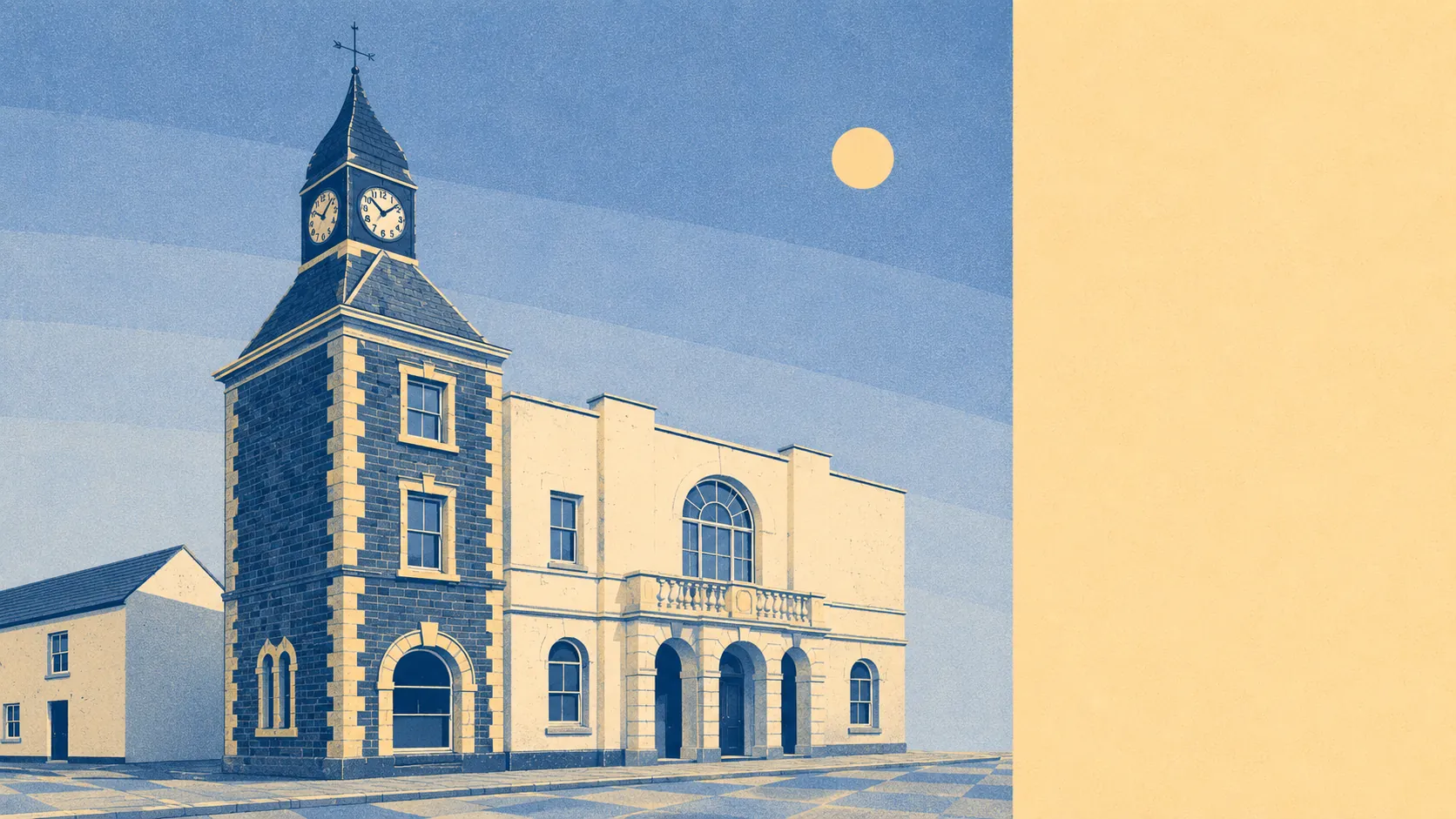
Wadebridge is a working town that happens to have an estuary. Two-thirds own their homes. The median resident is fifty. Nobody commutes by train, because there is no train. That is not a resort that lost its nerve. That is a town with a job, doing it upstream of the places that get photographed.
The housing stock is unusually evenly cut. The council tax valuation list, which covers every dwelling rather than only the ones certificated or sold recently, puts terraces at 22%, detached houses at 21%, semi-detached at 19%, bungalows at 18% and flats at 17%. Only 24% of dwellings went up before 1930, so the period terrace is a minority interest here rather than the default setting, and the late twentieth century did most of the building. The bungalow share is the honest signal about who has been arriving and how long they plan to stay. On heating, 58% are on mains gas and 15% run on electricity alone, which matters because energy certificates put 52% of certificated stock in bands A to C, 33% in band D and 15% in band E or worse. An electric-only property in the bottom bands is a running cost you find out about in February, not at the viewing.
The Land Registry recorded 85 sales in the twelve months to April 2026 at a median of £322,500. Split by type, detached houses came in at a median of £405,000, semi-detached at £300,000, terraces at £250,000 and flats at £177,500. The distance between the detached figure and the flat figure is the whole town in one line: a family house here costs more than double a flat, and both are in the same postcode with the same estuary at the bottom of it. Council tax leans low, with band B the most common and 47% of dwellings sitting in bands A or B.
Rent is harder to pin to the town itself. Typical private rent across the Cornwall area was about £1,000 a month as of April 2026, up roughly 5% over the year. That is a county-wide average covering everything from a Truro flat to a converted barn, so treat it as the shape of the market rather than the price of a specific house on Egloshayle Road.
On safety, the published crime rate for the area is about 80 recorded crimes per 1,000 residents in the year to May 2026, against about 74 for Cornwall as a whole, putting Wadebridge roughly 7% above the county average. That is a small-town number with a market-town explanation. Violence and sexual offences account for 48% of recorded crime against 35% nationally, though that category is a broad statutory grouping that sweeps in assault without injury, so it flatters nobody and describes nothing precisely. Worth knowing separately: Devon and Cornwall Police charged in 8% of cases over the same period against 12% nationally, and the force ranks last of the 42 in England and Wales on that measure. Reporting something and resolving something are different activities.
Getting about is a car proposition and the numbers do not pretend otherwise. Some 57% drive to work, 23% work from home and 13% walk, while the bus share is under 1% and the train share rounds to nothing. There are 33 bus stops in the area, averaging 44 weekday departures each, and every stop carrying service data also runs at weekends, which is better than most Cornish towns manage. Department for Transport modelling puts the town centre 7 minutes away by car and 14 on foot, and the nearest hospital about 54 minutes by car, which is the single figure most likely to change someone's mind. Broadband is the quiet triumph: gigabit service reaches 82% of premises, superfast 93%, and nothing falls below the universal service standard.
Water is the recurring theme, in both directions. Environment Agency mapping puts 19% of the area inside river-and-sea flood zone 3, rising to 26% once climate allowances are applied. On the postcode indicators, which include surface water and not just the river, 16% of postcodes carry a high rating on at least one measure, 17% medium and 41% low. This is not theoretical. St Swithin's day in 1965 put water through the Swan Hotel on The Platt after a morning of rain met a high tide, and a town built at the tidal limit of a river will keep having that conversation. The compensation is immediate and generous: green space averages about 170 metres from the doorstep, with around 14 separate green spaces within a kilometre, and open water about 230 metres away.
Heritage constraints are real but concentrated. There are 85 listed buildings, one at Grade I, two at Grade II star and 82 at Grade II, along with five scheduled monuments and two conservation areas covering Wadebridge and St Breock. The medieval bridge itself is scheduled. In practice that means the historic core answers to a planning officer over windows, roofs and anything visible from the street, while the later estates that make up most of the stock do not.
The people match the housing. Around 65% own their homes, the median age is 50, and modelled household income runs at about £46,200 gross before tax for the financial year to March 2023. This page also covers Egloshayle across the river, Little Petherick down in its creek valley, St Kew, St Eval, and Rock and Trebetherick over on the eastern shore of the estuary. Those last two are where the money looks at the water rather than crossing it, and the area carries 1,453 holiday lets on the business rating list, which is the arithmetic behind every conversation about who actually lives here in January.
Wadebridge suits people who want the Cornish coast as a place to live rather than a place to visit: buyers who need a supermarket, a school run and a bank of green space, and who can absorb the drive to a hospital. It suits downsizers, given how much of the stock is bungalow, and it suits anyone who would rather own a proper house here than a compromise nearer the sand.
It does not suit anyone who needs a railway station, anyone who wants a seafront view without checking a flood map first, or anyone buying a low-rated electric-heated property on the assumption that Cornwall does not get cold.
The town has always been where the practical work happened. The granite for the Eddystone Lighthouse was dovetailed by stonemasons here before it went out to the rocks in 1882, and the road they worked on is still called Eddystone Road. Sir Goldsworthy Gurney, who invented the Bude-Light, lived locally in his twenties and has a street named for him. The Lobb brothers went out from here to collect plants for Veitch Nurseries. Nick Darke wrote plays and caught lobsters, which is a career combination that tells you more about north Cornwall than any brochure. Even the railway had a sense of humour about itself: the first locomotive was named Camel after the river, and the second arrived from the makers named Elephant because nobody had explained the joke.
So yes, with conditions. Its real strength is the surroundings, the walkable green and the water on three sides of your week, and on that measure very little in Cornwall beats it. The weak spot is flood risk, and it is not a rounding error. Buy on high ground and Wadebridge is one of the better bargains on this coast. Buy at the bottom of the hill without reading the map, and the river will explain the position to you eventually.