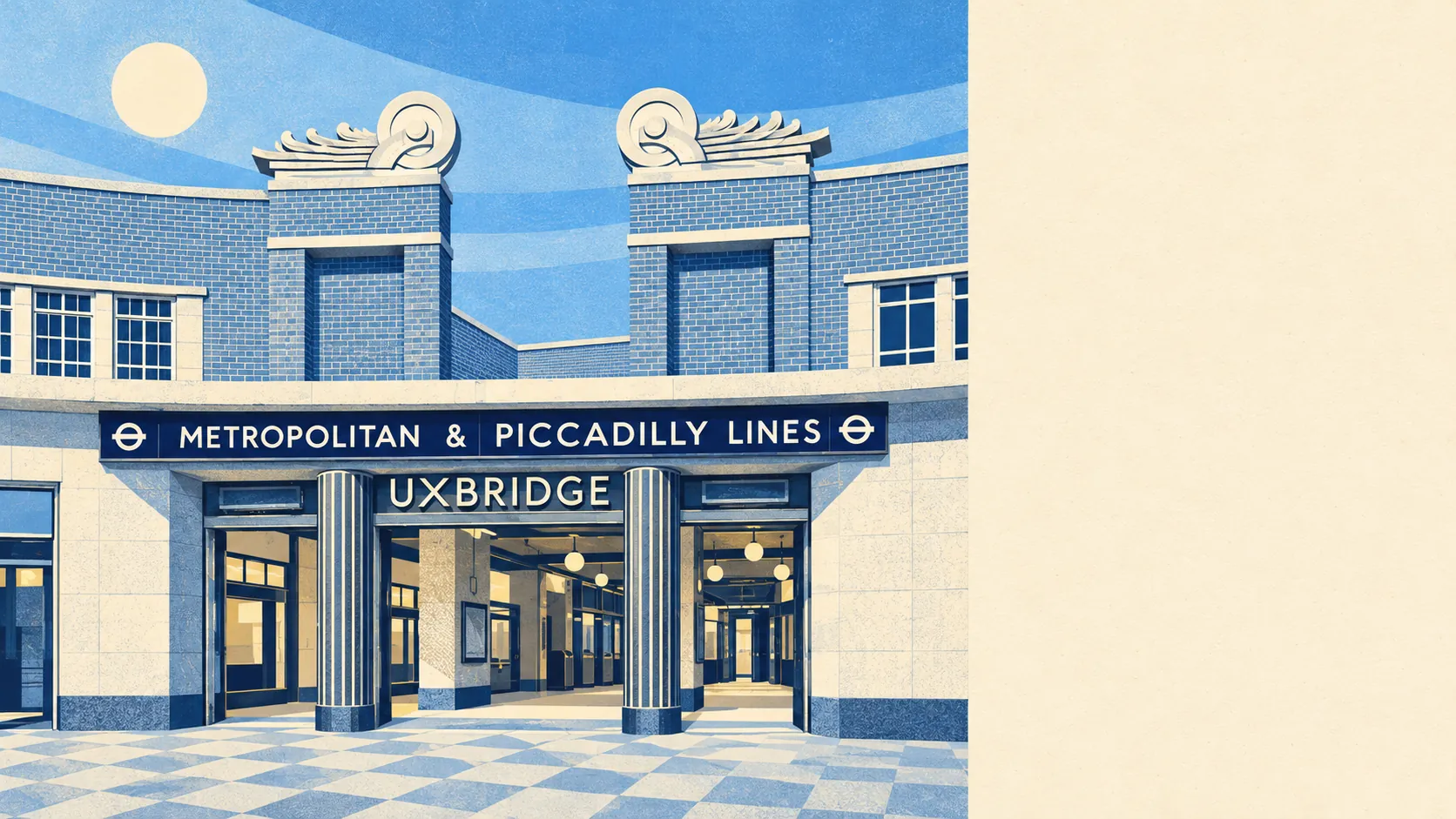
Uxbridge records about 160 crimes a year for every 1,000 residents, and a buyer has to settle that number before any of the town's good points come into it. The parks and water are a short walk from almost every door. The schools grade well. About half the homes are owned and the rest are rented. It is a capable, mid-table town, held back by the one thing a buyer can't fix with a survey.
That 160 comes from the police.uk figures for the year to May 2026. It runs about 22% above the Hillingdon average of roughly 131, and Uxbridge is the borough's administrative headquarters. The mix is the useful part. Anti-social behaviour makes up about 24% of recorded crime here against 16% across England and Wales, while violence and sexual offences come in lower than the national share, at 28% against 35%. In plain terms the town is more often rowdy than dangerous, though a buyer still has to live with the rowdy. The Metropolitan Police Service charged about 10% of the crimes it dealt with over the same year, against 12% nationally, and that is a force-wide figure covering all of London. It would be unfair to blame Uxbridge for it, and just as unwise to expect much from it.
The people are young and mixed in how they hold their homes. The typical resident is 33, owner-occupiers make up about 50% of households, and the Office for National Statistics models gross household income in the area at about £72,000 for the financial year to March 2023. Brunel University and Uxbridge College add to the young end, along with a steady stream of office workers on their lunch break. The town has been home to the European offices of chocolate and soft-drink companies for long enough that the high street knows exactly what a lanyard looks like.
History has left its paperwork. Historic England lists 148 buildings in and around the town, two of them Grade I and eight Grade II*, and 11 conservation areas fall within the wider area, including Old Uxbridge and Windsor Street, Cowley Lock and Hillingdon Village. Inside those lines, a new window or front door becomes a conversation with the planning department. The Crown and Treaty Inn is one of the listed buildings, and its panelled room once spent nearly thirty years in an American businessman's office in the Empire State Building before it was sent back. Uxbridge has a record of letting things go and then wanting them back.
For getting about, buses do more of the work than trains. Hillingdon's 204 bus stops in and around the town average about 347 departures each on a weekday, and every stop with timetable data has a weekend service. Rail stations on the national network, such as West Ruislip, West Drayton and Denham, are all outside the town. At the 2021 Census about 37% of working residents drove to work, 31% worked from home, 9% took the bus and 2% the train. Gigabit broadband reaches about 89% of premises, and every postcode gets 4G or 5G from at least one operator. A town built as the first coaching stop out of London on the road to Oxford still sends most of its commuters off by car.
Flood risk depends on which measure you use. On the postcode indicators, which include surface water, about 27% of Uxbridge postcodes carry a high rating on at least one count. In the Environment Agency's river-and-sea flood zones the figures are much smaller: about 5% in Zone 2 and 1% in Zone 3. The agency has three recorded flood events on file, the latest in December 1988, when a main river overflowed its channel. The rain that falls on the town is the bigger problem than the River Colne running past it.
Ofsted has graded 35 of the 38 settings it rates in the area as good or outstanding, and seven of those are outstanding. Pupils at the six primary schools within the district average a maths score of about 106 at the end of primary school, slightly above the expected standard of 100. Across the three secondaries the average Attainment 8 score at sixteen is about 47. Hermitage Primary School, St Mary's Catholic Primary School and Uxbridge High School are among the town's schools, and Bishopshalt School taught the actor and director Bernard Miles before the House of Lords did.
The Land Registry recorded 213 sales in the year to May 2026, at a median of about £475,000. Semi-detached houses fetched about £535,000, terraced houses about £473,000 and flats about £275,000. Detached houses went for about £571,000, though there were only 15 of them, so that figure is shaky. The most common council-tax band is D, which costs about £2,045 a year, and only about 8% of homes are in Bands A or B. Rent is measured across the whole borough: the Office for National Statistics puts typical private rent in Hillingdon at about £1,550 a month as of April 2026.
The housing is mostly flats and post-war houses. On the council-tax valuation list about 44% of dwellings are flats, 23% semis, 21% terraced, and detached houses make up about 7%. Only around 17% were built before 1930. About 72% of homes heat with mains gas and 15% with electricity alone. In a modern flat that is a fair arrangement. In an older conversion, a buyer should find out which kind of electric heating it is before the first winter bill does it for them.
The surroundings are where Uxbridge pays its way. The nearest green space is about 170 metres from the average home, and water is about 250 metres away, whether the Grand Union Canal along the western edge, the Frays River or the Pinn running through Brunel's grounds. The page also covers Cowley, Harefield, Higher Denham, New Denham and Tatling End. Some of these are canal villages and some sit just over the Buckinghamshire line, but all of them are close to the towpath. The Lido opened in 1935, closed, was vandalised, and came back in 2010 as the Hillingdon Sports and Leisure Complex. For a place this busy, that is a decent amount to have on the doorstep.
The town is right for a young professional or a family that wants Underground-end convenience, schools that grade well and a towpath for the weekend, and can live with a busier street outside. Anyone who wants low recorded crime, or who will lie awake reading the borough's crime map, should look further out. For a buyer, the safety problem is mostly about noise and nuisance in a busy centre. Uxbridge is an average place to live overall: excellent once you reach the canal, and a bit more trouble than most of the borough when you walk back up the high street.