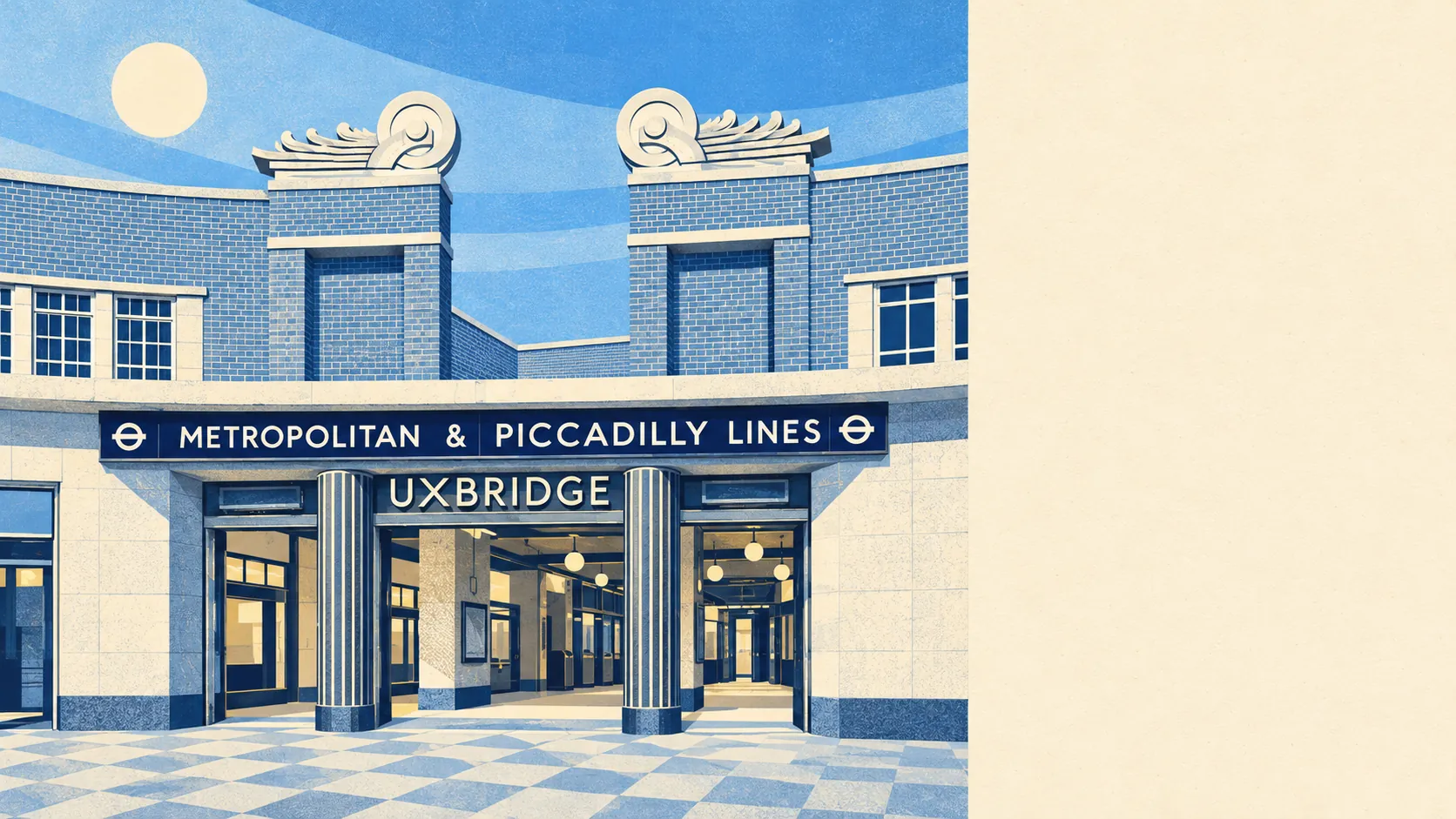
You can extend in Uxbridge, but you will have more forms to fill in than in most suburbs. Listed buildings are scattered through the town and the land around it. Conservation areas cover the old centre, the canal locks and the nearby villages. The clay under much of the area has views of its own. The extension itself is the easy bit, and the sign-off from the planners and the ground is what takes the time.
Historic England lists 148 buildings in and around Uxbridge. Two are Grade I, eight are Grade II* and the other 138 are Grade II. Listing covers the whole building, inside and out, so even a change to a window, a staircase or an internal wall needs listed building consent from Hillingdon Council on top of any planning permission. The town has form when it comes to being careful: when The Chimes shopping centre went up, timber saved from older demolished buildings was used in a new building designed to look much older than it was. In Uxbridge, even new building tends to look back.
There are 11 conservation areas within the wider area, among them Old Uxbridge and Windsor Street, Cowley Lock, Hillingdon Village and The Greenway. Inside them the council looks closely at anything visible from the street, and some work that would go ahead without permission elsewhere needs consent here. The old centre has reason to be protective. In the 1970s, buildings along the High Street and Windsor Street were knocked down for the Market Square precinct, which turned out to be so draughty that it had to be given a roof.
There is one scheduled monument in the area. That is the strictest level of protection in the system, and it matters mainly for land close to it.
Plenty of people are building anyway. Hillingdon Council's records show 745 planning applications in Uxbridge between April 2024 and June 2026, 314 of them in the last 12 months. The council is clearly used to plans for kitchen extensions and loft conversions.
The ground is the part buyers tend not to ask about. The British Geological Survey rates shrink-swell clay here at class 3 at its worst, and about 53% of the area reaches that class. Clay at that level swells when wet and shrinks in dry summers, so extension foundations may need to go deeper than a builder's standard quote, especially near large trees. Ask a structural engineer to look at the ground and the trees before the architect starts drawing.
Eight listed buildings in the area are on Historic England's Heritage at Risk register. Those are buildings in poor condition, whose repairs may qualify for grant support and will be closely watched. They are not a risk to someone buying an ordinary house nearby, though living next to one may mean scaffolding for longer than you would like.
In practice, most homes in the town are unlisted and outside a conservation area. For those, the national permitted development rights still allow many modest rear extensions and loft conversions without a full planning application. Inside a conservation area those rights are narrower. For a listed house, almost nothing is permitted development, and an extension means a full application with consent attached.
Your freedom to extend or alter a house in Uxbridge is limited. The heritage rules cover a large part of the town, and the clay gives your foundations their own requirements.